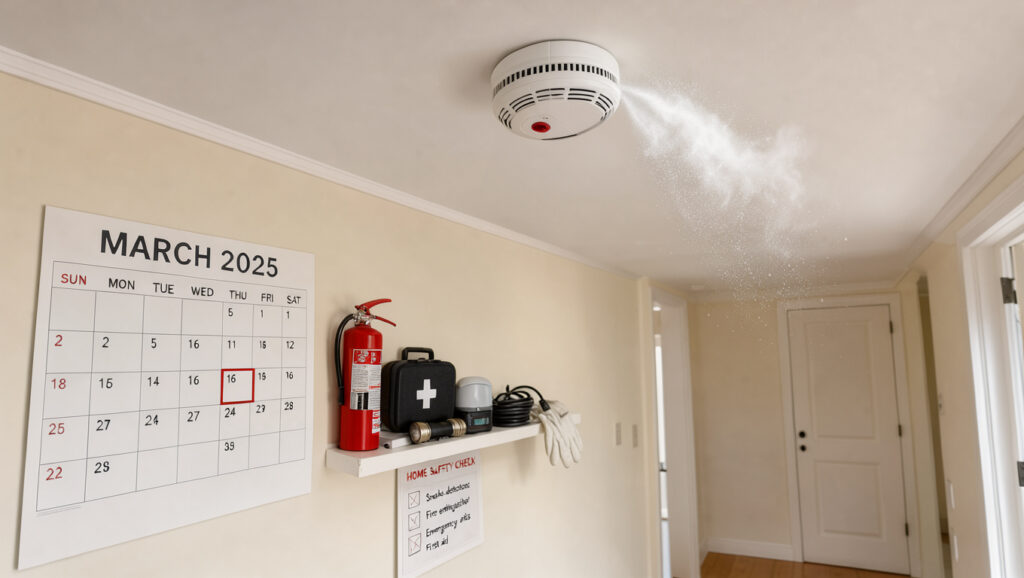
How to Test Smoke Detectors: Test Button, Spray & Frequency
Most of us press the test button on a smoke alarm once, hear the beep, and assume the job is done. Eureka Fire Protection District (local fire district) recommends testing at least once a month, yet the button answers a narrower question than most people expect.
Recommended test frequency: Monthly, with the test button (American Red Cross (national nonprofit)) · Replacement interval: 10 years from the manufacture date (U.S. Consumer Product Safety Commission (federal regulator)) · Battery replacement: 1 year for replaceable-battery units (City of Brampton Fire and Emergency Services (Ontario municipal fire authority))
Quick snapshot
- Test monthly with the test button (American Red Cross, national nonprofit) (PEMCO (insurer’s safety guidance))
- The button checks electronics, battery and horn (PEMCO (insurer’s safety guidance))
- Replace alarms 10 years from manufacture date (U.S. Consumer Product Safety Commission, federal regulator) (PEMCO (insurer’s safety guidance))
- Hold times on specific Kidde and First Alert models
- Whether a given hardwired model needs a reset after a battery change
- How interconnected alarms behave during a test
- The Red Cross links testing to the end of daylight saving time, November 1, 2026 (American Red Cross, national nonprofit) (International Fire and Safety Journal (trade publication citing USFA))
- The 10-year clock runs from manufacture date, not installation (International Fire and Safety Journal (trade publication citing USFA))
- Replace at 10 years; alarms with built-in CO detection need replacing sooner (Allstate (insurer citing NFPA))
- Check the manufacture date printed on the back (North Whatcom Fire & Rescue (local fire agency))
Six key figures set the baseline for every test and replacement decision.
| Item | Value |
|---|---|
| Test frequency | Monthly, using the test button (Denver Fire Department (municipal fire authority)) |
| Replacement interval | 10 years from manufacture date (U.S. Consumer Product Safety Commission, federal regulator) |
| Battery replacement | 1 year for replaceable-battery units (City of Brampton Fire and Emergency Services, Ontario municipal fire authority) |
| Test hold duration | 3-5 seconds (PEMCO, insurer’s safety guidance) |
| Mounting height for high wall units | Within 12 inches of the ceiling (Denver Fire Department, municipal fire authority) |
| Sealed 10-year battery models | No battery replacement needed (City of Brampton Fire and Emergency Services, Ontario municipal fire authority) |
How do you test smoke detectors at home?
The routine is short: press, listen, log. The button is the first step, and the sections below explain what it does not cover.
- Press and hold the test button until the alarm sounds, then release (Eureka Fire Protection District, local fire district, describes this method).
- Listen for a loud, consistent tone. A weak, broken or silent response means the alarm needs attention before you rely on it.
- Repeat on every alarm in the home, then log the date.
- Test again after each battery change, using the same routine.
- Find the manufacture date on the back and mark the 10-year replacement date on your calendar.
What does the test button check?
- Electronic circuitry, battery power and the alarm horn (PEMCO, insurer’s safety guidance)
- Not the smoke sensor’s response to actual smoke particles
Those checks cover the hardware path, not the detection path. That gap is why the next question matters.
Can canned smoke or test spray be used?
- Use a test product made for smoke alarms, not an improvised source
- Skip open flames when testing
- Follow the model manual for spray distance
Test products made for smoke alarms are the route to checking the sensor, which the button alone does not do. Use the product the manufacturer names.
The implication: a button press confirms the alarm is powered and audible, and it leaves sensor performance untested.
Where is the test button on a smoke detector?
Layouts differ by brand and model, so the button can sit in different spots on different alarms.
A passing button test proves the electronics, battery and horn work. That is useful, but it is narrower than the reassurance a beep usually brings.
Why do some alarms not respond to the test button?
- A silent response points to the same parts the button checks: battery, circuitry and horn
- Start with a fresh battery and check the model manual
- Contact the manufacturer when the manual has no test step
Model manuals give the exact steps, so the manual beats guesswork for any alarm that stays quiet.
The trade-off: a hidden button gets skipped, and a skipped test leaves the alarm unverified for another month.
How often should you test smoke detectors?
Monthly is the consistent answer across the sources, and the replacement clock runs separately at 10 years.
How long do smoke detectors last?
- Count the 10-year clock from the manufacture date on the back, not from the install day
- Write the replacement year on the unit or in your calendar when you install it
- Plan CO alarm replacement on its own, shorter schedule
CO alarms run on a shorter clock, so one calendar entry for each alarm type avoids a missed date.
Battery neglect explains a share of failed alarms, so the monthly press is the cheapest insurance in the house. The sensor check is the gap no button closes.
The implication: the monthly press costs almost nothing, while the 10-year date is the one people forget. Schedule both on the same calendar.
Do you have to reset your smoke detector after you change the battery?
It depends on the model, and the manual states the exact step. The Eureka guidance quoted below treats every battery change as a reason to test.
Why does my hardwired smoke detector keep beeping even after I replaced the battery?
- Check the manufacture date first; a unit at 10 years needs replacement, not another battery
- Some alarms need a reset or test after a battery change, and the model manual names the step
- Persistent chirping after a fresh battery usually signals a fault or an end-of-life condition
A second battery swap does not fix an end-of-life unit, so check the date before buying batteries.
The catch: a hardwired unit that still chirps after a fresh battery is the case where guessing wastes the most time.
Why is my smoke detector beeping even though there’s no smoke?
A chirp reports the alarm’s own condition, not smoke in the room.
Why does the smoke detector go off randomly without saying anything?
- Dust can interfere with detection, and Denver recommends cleaning detectors every few months (Denver Fire Department, municipal fire authority)
- Alarms lose sensitivity with age (Liberty Township Fire (Ohio local government))
- Check the unit’s age before blaming the sensor
Log the date and time of each false alarm, so the pattern shows whether dust, age or a fault is behind it.
How to get a hardwired smoke detector to stop beeping?
- Replace the battery when the low-battery chirp starts
- Replace the whole unit once it passes 10 years from manufacture
- Match any replacement unit to the model manual
Replacing the battery or the unit usually stops the chirp. The fix depends on which condition is on the unit.
What this means: the chirp is a maintenance ticket, and handling it promptly keeps the alarm credible when a real fire fills the room.
Six figures sit outside the basic button test, and most come from trade publications, an insurer and a safety blog rather than fire agencies. Confirm them against your model manual.
| Item | Value | Source |
|---|---|---|
| Commercial systems | Functional testing at least annually, with a documented test log | Fire and Safety Journal Americas (trade publication on NFPA 72) |
| Sensitivity testing | Separate schedule from functional testing | Fire and Safety Journal Americas (trade publication on NFPA 72) |
| CO alarm lifespan | 5-7 years, per one safety blog; not confirmed by a fire agency | WC Safety (safety guidance blog) |
| Smoke alarm lifespan | 10 years from manufacture date | International Fire and Safety Journal (trade publication citing USFA) |
| Missing batteries in failed fires | 46 percent of non-operating alarms | Allstate (insurer citing NFPA data) |
| Sensitivity over time | Alarms become less sensitive as they age | Liberty Township Fire (Ohio local government) |
Confirmed
- Replace alarms 10 years after manufacture (North Whatcom Fire & Rescue, local fire agency)
- Replace alkaline batteries every 12 months (Fire and Rescue NSW (New South Wales state fire agency))
- Sensitivity testing follows a separate schedule from functional testing in commercial systems (Fire and Safety Journal Americas, trade publication on NFPA 72)
Still unclear
- Hold times on specific Kidde and First Alert models
- Whether a given hardwired model needs a reset after a battery change
- Anecdotal reports of alarms that pass the button test but miss real smoke
- How interconnected alarms behave during a test
“I can’t stress the importance of testing enough. It’s the only way you can know that your smoke alarm is working.”
Richard Roux, senior electrical specialist at the National Fire Protection Association, quoted by Allstate (insurer citing NFPA)
“For best results, we recommend homeowners test their smoke detectors at least once a month and after every battery change.”
Eureka Fire Protection District (local fire district)
The button is a fast check on power and sound, not a verdict on the sensor, and that gap decides whether a fire gets an early warning. The routine is simple: press monthly, log the manufacture date, and replace units at 10 years (North Whatcom Fire & Rescue, local fire agency). For homeowners, the choice is clear: put the monthly press and the 10-year date on one calendar, or accept an alarm whose sensor has never been checked.
Related reading: Worksafe electrical rule changes and home electrical risks · Selwyn state of emergency flood contacts and updates
Frequently asked questions
Can you test a smoke detector without its test button?
Not for the sensor. The button checks electronics, battery and horn, so a test product made for smoke alarms is the route to checking sensor response.
What sound should a working smoke alarm make during a test?
A loud, consistent tone. If the alarm stays silent, replace the battery, then check the manufacture date and the model manual before assuming the unit works.
Do interconnected smoke alarms all sound when one is tested?
The sources reviewed for this article do not cover that behavior. Check your model manual before assuming every linked unit responds.
How often should replaceable batteries be changed?
At least once a year, and sooner when the alarm chirps. Fire and Rescue NSW advises replacing alkaline batteries every 12 months.
Do CO alarms need the same replacement schedule as smoke alarms?
No. WC Safety, a safety blog, reports a shorter window of 5-7 years for CO alarms.
More related posts
 3 New COVID Symptoms in 2026: Runny Nose, Sore Throat, Headache
 Westfield Newmarket Shopping Mall Impact: Cost & Local Effects
 How to Make Money Online NZ – 10 Proven Ways for Kiwis
 Ride On Lawn Mowers 2026: Best Brands & Reliability
 Exchange Rate NZD to GBP: Live Rates, History & Forecast
 FIFO Jobs NZ to Australia: A Guide for Kiwis
 Mary Had a Little Lamb: History, Lyrics, and Dark Rumors Debunked