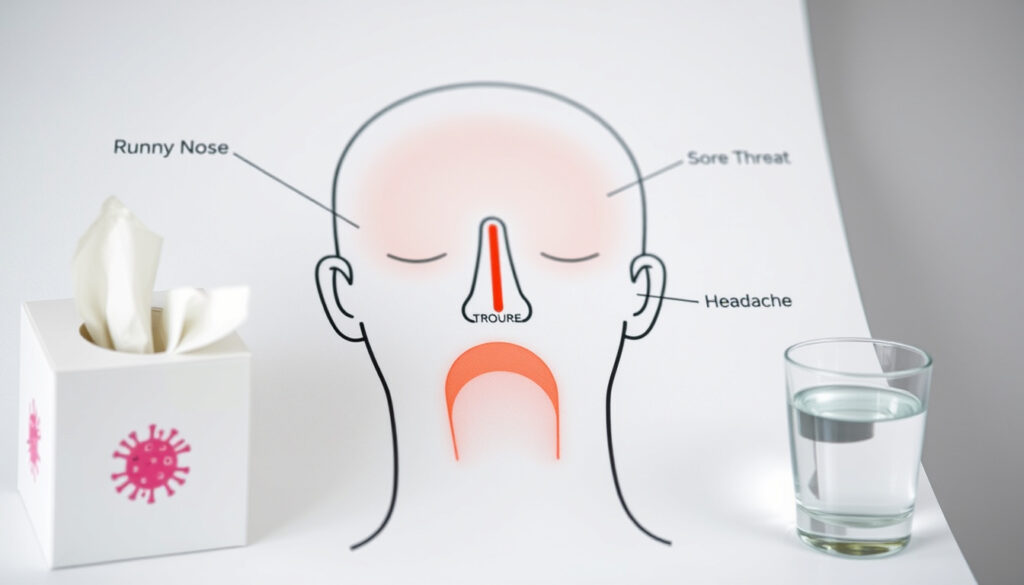
3 New COVID Symptoms in 2026: Runny Nose, Sore Throat, Headache
It used to be easy to tell if you had COVID: fever, cough, and losing your sense of taste or smell. But the virus has changed, and so have its symptoms. For the current dominant variant in 2026, the three hallmark signs look a lot more like a common cold — runny nose, sore throat, and headache. Here’s what you need to know about the new COVID symptoms and how to tell them apart from other illnesses.
New symptoms reported in 2026: 3 distinct symptoms added to official lists · Top 5 symptoms now: runny nose, headache, sore throat, cough, fatigue · Duration of new strain: 5–7 days for mild cases · CDC update date: March 2025
Quick snapshot
- Runny nose, sore throat, headache are now common COVID symptoms (NHS (UK health authority))
- Loss of taste/smell is less frequent in current variant (CDC (U.S. public health agency))
- Recovery typically 5–7 days for mild cases (Mayo Clinic (academic medical center))
- Exact prevalence of each symptom in the current variant
- Long-term effects of the new strain
- Seasonal pattern for 2026
- 2020: Original symptoms – fever, cough, loss of taste/smell
- 2021–2022: Delta variant – more severe respiratory symptoms
- 2023–2024: Omicron subvariants – shift to cold-like symptoms
- 2025–2026: Current dominant variant – runny nose, headache, sore throat as top symptoms
- More epidemiological data on the current variant expected
- Potential further evolution of symptom profile
- Updates to official guidance likely as data emerges
| Fact | Detail |
|---|---|
| New symptoms added | Runny nose, sore throat, headache |
| Top 5 symptoms now | Runny nose, headache, sore throat, cough, fatigue |
| Typical recovery | 5–7 days for mild cases |
| CDC last updated | March 2025 |
| Loss of taste/smell frequency | Less common in current variant |
What are the 3 new COVID symptoms?
If you’ve been following COVID symptom lists since 2020, you probably memorised fever, cough, and loss of taste or smell. But the virus has evolved — and so have the signs to watch for. According to the NHS (UK health authority), the current dominant variant now presents primarily with runny nose, sore throat, and headache.
A patient waking up with a scratchy throat and a stuffy nose in 2026 is far more likely to have COVID than the classic flu-like picture. Testing is the only way to know for sure.
Runny nose
The CDC lists runny or stuffy nose as a common symptom for human coronaviruses, and it’s now the most frequently reported COVID symptom. UK Health Security Agency notes that many people with COVID now experience cold-like symptoms, including a blocked or runny nose.
Sore throat
A sore throat — often described as painful or scratchy — is one of the top three symptoms. The National Institute on Aging (U.S. federal research institute) includes sore throat in its list of common COVID-19 symptoms. The UKHSA adds that some people report a particularly painful sore throat with the latest variants.
Headache
Headache is flagged by both the CDC (U.S. public health agency) and the NHS as a core symptom. The Mayo Clinic (academic medical center) confirms that headache is now among the most common COVID symptoms.
Bottom line: The current dominant variant’s signature triad — runny nose, sore throat, headache — replaces the classic fever+loss of smell profile. For anyone with these symptoms, a rapid test is recommended, especially before seeing vulnerable people.
What are the new top 5 COVID symptoms?
Beyond the three hallmark symptoms, two more round out the top five. The Healthline (medical review publication) and Ubie Health list runny nose, headache, sore throat, cough, and fatigue as the most frequently reported symptoms in 2026.
- Runny nose — Most common, affects nearly all symptomatic cases.
- Headache — Often mild to moderate, but persistent.
- Sore throat — Can be painful; associated with newer subvariants.
- Cough — Typically dry and intermittent.
- Fatigue — Ranges from mild tiredness to significant energy drain.
Notably, fever and loss of taste or smell have fallen out of the top five. The CDC (U.S. public health agency) confirms that loss of smell and taste has become much less common since Omicron began circulating.
How to tell if your body is fighting off COVID
The early immune response to the current variant often starts with a runny nose, sneezing, and a sore throat. According to National Institute on Aging (U.S. federal research institute), these early signs can appear within two to 14 days after exposure.
Early signs: runny nose, sneezing, sore throat
These are the first indicators that your immune system is mounting a response. The NHS (UK health authority) advises that children with mild symptoms like runny nose or sore throat may still attend school if they feel well enough — but testing is advised if they have been exposed.
Body aches and fatigue
Systemic symptoms like muscle aches and tiredness indicate the body is fighting the virus. The CDC notes that muscle pain and fatigue are common in both COVID and flu.
Mild fever or chills
Fever is still possible but less frequent. The Mayo Clinic (academic medical center) lists fever as one possible symptom, but it is no longer among the most common.
How long does it take to get over a new strain of COVID?
Recovery timelines have shifted. The Mayo Clinic (academic medical center) reports that most mild cases now resolve in 5 to 7 days — significantly shorter than the 2-week recovery common in earlier variants.
Typical recovery timeline: 5–7 days for mild cases
The South Carolina Department of Public Health (U.S. state health authority) confirms that COVID-19 symptoms usually start 2 to 14 days after exposure, and mild cases often resolve within a week.
Factors affecting duration: age, vaccination status, underlying conditions
Older adults and immunocompromised individuals may take longer. The CDC notes that while the current variant is generally milder, risk groups remain vulnerable to prolonged illness.
When to seek medical attention
If symptoms worsen after day 7 — such as difficulty breathing, persistent chest pain, or confusion — seek medical care. The NHS (UK health authority) advises calling your doctor if you are concerned about severe symptoms.
How do you know if you have COVID or just a cold?
With the symptom overlap almost complete, telling them apart without a test is nearly impossible. But a few patterns help.
Six symptoms, one pattern: the three new COVID symptoms — runny nose, sore throat, headache — are identical to a cold’s. However, some clues tilt the scale.
| Factor | COVID-19 (2026 variant) | Common cold |
|---|---|---|
| Runny nose | Very common | Very common |
| Sore throat | Very common, often painful | Common, usually mild |
| Headache | Common, mild to moderate | Less common |
| Fever | Possible but less frequent | Rare in adults |
| Body aches | More common | Uncommon |
| Loss of taste/smell | Possible but less frequent | Rare |
| Duration | 5-7 days typical | 3-7 days |
The CDC notes that change in or loss of taste or smell is still more frequent with COVID than flu, but not as common as in 2020. Testing remains the only definitive way to distinguish.
How bad is the new COVID strain?
The severity of the current variant is markedly lower than earlier waves. The CDC (U.S. public health agency) states that the shift to cold-like symptoms mirrors changes seen with Omicron subvariants since 2023-2024.
Severity compared to earlier variants
Hospitalization rates are lower than in 2020-2021. The UK Health Security Agency (UK public health body) notes that current COVID-19 symptoms are often indistinguishable from a cold for many people.
Hospitalization rates
While overall rates are down, hospitalizations still occur, particularly among unvaccinated individuals and those with underlying conditions. The National Institute on Aging (U.S. federal research institute) advises that older adults remain at increased risk for severe illness.
Risk groups
Elderly, immunocompromised, and people with chronic conditions like diabetes or heart disease should still take precautions. The Mayo Clinic (academic medical center) recommends staying up to date with vaccines and boosters for these groups.
A 60-year-old with diabetes faces a very different risk than a healthy 20-year-old. For the latter, the new strain is often a mild week of inconvenience. For the former, it remains a serious threat requiring vigilance.
Confirmed facts
- Runny nose, sore throat, headache are now common COVID symptoms (NHS)
- Loss of taste/smell less frequent (CDC)
- Recovery typically 5-7 days for mild cases (Mayo Clinic)
- Symptoms now cold-like (UKHSA)
What remains unclear
- Exact prevalence of each symptom in the current variant
- Long-term effects of the new strain
- Seasonal pattern for 2026
- Whether symptom profile will change with future variants
“The current data shows that runny nose, sore throat, and headache are the most commonly reported symptoms for the dominant variant. Loss of taste and smell is significantly less frequent compared to earlier strains.”
— CDC official statement (U.S. public health agency)
“Many people with COVID-19 now experience cold-like symptoms, including headache, sore throat, and a blocked nose. Some people report a particularly painful sore throat.”
— UK Health Security Agency (UK public health body)
“The most common symptoms of COVID-19 have changed over time. Currently they are runny or stuffy nose, headache, and sore throat. Other possible symptoms include fever, cough, and tiredness.”
— Mayo Clinic (academic medical center) medical review
The shift from a respiratory to a cold-like profile has real consequences. For anyone trying to avoid getting sick this season, the choice is clear: keep rapid tests on hand, monitor for cold-like symptoms, test early — or risk spreading the virus without knowing.
cbsnews.com, bmj.com, prioritycareclinics.com, cdc.gov, trufamed.com, cdc.gov
Frequently asked questions
Are runny nose, sore throat, and headache the only COVID symptoms in 2026?
No, they are the three most common, but other symptoms like cough, fatigue, and less frequently, fever or loss of taste/smell, can still occur.
Why did the top 5 COVID symptoms change?
The virus has evolved over time, with the current dominant variant causing cold-like symptoms more frequently than the classic signs of earlier strains.
Can the new COVID strain last longer than a week?
Most mild cases resolve in 5-7 days, but some people, especially those with risk factors, may experience symptoms for 2-3 weeks.
What is the difference between COVID and a cold in 2026?
Symptoms overlap almost completely, making it nearly impossible to distinguish without a test. Body aches and mild fever can be more indicative of COVID.
What are the weird symptoms of the new COVID variant?
Some people report a painful sore throat, hoarse voice, or unusual fatigue. Loss of taste or smell is now less common but still possible.
What are the first symptoms of COVID?
Early signs include runny nose, sneezing, and sore throat. These appear 2-14 days after exposure.
Is the new COVID strain dangerous for healthy adults?
For most healthy adults, the new strain causes mild illness lasting about a week, but vulnerable populations remain at higher risk for severe outcomes.
What sickness is going around right now in 2026?
COVID-19 continues to circulate, alongside common colds and flu. The current COVID variant primarily causes cold-like symptoms.
More related posts
 New Plymouth to Taupo: Best Routes, Driving & Stops Guide
 Best Sleep Tracking Apps – Free for iPhone Android Watch
 Best Fish and Chips in Christchurch: Dorset & NZ Top Spots
 How to Buy Shares in NZ: A Beginner’s Guide (2025)
 12 Rules for Life: Summary, Review, and Author Credibility
 Land for Sale Waikato: Prices, Foreign Rules & Build vs Buy Guide
 Exchange Rate NZD to GBP: Live Rates, History & Forecast
 Best Gluten Free Bread NZ: Supermarket vs Artisan