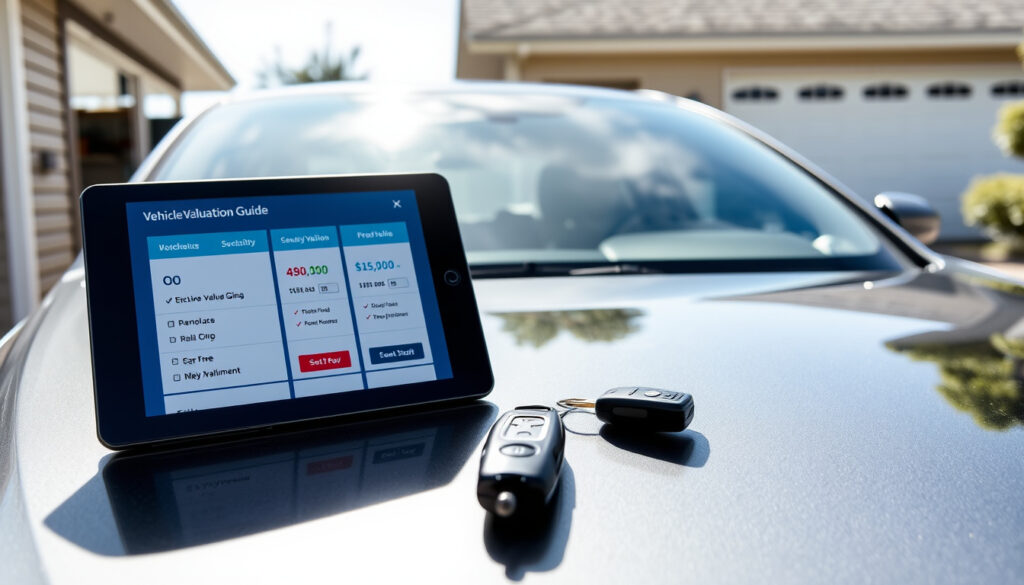
How Much Is My Car Worth in NZ? Free Valuation Guide
Few moments in a car owner’s life mix hope and dread quite like typing a number plate into a valuation tool. The honest answer to “how much is my car worth in NZ” sits between the AA’s (New Zealand motoring association) $19.95 valuation report and the wholesale-minded figure a dealer can justify — and that gap is where most sellers make or leave their money, but knowing which free tools, official records and private-sale signals actually matter closes most of it.
AA online valuation report: $19.95 (AA (motoring association)) · RedBook personalised report: about $20 (Consumer NZ (consumer research group)) · RedBook market data: hundreds of thousands of data points (RedBook NZ (vehicle data provider)) · Free estimate tools: Trade Me Value My Car, BestCar (MoneyHub (research site)) · Trade-in reality: below private sale, dealer margin built in (Consumer NZ (consumer research group))
Quick snapshot
- A private sale generally returns more money than a dealer trade-in (Consumer NZ (consumer research group)).
- Online valuations are ballpark estimates, not final-price guarantees (OnlyCars NZ (car-selling platform)).
- How much colour affects resale value — no public NZ dataset quantifies it.
- Whether future emissions-standard changes will shift used-car prices.
- How valuation tools weight each history factor internally.
- Make, model, age, kilometres, condition and fitted options (RedBook NZ (vehicle data provider)).
- Owner count, accident reports and WoF history (OnlyCars NZ (car-selling platform)).
- Latest odometer reading held by NZTA (MoneyHub (research site)).
- Start with a free estimate from Trade Me Value My Car or BestCar (MoneyHub (research site)).
- Compare trade-in quotes against private-sale proceeds (Calculate.co.nz (finance calculator)).
Six facts, one pattern: the spread between a dealer’s wholesale logic and a private buyer’s retail logic is where the value actually lives.
| Fact | Value | Source |
|---|---|---|
| Private sale result | Generally more money than a dealer trade-in | Consumer NZ (consumer research group) |
| Dealer trade-in logic | Wholesale-oriented; dealer needs margin to prepare and resell | OnlyCars NZ (car-selling platform) |
| AA online valuation report | $19.95 | AA (motoring association) |
| RedBook valuation inputs | Make, model, age, kilometres, condition, fitted options | RedBook NZ (vehicle data provider) |
| Free valuation tools | Trade Me Value My Car and BestCar give basic estimates | MoneyHub (research site) |
| Valuation nature | Ballpark estimate, not a guaranteed final price | OnlyCars NZ (car-selling platform) |
The implication: no single price exists until you choose how you sell — the same car has a trade-in self and a private-sale self living thousands of dollars apart.
How much is my car worth in New Zealand?
Valuation tools answer with a range, not a number — and the range only holds if the details feeding it are accurate. Gather those first, then let the tools argue about the price.
Step 1: Gather vehicle details
- Make, model, year of manufacture, kilometres, condition and fitted options — the core inputs in any serious valuation (RedBook NZ (vehicle data provider)).
- Your registration number, because some tools use it to identify comparable vehicles and pull records automatically.
- Service history and WoF record, since owner count, accident reports and WoF history all feed the estimate (OnlyCars NZ (car-selling platform)).
Step 2: Use online valuation tools
- Free first: Trade Me Value My Car and BestCar give basic estimates from make, model, year, mileage and condition (MoneyHub (research site)).
- Paid for precision: the AA’s online vehicle valuation report costs $19.95 (AA (motoring association)).
- RedBook’s personalised report runs about $20 and draws on dealer and private data (Consumer NZ (consumer research group)).
Treat every output as a ballpark. Online valuations estimate a range; they do not guarantee the final sale price (OnlyCars NZ (car-selling platform)).
Step 3: Compare with similar listings
- Search live listings for the same model, year and kilometre band — not the same price band.
- Use RedBook’s separate trade-in and private-sale ranges to understand both endpoints (RedBook NZ (vehicle data provider)).
- Get a dealer quote too — but only after you know the car’s value (Consumer NZ (consumer research group)).
The same car with the same odometer reading can swing thousands depending on who’s doing the valuing — dealer offers build in margin, private sales build in hope, and history decides who’s right.
The pattern is consistent: the seller who gathers details first, tests two or three tools, and checks live listings walks in knowing the range — and that range is what negotiation is built on.
Can I check a vehicle’s history for free in New Zealand?
Partially — and the free part matters more than most sellers realise.
Free vs paid history checks
- Free: NZTA’s official vehicle register holds basic records, and some valuation tools use the latest odometer reading from NZTA when you don’t enter one (MoneyHub (research site)).
- Paid: the AA’s report costs $19.95 (AA (motoring association)) and RedBook’s personalised report about $20 (Consumer NZ (consumer research group)).
Free tools tell you what similar cars are worth. History reports tell you why your car might not match them — owner count, accident reports and WoF history all feed the valuation (OnlyCars NZ (car-selling platform)).
NZTA data is public enough to build services on — the same agency that logs odometer readings also publishes the real-time road information covered in our NZTA Road Closures Map guide.
What a history report reveals
- Latest odometer reading on file, giving a free cross-check against what the seller claims.
- Owner count, accident reports and WoF history — the factors that separate a strong price from a weak one.
- Condition expected for the car’s age, which is exactly what disciplined valuation models weigh (RedBook NZ (vehicle data provider)).
A free estimate won’t show accident or WoF history — yet those are the factors that move the final number most when a buyer gets serious.
The implication: a clean history is a seller’s cheapest marketing, and a muddled one is the reason trade-in quotes feel insulting.
What is the average cost of a normal car?
There is no single “normal” price in New Zealand — the market splits by segment, age and condition before brand even enters the picture.
Average prices by segment (hatchback, SUV, ute)
- The most-sold models, like the Toyota Corolla, produce the deepest comparable data — and more listings means a more reliable estimate.
- SUVs and utes run wider ranges because condition, towing gear and service history matter more to buyers.
- Every tool prices them the same way: make, model, age, kilometres, condition and options in, a range out (RedBook NZ (vehicle data provider)).
In valuation terms, a “normal” car is one whose service history and condition match what buyers expect for its age. Trade Me Value My Car and BestCar build their free estimates on exactly those comparisons (MoneyHub (research site)).
Depreciation by brand
- Depreciation hits hardest early: dealer margin means the gap between what a nearly-new car is worth and what a dealer will pay is widest in the first years (Consumer NZ (consumer research group)).
- Condition relative to age then takes over — a well-maintained older car consistently beats a “bargain” newer one with gaps in its record.
- Brands matter through demand: the models with deep buyer pools and strong service records hold their value ranges best.
The pattern: “average” is the wrong target. The question that sets your price is whether your car sits at the top or the bottom of its own segment — that is a condition-and-history story, not a national average.
How long should I keep a car?
The ideal ownership period balances the steep early decline against the rising costs of age. Valuation data explains both ends of that curve.
Depreciation curve by year
- The first years are the steepest: dealer margin sits between you and the car’s value, so the gap is widest early (OnlyCars NZ (car-selling platform)).
- From five to eight years old, condition relative to age matters more than the calendar — two cars of the same year can sit at very different values.
- Beyond about ten years, service history and WoF record become the deciding factors; the value itself flattens out.
That flattening is good news for patient owners: a high-mileage, well-serviced car is easier to price because its records explain the number.
Optimal trade-in time
- The best moment to trade is when the gap between a dealer’s trade-in range and a private-sale range is smallest — early enough that margin doesn’t compound, late enough that repairs aren’t eating the sale.
- Know the car’s value before you negotiate; Consumer NZ’s guidance is blunt on this point (Consumer NZ (consumer research group)).
- Run the math both ways: a private sale nets the private price minus selling costs, while a trade-in is one transaction with no advertising and no waiting (Calculate.co.nz (finance calculator)).
Sellers who wait until the car feels “too old to bother” are usually the ones accepting the first trade-in quote — the most expensive convenience in the second-hand market.
The trade-off: your car is worth the most when someone else still wants it badly, not when you have grown tired of it.
What’s the most reliable car to buy?
Reliability shows up in the used market as two things: a cleaner service trail and a narrower price gap between good and bad examples of the same model.
Reliability ratings by brand
- Valuation tools don’t rate reliability directly, but they measure its results — condition, kilometres and service history are core inputs (RedBook NZ (vehicle data provider)).
- Owner count, accident reports and WoF history do the same work in the background; a reliable model usually arrives with a cleaner trail (OnlyCars NZ (car-selling platform)).
- NZ buyers are practical: Japanese models dominate because parts, mechanics and comparable listings are everywhere — which also makes their valuations more accurate.
Resale value correlation
- A private sale moves closer to retail value when the car is well presented and in good condition.
- Dealers, by contrast, offer wholesale-oriented values because they must prepare and resell the vehicle (Consumer NZ (consumer research group)).
- The reliability advantage is therefore structural: good history keeps a car in the private-sale zone longer, and that is where the higher price lives.
Why this matters: the most reliable car to buy in NZ is the one whose paperwork can prove it — the brand matters less than the trail.
Private sale or trade-in: what the economics say
Upsides
- A private sale generally produces more money than a dealer trade-in (Consumer NZ (consumer research group)).
- Well-presented cars in good condition move closer to retail value.
- You control the listing, the timing and the story around the service history.
Downsides
- Trade-in offers are lower because the dealer needs margin to prepare and resell (Consumer NZ (consumer research group)).
- A private sale means advertising, showing the car and handling the transaction yourself.
- Net private proceeds equal the private price minus selling costs — the figure that actually matters (Calculate.co.nz (finance calculator)).
The implication: a trade-in is a convenience fee in disguise — worth paying only when your time and effort would earn more elsewhere.
How to value a car in NZ: a five-step workflow
- Collect the basics — make, model, year, kilometres, condition and options (RedBook NZ (vehicle data provider)).
- Run a free estimate from Trade Me Value My Car or BestCar (MoneyHub (research site)).
- Add a paid report for structure — the AA’s costs $19.95 (AA (motoring association)).
- Check the history signals — owner count, accidents and WoF record (OnlyCars NZ (car-selling platform)).
- Model both exits — trade-in offer versus net private proceeds (Calculate.co.nz (finance calculator)).
The payoff: five steps, roughly 20 minutes, and a number you can defend to a dealer or a private buyer.
Confirmed facts vs what’s unclear
Confirmed facts
- Private sales generally return more money than dealer trade-ins (Consumer NZ (consumer research group)).
- Trade-in offers include dealer margin for preparation and resale (OnlyCars NZ (car-selling platform)).
- The AA’s online valuation report costs $19.95 (AA (motoring association)).
- RedBook values cars on make, model, age, kilometres, condition and options (RedBook NZ (vehicle data provider)).
What’s unclear
- How much colour affects resale value — no public NZ dataset quantifies it.
- Whether future emissions-standard changes will shift used-car prices.
- How individual tools weight history factors internally.
- Whether NZTA odometer records fully reflect a car’s real condition.
- Which factor — age or mileage — dominates value for a given model.
What this means: the facts point one direction — data beats guesswork — while the unknowns are exactly the places where a buyer’s or dealer’s story can start to bend.
Three pieces of guidance worth remembering
“A dealer trade-in offer is lower because the dealer needs margin to prepare and resell the vehicle.”
Consumer NZ (consumer research group)
“RedBook valuations use make, model, age, kilometres, condition, and fitted options.”
RedBook New Zealand (vehicle data provider)
“Online valuations provide a ballpark estimate and do not guarantee the final sale price.”
OnlyCars NZ (car-selling platform)
Three different sources, one consistent thread: value is a range with a reason behind every endpoint — and the reason is always the data you bothered to check.
For a New Zealand seller, the decision is a straight trade: spend about 20 minutes with free tools, one paid report and a look at the history signals — or hand the dealer the margin because you walked in without a number. The seller who knows the car’s real range first keeps the thousands-of-dollars gap; the seller who doesn’t funds someone else’s convenience.
Does mileage affect car value?
Yes — kilometres and condition relative to age are core inputs in every serious valuation model (RedBook NZ (vehicle data provider)).
How can I get a free car valuation in New Zealand?
Use Trade Me Value My Car or BestCar for a free estimate, then compare with live listings for the same model and year (MoneyHub (research site)). For a tighter range, the AA’s report costs $19.95 (AA (motoring association)).
What documents do I need to sell a car?
You’ll want the registration papers, a current WoF where one is required, and a completed change-of-ownership form so the new owner’s details are recorded with NZTA. Confirm any finance on the vehicle is settled before you hand over the keys.
Should I get a pre-purchase inspection?
If you’re buying, yes — owner count, accident reports and WoF history are exactly the factors that move a car’s value, and a report plus an inspection gives you negotiating power (OnlyCars NZ (car-selling platform)).
How do I negotiate price with a dealer?
Consumer NZ recommends knowing the vehicle’s value before you negotiate a trade-in (Consumer NZ (consumer research group)). Treat the first quote as the start of a conversation, not the end of one.
What is a fair trade-in value?
A fair trade-in sits below private-sale value because the dealer must prep, cover costs and still make a margin. Model the difference with a trade-in vs private-sale calculator before you commit (Calculate.co.nz (finance calculator)).
How do I check if a car is still under finance in NZ?
Ask the seller to confirm in writing that any finance is settled, and verify the car’s official records as part of your pre-purchase checks. The fastest way to derail a sale is discovering too late that a lender still holds an interest in the vehicle.
What this means: for New Zealand sellers, every answer points back to the same habit — check the data, then negotiate.
More related posts
 It Is Well With My Soul: Story, Author, Bible Verse & Versions
 High Performance Sport NZ: Role, Top Sports, Top Paid Athletes
 Cast of Power TV Series: Main & Supporting Characters
 Wooden Chopping Board NZ: Best Wood Types Compared
 Flights to Sydney from Wellington: Airlines, Prices and Tips
 Ra Apparel Home and Away: Episodes & Cast 2022-2026
 Cast of Fire Country: Main Actors, Departures, New Additions