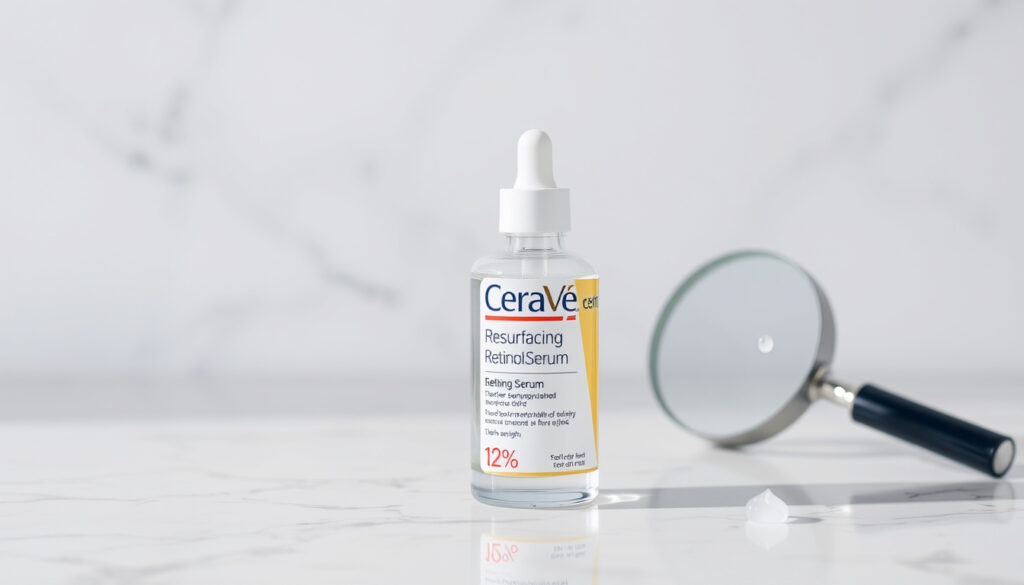
CeraVe Resurfacing Retinol Serum: Percentage, Use, and Safety
There’s a small irony in CeraVe’s Resurfacing Retinol Serum: the product is built to smooth away post-acne marks and visible pores, yet the number retinol shoppers hunt for first — the percentage — isn’t disclosed on the brand’s official page. What CeraVe does publish is the formula’s supporting cast — ceramides, niacinamide, and a $21.99 U.S. price in a 30 ml bottle (CeraVe US) — leaving a routine that protects your skin barrier while the active does its work.
Product: CeraVe Resurfacing Retinol Serum ·
Key ingredients (retailer-sourced): Retinol, ceramides, niacinamide ·
Size in top results: 30 ml ·
Main retailer claims: Reduces post-acne marks, minimizes pores, improves smoothness ·
Concentration asked in PAA: 0.2% retinol — not confirmed on label ·
Top comparison asked: CeraVe Renewing vs Resurfacing
Quick snapshot
- Marketed as the blemish-mark-focused option in CeraVe’s retinol range (Beautiful With Brains).
- Formula includes retinol, ceramides, and niacinamide per retailer descriptions (CeraVe US). (Beautiful With Brains)
- Both CeraVe retinol serums use encapsulated retinol (CeraVe Singapore).
- The exact retinol percentage is not printed on the official U.S. page (CeraVe US).
- The 0.2% figure circulating in searches is not confirmed on any label reviewed (CeraVe US; Ulta Beauty).
- The manufacturer’s full daily-use protocol isn’t spelled out in the available official snippets (Beautiful With Brains).
- No official week-by-week results timeline appears in the available product pages (CeraVe US). (Lazada Thailand editorial)
- A practical starter cadence: two to three nights per week (Lazada Thailand editorial).
- About a pea-sized amount per application is the recommended starting dose (Lazada Thailand editorial). (Lazada Thailand editorial)
- Don’t expect the retailer to settle the percentage question: Ulta says ingredient percentages are proprietary (Ulta Beauty).
- Choose by concern: Resurfacing for marks and pores, Skin Renewing for fine lines (CeraVe UK; Beautiful With Brains). (Ulta Beauty)
- Start slow, moisturize after, and let your skin set the pace (Lazada Thailand editorial). (Ulta Beauty)
Eight facts, one pattern: the official pages tell you what this serum does and what’s in it, but they stop short of the one number retinol fans argue about most.
| Label | Value |
|---|---|
| Product name | CeraVe Resurfacing Retinol Serum |
| Size in top results | 30 ml |
| Key ingredients (retailer-sourced) | Retinol, ceramides, niacinamide |
| Main positioning | Resurfacing, brightening, smoothing |
| Claimed skincare benefits | Reduces post-acne marks, minimizes pores, improves smoothness, restores barrier |
| Retinol percentage disclosed? | No — official pages don’t state it |
| Retinol delivery | Encapsulated retinol |
| Primary SERP context | Pharmacy e-commerce product pages |
What does Resurfacing Retinol Serum do?
The shortest useful answer: CeraVe positions this serum as a texture treatment, not an anti-aging cream. “Resurfacing” is the clue — the goal is smoother-looking skin, not erased wrinkles.
Key benefits from retailer descriptions
- The core promise, repeated across retailer descriptions, is improving the appearance of post-acne marks and uneven texture — the resurfacing brief (CeraVe Africa).
- Reseller product summaries describe it as formulated to exfoliate, brighten, and smooth the appearance of the complexion.
- CeraVe’s UK listing describes Resurfacing as suitable for all skin types (CeraVe UK).
- The brand frames retinol as a vitamin-A derivative that supports the skin’s natural exfoliation process — the mechanism behind the “resurfacing” name (CeraVe US).
The one-line read: this is a marks-and-texture serum, aimed at people whose complaint is what a breakout leaves behind.
Ceramides and niacinamide in the formula
- The Resurfacing formula pairs retinol with ceramides NP/AP/EOP and niacinamide — the barrier-supporting, soothing end of the ingredient list (CeraVe US).
- That combination is why this serum reads as beginner-friendly: the active gets a buffer, not a bare drop.
The practical read: CeraVe is selling a retinol routine, not just a retinol molecule — the ceramides and niacinamide are the insurance policy against the peeling that made older retinols notorious.
What the label says about texture and pores
- Labels and product descriptions lean on texture language: reducing the look of post-acne marks, minimizing the appearance of pores, smoothing rough patches.
- Reseller summaries mirror that language: “smooth your skin’s texture by reducing the appearance of post-acne marks, minimizing the look of pores” (Briarhill Pharmacy reseller summary).
What percentage of retinol is in CeraVe Resurfacing Retinol Serum?
The direct answer: nobody can tell you from the label, because CeraVe doesn’t publish the concentration on the official U.S. retinol page reviewed for this guide (CeraVe US).
Retailers don’t fill the gap. Ulta’s listing states that ingredient percentages other than active ingredients are proprietary, and the page shows no retinol percentage (Ulta Beauty).
Is 0.2% retinol too low?
- Searches for this serum regularly ask about 0.2% retinol — a figure that circulates in forums and comparison posts, not in CeraVe’s own materials.
- On the over-the-counter scale, 0.2% would sit at the gentle, entry-level end: enough to nudge cell turnover, mild enough for most beginners to tolerate.
What this means: don’t buy this serum for a percentage showdown. If 0.2% is the real number, it’s a starting-strength bet, not a resurfacing blitz — and the formula’s ceramides are there to keep you consistent.
What is stronger, 1% retinol or 0.2% retinal?
- In vitamin-A chemistry, retinal (retinaldehyde) sits one step closer to retinoic acid than retinol, so a lower percentage of retinal can act faster than a higher percentage of retinol.
- The “11 times faster” phrase in related searches is a retinal-vs-retinol marketing comparison, not a spec printed on this serum’s box.
The pattern: percentages only make sense molecule-by-molecule, and CeraVe’s silence on the number is a signal — the brand wants you to compare formulas, not fractions.
How to read the label for retinol percentage
- Scan the ingredient list for “retinol” — it’s there, but no percentage follows it on the official U.S. page (CeraVe US).
- Check the retailer listing: Ulta explicitly says ingredient percentages other than actives are proprietary (Ulta Beauty).
Seven facts, one pattern: the label tells you what the formula contains and what it’s for, while the concentration stays in the brand’s back pocket.
| Label | Value |
|---|---|
| Product name | CeraVe Resurfacing Retinol Serum |
| Size in top results | 30 ml |
| Retinol percentage disclosed? | No — official pages don’t state it |
| Retinol delivery | Encapsulated retinol |
| Key formula ingredients | Retinol, niacinamide, dipotassium glycyrrhizate, ceramides NP/AP/EOP |
| Skin type positioning | All skin types |
| Main marketed benefit | Post-acne marks and uneven texture |
The trade-off: CeraVe gets to call this “resurfacing” without committing to a number. For shoppers, the missing percentage is exactly why the routine matters more than the label.
The pattern: CeraVe’s official materials commit to a formula, not a fraction — and that’s the context shoppers need before comparing strengths.
What are the differences between CeraVe Renewing retinol and CeraVe Resurfacing retinol?
CeraVe sells two retinol serums in this range, and the names encode the difference: Resurfacing is the texture-and-marks specialist, Skin Renewing is the anti-aging play.
CeraVe Renewing vs Resurfacing: intended positioning
- The official UK listing positions Skin Renewing for fine lines, wrinkles, texture, and radiance, aimed at normal-to-dry skin (CeraVe UK).
- Resurfacing, by contrast, is listed as suitable for all skin types (CeraVe UK).
- An editorial comparison describes Skin Renewing as the creamier formula, supported by glycerin, hydrolyzed hyaluronic acid, shea butter, and vitamin E (Beautiful With Brains).
The implication: you pick between the two based on the problem you’re solving — marks and pores point to Resurfacing; fine lines and drier skin point to Skin Renewing.
Choose the serum by the complaint, not the tech: both use encapsulated retinol (CeraVe Singapore), so the real difference is whether you’re treating marks and pores or fine lines.
Where Resurfacing fits for post-acne marks and pores
- Resurfacing’s working brief is visible texture: post-acne marks, enlarged-looking pores, rough patches.
- The supporting cast — niacinamide and ceramides — is the kind of addition that makes a texture-focused retinol wearable on facial skin.
The pattern: Resurfacing doesn’t claim to erase scars; the language is “reduce the appearance” — a narrower, more honest promise.
Texture and barrier support claims
- Skin Renewing reads as the richer formula — creamier, with glycerin, hyaluronic acid, shea butter, and vitamin E around the retinol.
- Both formulas include niacinamide and ceramides in CeraVe’s dual-retinol lineup, which is why the range often becomes the default recommendation for retinol beginners.
Five comparisons, one pattern: the same retinol technology, pointed at two different skincare complaints.
| Attribute | Resurfacing Retinol Serum | Skin Renewing Retinol Serum |
|---|---|---|
| Marketing focus | Post-acne marks, uneven texture | Fine lines, wrinkles, texture, radiance |
| Skin type positioning | All skin types (CeraVe UK) | Normal-to-dry skin |
| Formula character | Light, texture-focused | Creamier, with glycerin, hyaluronic acid, shea butter, vitamin E |
| Retinol delivery | Encapsulated retinol | Encapsulated retinol |
| Retinol percentage disclosed? | No | No |
What this means: if you’re choosing between them, pick the complaint first — marks and pores means Resurfacing; fine lines and drier skin means Skin Renewing — then let tolerance, not the label, set the pace.
The pattern: the two serums share technology, but the marketing split is clear enough to make the choice about your skin concern rather than a spec sheet.
Which retinol cream is best for faces?
There’s no single best face retinol in the pharmacy aisle — but there is a best-fit formula, and CeraVe’s Resurfacing is a useful case study in how a barrier-supportive retinol gets positioned for everyday facial use.
What works 11 times faster than retinol?
The “11 times faster” claim circulating in searches is tied to retinal (retinaldehyde), the closer-to-active form of vitamin A — not to anything printed on this serum’s box. No official CeraVe page in the available material makes that claim, so treat the multiplier as search-bait, not a spec.
- For facial skin, the practical question is tolerance, and CeraVe’s answer is a retinol paired with ceramides and niacinamide — ingredients that make the active wearable enough to use consistently.
- A “stronger” formula only wins if your face can handle it nightly; a gentle one you keep using beats a strong one you keep quitting.
The upshot: speed claims make for good search results. Consistency makes for good skin.
Is 40 too late for retinol?
- CeraVe frames retinol as supporting the skin’s natural exfoliation process — the process that slows with age, which is exactly why starting in your 40s is common rather than catastrophic.
- The available official materials show no age cutoff for either CeraVe serum; the gatekeeper is skin tolerance, not a birthday.
Why this matters: at 40, the real question is whether your skin can handle the adjustment phase, and that’s determined by formula and routine, not by how late you started.
La Roche-Posay Retinol as a comparison point
- Related searches slot La Roche-Posay’s retinol next to CeraVe’s, which means shoppers are weighing two pharmacy-positioned retinol serums rather than a clear category winner.
- Without La Roche-Posay’s official materials in front of us, the more useful comparison is CeraVe against CeraVe: Resurfacing for post-acne marks and pores, Skin Renewing for fine lines and radiance.
The trade-off: brand-vs-brand retinol battles usually come down to vehicle and tolerance — neither of which shows up cleanly in a comparison chart. A formula whose supporting ingredients match your skin type is the safer bet.
The implication: category winners exist in marketing, but skin wins with a routine it can sustain.
Can I use CeraVe Resurfacing Retinol Serum every day?
Eventually, yes — but “can” and “should on night one” are different questions. The available official snippets don’t print a full daily-use protocol for this serum, and most beginner guidance starts at a slower cadence.
Starting frequency and how to layer a retinol serum
- Retinol is generally best introduced in the evening, because irritation and photosensitivity are practical concerns; the available official snippets don’t provide complete directions for either CeraVe serum (Beautiful With Brains).
- A market-retailer retinol guide recommends starting at roughly two to three applications per week and increasing only if the skin tolerates it (Lazada Thailand editorial).
- The same guide recommends about a pea-sized amount rather than more product to speed results (Lazada Thailand editorial).
- Cleanse and dry your face, then apply the serum in the evening.
- Use a pea-sized amount, spread lightly across the face while avoiding the eye area.
- Wait a few minutes, then apply moisturizer to buffer dryness.
- Start with two or three non-consecutive nights per week; increase frequency only if no redness, flaking, or stinging appears.
- If irritation appears, drop back to once a week and rebuild from there.
The pattern: the fastest way to use retinol is slowly. Daily use is an endpoint your skin earns, not a starting line printed on the box.
Should I apply moisturizer after applying retinol?
- Yes — in virtually every beginner retinol routine, a moisturizer after the serum offsets the dryness and barrier stress that vitamin A can cause.
- The Resurfacing formula already contains ceramides, but layering a separate moisturizer is the standard buffer while your skin adapts.
What this means: order matters — serum first, moisturizer second — and in the first few weeks, the moisturizer is not optional.
The pattern: tolerance decides the schedule, so let the skin’s response set the pace.
What should you never mix with retinol?
Retinol’s rules are less about what it is and more about what you stack beside it. Most of the “dark side” stories are self-inflicted: irritation, peeling, and sun sensitivity from doing too much too fast.
What is the dark side of retinol?
The classic mistake is stacking: retinol plus a strong exfoliant or acne treatment (glycolic acid, salicylic acid, benzoyl peroxide) on the same night is how redness and peeling happen. If a doctor hasn’t prescribed that combination, don’t invent it.
- Retinol can cause dryness, peeling, redness, and a temporary “purging” phase when introduced too aggressively.
- The other side of the coin is photosensitivity: retinol-using skin is more easily irritated by UV exposure, which is why sunscreen becomes a non-negotiable daytime step.
The catch: retinol isn’t dangerous; it’s demanding. The damage is usually a routine problem, not a formula problem.
How to minimize retinol irritation
- Start low and slow — two to three nights a week is the standard on-ramp, and the dose that works is the dose your skin tolerates.
- Keep the rest of the routine simple on retinol nights: cleanse, retinol, moisturizer. No acid toners, no scrubs, no extra active serums.
- If irritation shows up, reduce frequency before you reduce the amount — a pea-sized dose stays constant, the schedule flexes.
The strategy: treat retinol like a recurring appointment, not an argument with your skin.
Protecting the skin barrier while using retinol
- CeraVe’s delivery answer is encapsulation — the active is wrapped so it releases gradually rather than hitting the skin all at once.
- The Resurfacing formula’s ceramides and niacinamide are the barrier-support layer; your job is to not undo that engineering with a harsh second step.
Why this matters: encapsulation is CeraVe’s way of keeping the active effective but slow. The rest of the routine should respect that pace.
Upsides
- Barrier-supportive formula: retinol backed by ceramides and niacinamide.
- Encapsulated retinol for gradual release.
- Positioned for all skin types.
- A clear, honest brief: post-acne marks and texture, not overpromised anti-aging.
Downsides
- The retinol percentage is not disclosed on official materials.
- No full daily-use protocol printed in the available official snippets.
- Demands a careful routine: no harsh actives on the same night, sunscreen during the day.
- Results are slow and depend on consistency; “resurfacing” won’t erase deep scars.
Confirmed facts
- Sold as CeraVe Resurfacing Retinol Serum in a 30 ml size (CeraVe US).
- Formula includes retinol, ceramides, and niacinamide per retailer descriptions (CeraVe US).
- Marketed to reduce the appearance of post-acne marks and minimize the look of pores (CeraVe Africa).
- Both CeraVe retinol serums use encapsulated retinol (CeraVe Singapore).
- Official U.S. price: $21.99 (CeraVe US).
What’s unclear
- The exact retinol percentage is not disclosed on the official U.S. page (CeraVe US).
- Whether the circulating 0.2% figure matches this specific bottle (CeraVe US; Ulta Beauty).
- Clinical before-and-after results and customer review scores are not shown in the CeraVe or Ulta pages reviewed (CeraVe US; Ulta Beauty).
- The real-world difference between Renewing and Resurfacing beyond marketing; only an editorial characterization is available (Beautiful With Brains).
- CeraVe’s official daily-use protocol, which is not fully printed in the available snippets (CeraVe US).
- The “11 times faster” claim, which no official source in the available material supports for this serum (CeraVe US).
What the product descriptions actually say
- Three descriptions, one consistent message: CeraVe’s science page and two pharmacy resellers describe the same serum in almost the same words.
“CeraVe’s Resurfacing Retinol Serum with Ceramides and Niacinamide is formulated to exfoliate, brighten and smooth the appearance of the complexion.”
CeraVe reseller product summary (Purepharmacy.ie)
“CeraVe Resurfacing Retinol Serum helps smooth your skin’s texture by reducing the appearance of post-acne marks, minimizing the look of pores.”
CeraVe reseller product summary (Briarhill Pharmacy)
“Retinol is a vitamin A derivative that promotes the skin’s natural exfoliation process and can reduce the appearance of fine lines, wrinkles, and hyperpigmentation.”
CeraVe US (official retinol page)
The gap between what the label promises and what the label hides is the whole story of this serum: a sensible, barrier-supportive retinol for post-acne marks and texture, with a concentration CeraVe keeps to itself. For a first-time retinol buyer, the choice is clear: start Resurfacing at two to three nights a week, moisturize after, and judge it in months — or keep chasing percentages and let the perfect be the enemy of a routine your skin can actually keep.
Frequently asked questions
Does CeraVe Resurfacing Retinol Serum help with acne scars?
It’s marketed for the appearance of post-acne marks and uneven texture — the discoloration and rough patches left behind by breakouts. That’s “marks,” not deep scar remodeling, so the honest answer is: yes for the look of marks, no for true scarring.
How long does it take to see results from CeraVe Resurfacing Retinol Serum?
CeraVe’s available official pages don’t publish a week-by-week timeline. The practical expectation is consistency over several weeks, starting at two to three nights per week; visible changes in texture and marks usually follow a sustained routine, not a single bottle.
Can I use CeraVe Resurfacing Retinol Serum in the morning?
You can, but the standard advice is evening use. Retinol is best introduced at night because irritation and photosensitivity are practical concerns, and morning use would make daily sunscreen even more essential.
Do I need sunscreen when using CeraVe Resurfacing Retinol Serum?
Yes. Retinol-using skin is more prone to UV irritation and pigmentation, so daily broad-spectrum sunscreen is the necessary companion. The available CeraVe snippets don’t print a specific SPF instruction, but SPF 30 or higher is the standard guidance.
Is CeraVe Resurfacing Retinol Serum good for sensitive skin?
The official UK listing describes it as suitable for all skin types, and the formula includes ceramides and niacinamide, which support barrier comfort. Sensitive skin should still patch-test and start at two nights per week before increasing frequency.
What skin type is CeraVe Resurfacing Retinol Serum for?
CeraVe UK lists Resurfacing for all skin types, while the Skin Renewing serum is positioned for normal-to-dry skin. If your skin leans dry, the richer Renewing formula is worth considering instead.
More related posts
 Washing Machine with Dryer: Irish Buyer’s Guide
 Wie Putzt Man Das Haus Schnell – 1-Hour Cleaning Guide
 Emergency Towing Cook Strait: Ferry Safety Explained
 Ruby Rose Te Awamutu: Women’s Fashion Boutique Guide
 Worksafe Electrical Rule Review 2025: RCD Changes and Risks
 How to Call Australia from NZ: Dialing Steps & Costs
 Jean Paul Gaultier NZ – Stockists, Stores and Buying Guide
 Pizza Hut Palmerston North Guide: Menu, Hours & Delivery