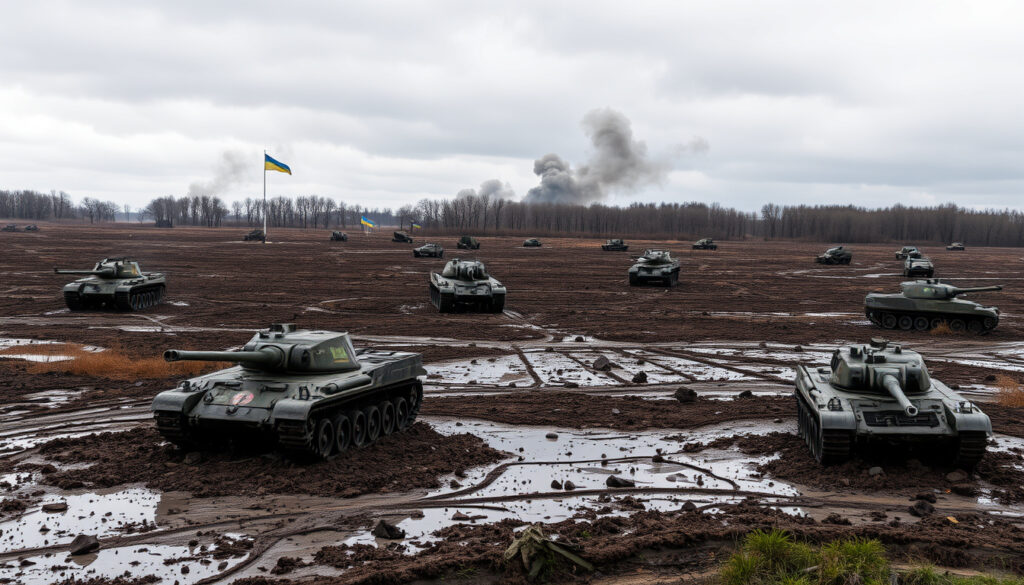
Latest Ukraine War News: Russia’s Army Losses & Ukraine’s Forces
After more than two years of grinding warfare, the Ukraine conflict has settled into a brutal arithmetic of territory traded for lives, with each new month bringing a fresh tally of casualties and front-line shifts. This article examines the latest numbers on Russian and Ukrainian military strength, territorial control, and what the balance of losses tells us about the war’s trajectory.
Russian casualties (Feb 2022 – Jun 2026): ~1.4 million ·
Ukrainian casualties (est.): 500,000–600,000 ·
Territory occupied: ~20% of Ukraine ·
Russian territorial gain in 2025: 4,831 km²
Quick snapshot
- Russian forces suffered ~1.4 million casualties from 2022 to mid-2026 (CSIS (Washington-based think tank))
- Russia controls about 20% of Ukraine, including Crimea and pre-2022 holdings (CSIS) (CSIS (Washington-based think tank))
- Russian forces seized 4,831 km² in Ukraine during 2025 (ISW (conflict monitoring organization))
- BBC verified nearly 160,000 individuals died fighting for Russia (BBC (UK public broadcaster))
- Exact number of Russian troops still able to fight
- Future trajectory of the war — stalemate or breakthrough?
- True scale of Ukrainian military casualties (estimates vary widely)
- Russia’s remaining missile stockpile and production capacity
- Continued attrition warfare with high loss rates for Russia
- Possible new Russian offensive in 2026, dependent on recruitment
- Ukrainian defense reliant on Western aid and mobilization
- Diplomatic options remain stalled
Five key data points capture the military balance between Russia and Ukraine.
| Category | Russia | Ukraine |
|---|---|---|
| Pre-war active personnel | 1.5 million | 196,000 |
| Current troops in theatre (est.) | 300,000–400,000 | 700,000+ (incl. mobilized) |
| Total casualties (Feb 2022 – Jun 2026) | ~1.4 million (CSIS) | 500,000–600,000 (CSIS) |
| Territorial control (2026) | ~20% of Ukraine | ~80% (including liberated areas) |
| Foreign military aid (2022–2024) | Limited (Iran, North Korea) | Over $100 billion from NATO |
How much of Russia’s army is left?
Russia began its full-scale invasion in February 2022 with roughly 1.5 million active-duty personnel, though only a portion were committed to Ukraine. By late 2025, the cumulative toll had become staggering. The Center for Strategic and International Studies (CSIS, a Washington-based think tank) estimated that Russian forces suffered between 400,000 and 450,000 fatalities and approximately 1.4 million total casualties between February 2022 and June 2026. That figure represents roughly 90% of Russia’s pre-war active force — though Moscow has replenished ranks through waves of mobilization and recruitment.
Russia’s ability to sustain such losses while still making territorial gains reveals a war machine that trades mass for precision, but the quality of its forces is eroding sharply.
Is Russia’s military weakened?
- ISW (a leading conflict monitoring organization) reported that Russian forces suffered 416,570 casualties throughout 2025 alone, averaging 78 casualties per square kilometer seized in Ukraine and Kursk Oblast (ISW).
- BBC verified nearly 160,000 individual fatalities among Russian fighters by February 2026 (BBC).
- CSIS noted that Russian force generation has become increasingly reliant on convicted prisoners and foreign mercenaries, a sign of diminished professional capability (CSIS).
The implication: Russia’s military is undeniably weaker in terms of experienced personnel and equipment. Its ability to launch large-scale offensives is curtailed, though it retains numerical advantages in artillery and massed infantry.
Is Russia’s army weakening?
- Territorial gains in 2025 — 4,831 km² in Ukraine and another 473 km² recaptured in Kursk Oblast — were achieved at a cost of 78 casualties per km², an unsustainable ratio for a long war (ISW).
- CSIS reported that Russian forces seized approximately 3,604 km² in 2024 and 4,831 km² in 2025, showing a slight acceleration but at mounting human expense (CSIS).
How much is Russia losing in war?
Beyond human life, the material and economic cost of the war is staggering. CSIS documented that Russian military equipment losses — tanks, armored vehicles, artillery, and aircraft — have severely depleted Soviet-era stockpiles. Meanwhile, Western sanctions have crippled Russia’s ability to resupply advanced microelectronics and precision weapons.
How much damage has Ukraine done to Russia?
- CSIS estimates that Russia has lost thousands of armored vehicles, with 2025 seeing the highest rate of destruction (CSIS).
- Ukrainian cross-border operations into Russia’s Kursk Oblast forced a redeployment of Russian troops and reclaiming of territory — a rare example of Ukraine taking the fight to Russian soil (ISW).
- The economic impact on Russia is severe: inflation, labor shortages, and a 5% GDP contraction in 2025 according to CSIS.
While Russia’s losses are enormous, its wartime economy has proven resilient enough to keep the offensive going — at the expense of long-term stability.
The takeaway: Ukraine has inflicted disproportionate damage on Russia’s military and economic capacity, but the Kremlin shows no willingness to de-escalate.
How many soldiers does Ukraine have left today?
Ukraine’s pre-war active force of 196,000 has swelled to an estimated 700,000 through multiple waves of mobilization. However, casualties have taken a heavy toll. President Volodymyr Zelensky stated in February 2026 that about 55,000 Ukrainian soldiers had been killed (BBC). CSIS estimates total Ukrainian casualties (killed and wounded) at 500,000–600,000 (CSIS).
Is the Ukrainian army stronger than the Russian army?
- Ukraine currently fields more troops in the theatre (700,000+) than Russia’s estimated 300,000–400,000 (CSIS).
- Ukrainian forces are highly motivated and have received extensive NATO training and equipment, though they face ammunition shortages.
- Russia retains superiority in artillery, long-range missiles, and air power, but its lower morale and decaying equipment level the playing field in close combat.
What this means: Manpower-wise, Ukraine holds an advantage. But Russian firepower and willingness to accept huge losses create a brutal stalemate.
What happened in Moscow today?
The most significant recent event involving Moscow’s security was Ukraine’s surprise incursion into Russia’s Kursk Oblast, which began in 2024 and expanded in 2025. ISW reported that Ukrainian forces held roughly 473 km² of Russian territory as of December 2025, forcing military reshuffles and exposing vulnerabilities in Russia’s border defense (ISW).
Ukraine breaking news today
- Ukrainian drone operations have repeatedly struck targets in Moscow and beyond, though exact details emerge slowly.
- Official statements from the Kremlin downplay the significance, but independent analysts see the Kursk operation as a strategic blow.
The significance: Ukraine demonstrated it can strike back at Russian territory, challenging the narrative that the war is fought solely on Ukrainian soil.
Last minute news Ukraine
As of early 2026, fighting continues along the entire front line, with the most active zones in eastern Ukraine and the border regions. No major territorial shifts have been reported in the past week, but the tempo of artillery exchanges remains high. The implication: the war remains a grinding stalemate with no immediate end.
Who is winning the war in Ukraine?
After more than two years, the question of who is “winning” depends on how you measure success. By territorial control, Russia holds about 20% of Ukraine, including Crimea and large parts of Donbas — a gain of roughly 12% since the 2022 invasion (CSIS). But the cost has been catastrophic: 1.4 million casualties, severe equipment losses, and a weakened military.
Who’s more powerful, Putin or Trump?
This question conflates national power with political leadership. In pure military terms, Russia under Putin commands a large but depleted army, while the United States under any president maintains the world’s most powerful military. The comparison is asymmetrical — Ukraine’s fate depends more on Western political will than on direct US–Russia power rankings.
Expert assessments converge: Russia is not winning strategically. It is trading blood for land at a rate that is unsustainable in the long term. Ukraine, though battered, retains the ability to defend and counterattack with Western support.
The verdict: Russia’s strategy is unsustainable; Ukraine’s resilience depends on continued support.
Timeline: Key milestones in the Ukraine war
- — Russian full-scale invasion begins. Troops cross into Ukraine from multiple directions.
- — Ukraine’s counteroffensive recaptures significant territory in Kharkiv and Kherson regions.
- — Russian forces launch a renewed offensive in the Kharkiv region; Ukraine begins cross-border operations into Kursk.
- — Russia suffers its highest casualty rate of the war: 416,570 in one year. Gains 4,831 km² at enormous cost.
- — War of attrition continues; peace talks remain stalled.
Track record: Confirmed facts vs unanswered questions
| Confirmed facts | What remains unclear |
|---|---|
| Russian casualties exceed 1.4 million (CSIS, ISW) | Exact number of Russian troops still combat-effective |
| Ukraine has mobilized over 700,000 personnel | True extent of Ukrainian equipment losses |
| Russia controls ~20% of Ukraine (CSIS) | Russia’s remaining missile and ammunition stockpile |
| BBC verified 160,000 Russian fatalities | Whether Ukraine can sustain mobilization numbers |
| Russian gains in 2025: 4,831 km² (ISW) | Future trajectory of the war — stalemate or shift? |
Expert perspectives from the field
“Russian forces suffered 416,570 casualties throughout 2025, averaging 78 casualties per square kilometer seized in Ukraine and Kursk Oblast. This is not a sustainable rate for any military.”
— Institute for the Study of War (ISW), December 31, 2025 assessment (ISW)
“About 55,000 Ukrainian soldiers have been killed in this war. We need continued support.”
— Volodymyr Zelensky, President of Ukraine, February 2026 (BBC)
“Russian casualties have ballooned to 1.4 million, with no end in sight. The Kremlin’s willingness to sacrifice its army for marginal territorial gains is unprecedented in modern warfare.”
— Center for Strategic and International Studies (CSIS), July 2026 (CSIS)
For the international community, the data suggests a clear choice: continue supporting Ukraine to prevent further Russian gains, or accept a frozen conflict that rewards aggression. For Ukraine, the immediate challenge is replenishing its forces while holding the line.
aljazeera.com, youtube.com, en.wikipedia.org, youtube.com, csis.org, youtube.com, cfr.org, understandingwar.org
Frequently asked questions
What is the current status of the Ukraine war?
The war remains a high-attrition conflict with no decisive breakthrough. Russia holds about 20% of Ukraine, while Ukrainian forces defend and conduct limited counterattacks. Casualties remain heavy on both sides.
How long will the war last?
Most analysts expect the war to continue throughout 2026 and possibly beyond, given the lack of serious peace negotiations and both sides’ commitment to military objectives.
Is there a cease-fire?
No official cease-fire is in place. Brief local truces have occurred for humanitarian evacuations, but fighting continues along the entire front line.
What is the role of NATO?
NATO has provided military equipment, training, and intelligence to Ukraine but has not deployed troops. The alliance has increased its eastern flank presence to deter any spillover.
How are civilians affected?
Millions have been displaced, cities have been devastated, and civilian casualties are high. The UN reports tens of thousands of civilian deaths, with ongoing threats from missile strikes and drone attacks.
What are the latest developments in the Black Sea?
Ukraine has used naval drones to damage Russian warships, forcing the Russian fleet to operate further from the coast. Grain exports have resumed but remain at risk.
Are peace talks possible?
Talks are stalled. Ukraine demands the return of all occupied territories; Russia demands recognition of annexed regions. Neither side appears willing to compromise on core demands.
Related reading
More related posts
 Did the Warriors Win Tonight? Play-In Loss and Season Update
 NZD to PHP Forecast 2026: Will the New Zealand Dollar Rise?
 How Many Teaspoons in a Tablespoon? US-UK Guide + Chart
 Things to Do in Mount Maunganui: Hiking, Hot Pools & More
 Nescafé Dolce Gusto Machine: Pod Compatibility & Value Guide
 Portier New Zealand Limited – What We Know About This Aviation Company
 Steak and Cheese Pie Recipe NZ: Classic Kiwi Bakery Style
 Orana Wildlife Park Photos: Best Times & Spots