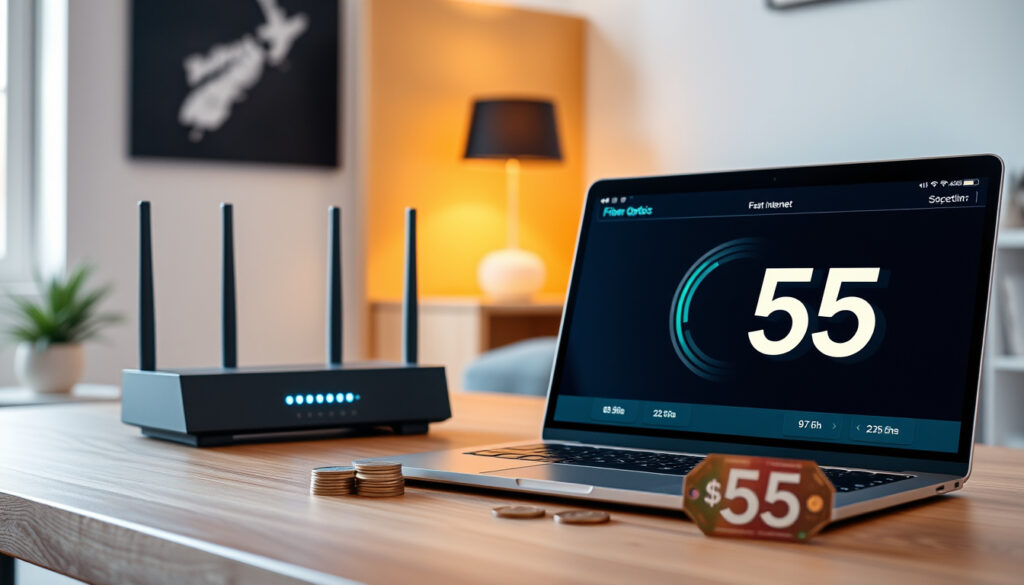
Cheapest Unlimited Broadband NZ: Compare Plans from $55/mo
Anyone who has shopped for broadband in New Zealand recently knows the feeling: too many plans, too many prices, and a lingering suspicion you might be overpaying. With unlimited data now the norm and fibre reaching more homes than ever, the real question isn’t whether you should get unlimited broadband — it’s how to find the cheapest unlimited broadband NZ has without sacrificing speed or reliability.
Cheapest unlimited plan (wireless): from $55/month (2degrees Wireless Essential) ·
Cheapest unlimited fibre plan: from $63.59/month (360Net via Simply Broadband) ·
Average unlimited broadband cost: around $70–$80 per month ·
Provider with most options: One NZ – wireless from $65, fibre from $87.99 ·
Recent price hike: from August 1, 2026 – increases of $5–$10/month
Quick snapshot
- 2degrees Wireless Essential at $55/month is the cheapest unlimited plan (BroadbandCompare (NZ’s leading comparison site))
- Sky Broadband is among the cheapest fibre options at $65/month for 100/20 Mbps (Kiwi Journal (tech analysis))
- Spark’s Everyday Fibre rises from $91 to $101/month on 1 August 2026 (Spark NZ (official pricing page))
- One NZ Fibre Starter will increase from $65 to $70/month in 2026 (One NZ (price change notice))
- Exact future pricing after hikes – providers may adjust again
- Whether more providers will offer no-contract plans long-term
- Long-term availability of the cheapest plans (may be promotional)
- August 1, 2026 – Major broadband price hikes take effect (Spark, One NZ, 2degrees) (Spark NZ (legal notice))
- January 2026 – 2degrees launches Wireless Essential plan at $55/month (BroadbandCompare (comparison tool))
- Consumers should lock in current prices before August 2026
- Look for bundle deals to offset the $5–$10 increase
- No-contract plans may become more attractive as prices rise
These snapshots reflect the most competitive pricing available as of mid-2026.
| Category | Value |
|---|---|
| Cheapest unlimited plan | 2degrees Wireless Essential at $55/month |
| Cheapest fibre unlimited plan | Simply Broadband (360Net) at $63.59/month |
| Average unlimited broadband cost | $70–$80 per month |
| Price hike effective | August 1, 2026 – typical increase $5–$10/month |
| Number of major providers | 5+ (Spark, One NZ, 2degrees, Vodafone, Slingshot, etc.) |
What is the average cost of broadband in NZ?
How much does unlimited fibre broadband cost?
Fibre broadband costs vary by speed tier and contract length. The typical range for unlimited fibre in New Zealand is $70–$80 per month for standard 100/20 Mbps plans, according to MoneyBalance (NZ consumer finance tracker). Entry-level fibre can drop under $60/month, while gigabit plans push past $100/month.
- Skinny Fibre 300 (300/100 Mbps): $60/month (MoneyBalance)
- Simply Broadband Essential Fibre (100/20 Mbps): $63.59/month (BroadbandCompare)
- 2degrees Fibre 300 (300/100 Mbps): $75/month (BroadbandCompare)
- Spark Fibre Everyday (500/100 Mbps): $91/month, rising to $101/month on 1 August 2026 (Spark NZ (official pricing))
- One NZ Fibre Max (900/500 Mbps): $116/month after the 2026 increase (One NZ (price change page))
The gap between entry-level fibre and top-tier gigabit plans is widening. Households that don’t need extreme speeds can save $40–$50 per month by sticking with 100/20 Mbps fibre.
How much does unlimited wireless broadband cost?
Wireless broadband — using 4G or 5G mobile networks instead of fibre — offers the cheapest path to unlimited data in many parts of New Zealand. These plans typically cost $55–$70 per month.
- 2degrees Wireless Essential: $55/month — the cheapest unlimited option overall (BroadbandCompare (NZ comparison tool))
- One NZ 4G Wireless Unlimited: $65/month (One NZ)
- Slingshot 4G Wireless: $65/month (BroadbandCompare)
- Skinny Jump 4G Wireless: $60/month (Kiwi Journal (tech review))
The catch: wireless speeds depend on network congestion and signal strength. In dense urban areas, 5G wireless can match entry-level fibre, but rural users may see slower speeds during peak hours.
The implication: choosing between fibre and wireless comes down to whether reliability or upfront cost matters more for your household.
Why is the internet so expensive in New Zealand?
Are there geographical factors?
New Zealand’s geography creates unavoidable cost pressure. The country’s low population density (around 19 people per square kilometre) means fibre-optic cables must cover vast distances to serve relatively few homes. According to MoneyBalance (consumer cost analysis), these infrastructure costs are spread across a small customer base, raising per-user prices compared to denser markets like the UK or Singapore.
- Rural areas have fewer provider options, keeping prices higher
- Undersea cable capacity is limited and expensive to maintain
- The Chorus monopoly on local fibre lines limits wholesale competition
How does NZ compare globally?
New Zealand ranks among the most expensive OECD countries for broadband. A 2026 analysis by Steady NZ (cost-of-living research) found that Kiwi households pay roughly 20–30% more than Australian households for equivalent fibre speeds.
New Zealand has world-class fibre infrastructure — the government-backed UFB programme covers 87% of the population. Yet the cost to access that network is higher than in many countries with older copper infrastructure. The infrastructure is great; the price to use it is not.
The 2026 price hikes — most providers added $5–$10 per month — are driven by inflation, rising wholesale costs from Chorus, and network maintenance overheads. Spark’s official price increase notice confirms the change takes effect on 1 August 2026 for all new and existing customers (Spark NZ (legal notice)).
The catch: geography and market structure are fixed constraints, making provider switching the most effective lever for individual savings.
Who is the best and cheapest broadband provider?
What criteria define ‘best’?
“Best” is a moving target. For one household, it means lowest monthly cost. For another, it means consistent speeds for video calls and gaming, or a provider that bundles broadband with mobile at a discount. Canstar (NZ consumer ratings platform) rates providers on speed, reliability, customer service, and value.
- Cheapest overall: 2degrees Wireless Essential at $55/month
- Best value fibre: Simply Broadband (360Net) at $63.59/month for 100/20 Mbps
- Best bundle deals: One NZ — save $120/year by bundling with mobile
- Best customer service: Slingshot and 2degrees rated highly by MoneyHub (Kiwi Journal)
Which provider offers the best value?
The cheapest plan is not always the best value. 2degrees at $55/month saves $15 over Skinny’s $60 plan, but Skinny offers no lock-in contract and free setup, which can save $50–$100 upfront. Factor in the total cost of ownership — not just monthly price.
The table below compares the cheapest unlimited plans from each major provider.
| Provider | Cheapest unlimited plan | Speed | Contract |
|---|---|---|---|
| 2degrees | Wireless Essential – $55/month | Up to 100 Mbps | No fixed term |
| Simply Broadband (360Net) | Fibre Essential – $63.59/month | 100/20 Mbps | Month-to-month available |
| One NZ | 4G Wireless – $65/month | Up to 100 Mbps | 12-month or no contract |
| Skinny | Fibre 300 – $60/month | 300/100 Mbps | No lock-in |
| Spark | Fibre Everyday – $101/month | 500/100 Mbps | 12-month |
The takeaway: for pure value, Simply Broadband’s $63.59 fibre plan combines low cost with fibre reliability, while 2degrees’ $55 wireless plan wins on raw price. The pattern: smaller providers consistently undercut the major telcos on price.
Who has the cheapest broadband in NZ?
What is the cheapest unlimited wireless plan?
The cheapest unlimited wireless broadband plan in New Zealand is 2degrees Wireless Essential at $55/month. Launched in January 2026, it set a new floor for unlimited data pricing, undercutting competitors by $10 or more. The plan includes unlimited data on the 2degrees 4G/5G network with no fixed-term contract (BroadbandCompare (NZ comparison tool)).
- 2degrees Wireless Essential: $55/month — cheapest overall
- One NZ 4G Wireless: $65/month
- Slingshot 4G Wireless: $65/month
- Skinny Jump 4G: $60/month
What is the cheapest unlimited fibre plan?
For fibre, the cheapest unlimited plan comes from Simply Broadband (360Net) at $63.59/month for 100/20 Mbps. That’s nearly half the price of Spark’s equivalent plan after the August 2026 increase. BroadbandCompare (independent comparison service) lists this as the leading budget fibre option, though availability depends on your address being in the 360Net coverage zone.
- Simply Broadband (360Net) Essential Fibre: $63.59/month
- Skinny Fibre 300: $60/month — cheaper but requires Chorus fibre connection
- 2degrees Fibre 300: $75/month
- Contact Energy Broadband 100: $70/month (12-month term) (Kiwi Journal)
What this means: the national cheapest plan is useless if it isn’t available at your address — location is the final filter.
Is $100 a month too much for internet?
What speed should I expect for $100?
At $100/month, you’re in gigabit fibre territory. One NZ’s Fibre Pro plan sits at $99.99/month for 900/500 Mbps, which is plenty for a household with heavy streaming, gaming, and multiple simultaneous video calls. Canstar (NZ consumer ratings) notes that $100 is the typical entry point for ultra-fast fibre in New Zealand.
- One NZ Fibre Pro: $99.99/month – 900/500 Mbps
- Spark Fibre Everyday: $101/month (after August 2026) – 500/100 Mbps
- 2degrees Fibre 900: $95/month – 900/500 Mbps
- Vodafone Fibre Superfast: $89.99/month – 800/400 Mbps
For most households, paying $100 is overkill. A 100/20 Mbps fibre plan at $60–$70 handles streaming, browsing, and home office work for a family of four. Only power users with large file transfers or 4K/8K streaming need gigabit speeds.
How can I lower my broadband bill?
With the 2026 price hikes adding $60–$120/year, the average household could save $240–$360 annually just by switching from a major provider to a budget alternative. The biggest trap is loyalty: existing customers often pay $10–$20 more per month than new sign-ups.
- Compare plans using BroadbandCompare (independent comparison tool) or MoneyBalance (cost calculator)
- Bundle broadband with mobile — One NZ and 2degrees offer discounts of $10–$15/month
- Check for seniors discounts or social tariffs (some providers offer $5–$10/month reductions)
- Choose a no-contract plan to allow easy switching when better deals appear
- Avoid promotional plans that spike after 6 or 12 months
“The key for consumers is to understand their actual speed needs. A family of four can comfortably stream and work on a 100/20 Mbps fibre plan. There’s no reason to pay for gigabit speeds unless you’re running a home server or editing 4K video.”
— MoneyHub NZ editor, via Kiwi Journal (Kiwi Journal (tech analysis))
“The market remains competitive despite the 2026 price hikes. Budget providers like 2degrees and Simply Broadband are still offering genuine alternatives to the big three. The gap between the cheapest and most expensive unlimited plan has actually widened this year.”
— Broadband Compare analyst, via BroadbandCompare (BroadbandCompare (market analysis))
The trade-off is clear: if you’re paying $100 or more, you’re likely over-provisioned. Downgrading to a 100/20 Mbps or 300/100 Mbps plan from a budget provider could save $30–$40 per month without any practical loss in day-to-day internet experience. The pattern: speed tiers above 300 Mbps deliver diminishing returns for most households.
Confirmed facts vs. what remains unclear
Confirmed facts
- 2degrees Wireless Essential costs $55/month (BroadbandCompare)
- Broadband prices increased on August 1, 2026 (Spark NZ (legal notice))
- One NZ offers SuperWiFi mesh for $5/month (One NZ)
- Simply Broadband (360Net) fibre from $63.59/month (BroadbandCompare)
What remains unclear
- Exact future pricing after hikes – providers may adjust again
- Whether more providers will offer no-contract plans long-term
- Long-term availability of the cheapest plans (may be promotional)
For New Zealand households shopping for broadband in 2026, the decision is straightforward: assess your actual speed needs, compare the budget options at your address, and lock in a plan before the August 2026 price hikes take effect. Shoppers who act now can lock in the cheapest unlimited broadband NZ has ever seen — at $55 for wireless or $63.59 for fibre — before these rates disappear.
Related reading: Contact Energy: cheapest plans and broadband · 2 Degrees mobile and broadband network guide
glimp.co.nz, broadbandcompare.co.nz, nzcompare.com, main.prod.vodafonenz.psdops.com
For those looking for plans starting at $55, Christchurch Reviews broadband comparison provides a broader view of options under $70.
Frequently asked questions
What is the difference between fibre and wireless broadband?
Fibre broadband uses physical fibre-optic cables to deliver internet to your home, offering symmetrical speeds (identical upload and download rates) and high reliability. Wireless broadband uses 4G or 5G mobile networks via a modem that picks up signal from a cell tower. Fibre is generally faster and more stable, while wireless is cheaper and doesn’t require physical installation — making it ideal for rentals or rural areas where fibre doesn’t reach.
Is unlimited broadband truly unlimited?
In New Zealand, most unlimited broadband plans genuinely have no data caps. However, some providers may apply “fair use” policies that throttle speeds during peak hours if you exceed very high usage thresholds (usually above 1TB per month). Always check the provider’s terms — the cheapness of a $55 wireless plan might come with speed reductions during evening congestion.
Can I get cheap broadband without a contract?
Yes. 2degrees Wireless Essential and Skinny Jump 4G both offer no fixed-term contracts. Simply Broadband (360Net) also offers month-to-month fibre. Going contract-free often means paying $5–$10 more per month than 12-month promotional prices, but you gain the flexibility to switch when a better deal appears — which is especially valuable with the current market shifts.
Do seniors get discounts on broadband in NZ?
Some providers offer discounted plans for seniors or SuperGold Card holders. Skinny has a Jump plan that includes broadband at reduced rates for qualifying customers. Contact Energy Broadband and some local fibre companies may also offer social tariffs. These are not always advertised, so it’s worth calling and asking about “community” or “low-income” pricing.
How do I switch broadband providers in NZ?
Switching is straightforward thanks to the Local Service Number (LSN) system. When you sign up with a new provider, they handle the cancellation and transfer with your old provider. You don’t need to contact your current provider. Most switches complete within 3–5 working days, and you won’t experience downtime if both providers use the same Chorus fibre connection.
What speed do I need for streaming and gaming?
For a typical household, 100/20 Mbps (the entry-level fibre plan) supports 4K streaming on two devices plus general browsing simultaneously. Gamers benefit from low latency rather than massive download speeds — 50 Mbps is enough for competitive gaming. Only households with multiple 4K streams, large file uploads, or home servers need 300 Mbps or higher.
Are there any hidden fees in broadband plans?
Common hidden fees include setup/installation charges ($50–$150), early termination fees for 12-month contracts, modem rental fees ($5–$10/month), and price escalation clauses that allow increases during your contract term. Always read the “standard terms” section of your plan — some budget plans charge extra for tech support or hardware replacement.
How do broadband bundles with mobile work?
Both One NZ and 2degrees offer discounts when you bundle broadband with a mobile plan. Typically, you save $10–$15 per month on the broadband component. For example, One NZ’s broadband + mobile bundle can save $120/year. These bundles often include perks like extra mobile data or a SuperWiFi mesh system at a reduced rate.
More related posts
 Cashmere High School Zone: Map, Decile & Enrolment
 When Is the Next Admin Abuse in Steal a Brainrot? Event Times
 Dog Car Seat Cover: Do They Really Work and How to Choose
 Apartments for Rent Wellington: 2025 Prices & Neighborhoods
 US Stock Market News Today: Current Situation and Rules
 Bay of Plenty Times Death Notices: Past 30 Days
 LA Clippers vs Denver Nuggets Match Player Stats (Jan 30, 2026)
 Tiny Homes New Zealand Legal Battle – Key Rulings and Compliance Guide