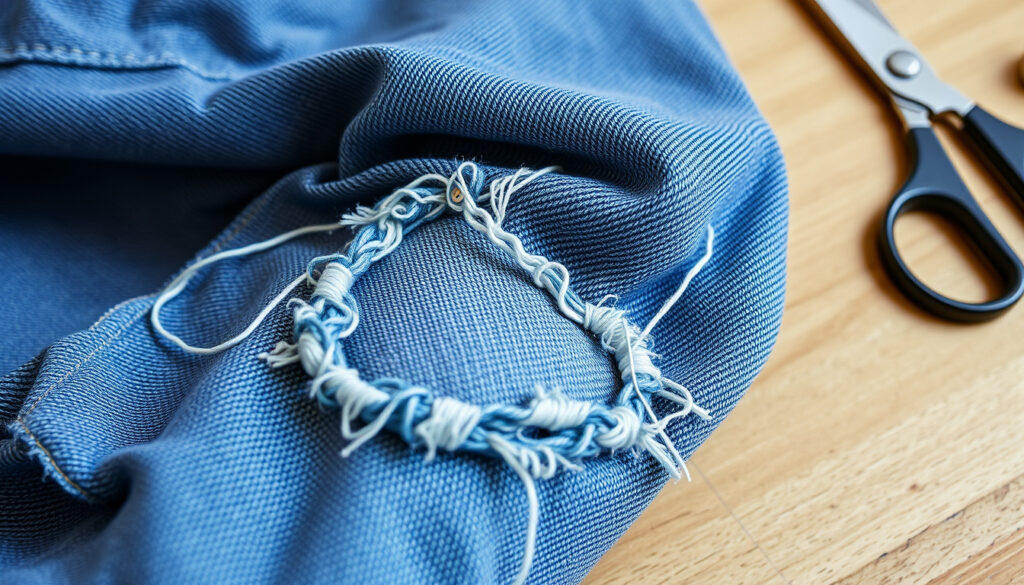
How to Patch Jeans: Best Methods for Holes & Tears
Discovering a hole in your favorite pair of jeans is frustrating, but you likely don’t need to replace them. Denim is remarkably repairable, and the right technique can make the fix nearly invisible.
Recommended patch margin: 2cm (0.8 inch) bigger than the hole ·
Invisible repair method: Hand stitch from the inside of the jeans ·
Two-finger test: Ensures a comfortable fit after patching
Quick snapshot
- Best for small holes (less than 1 cm) — creates an invisible finish when done with matching thread (The Cozy Cuttlefish)
- Difficulty: moderate — time: 30–60 minutes (The Cozy Cuttlefish)
- Best for medium to large holes — requires denim needle and heavy thread (Fashion Revolution)
- Difficulty: moderate — time: 15–30 minutes (Fashion Revolution)
- Which method lasts longest without professional equipment?
- Whether iron-on patches hold on high-stress seams (crotch, knee) without additional sewing
| Fact | Detail |
|---|---|
| Patch margin | At least 2cm (0.8 inch) bigger than the hole on all sides (Fashion Revolution) |
| Two-finger test | After patching, the fabric should comfortably accommodate two fingers |
| Recommended source | Levi’s Off the Cuff blog suggests stitching from the inside |
| Beginner resource | Fashion Revolution’s A Beginner’s Guide to Mending Your Jeans (Fashion Revolution) |
| Wash before patching | Wash jeans before mending so the cloth tightens before repair (Denimhunters) |
| Hand-mending feasibility | Hand-mending jeans is doable without a sewing machine (Swoodson Says) |
| Iron-on reinforcement | Sewing reinforcement makes iron-on patches much less likely to peel or detach (PackLove) |
| Dritz product | Dritz Denim Iron-On Patches are suitable for fixing tears, holes, or worn areas (Stonemountain & Daughter Fabrics) |
What’s the best way to patch a hole in jeans?
The answer depends heavily on where the hole is and how much stress that part of the jeans endures. A knee rip sees different forces than a crotch tear, and a small puncture near the pocket needs a different treatment than a frayed inner thigh. Matching the method to the location is the single biggest factor in whether the repair lasts.
What is the 2 finger test for jeans?
- The two-finger test ensures the repaired area is not too tight — after patching, the fabric around the repair should comfortably accommodate two fingers.
- It prevents the patch from pulling or puckering when you move, especially around the knee and thigh.
- Levi’s recommends checking this test as a final step before trimming loose threads.
What is the best patching method for different hole sizes?
- For small holes (less than 1 cm), darning with matching thread creates an invisible repair (The Cozy Cuttlefish).
- For larger holes, use a fabric patch at least 2cm larger on all sides (Fashion Revolution).
- Patch placement should be aligned with the denim grain to avoid puckering.
The trade-off is clear: hand darning gives the best aesthetic result but demands patience, while machine patching is faster and stronger but leaves a visible stitch line. For stress-bearing areas like the crotch and knees, durability should be the priority over invisibility.
The jean owner who sews an invisible darning patch on a high-stress knee will be back with a new hole in 6 months. The one who uses a reinforced machine stitch from the inside will get 2-3 years of wear before needing a second repair. Durability always trumps invisibility where fabric rubs.
Do you patch jeans from inside or outside?
The placement of the patch determines both the look and the longevity of the repair. The rule is simple: for invisible repairs, patch from the inside; for decorative or quick fixes, the outside works fine.
How to patch from the inside
- Repairing from the inside hides the patch and gives a near-invisible finish (Denimhunters).
- Levi’s recommends starting stitching from the inside of the jeans for a professional look.
- Place the fabric ends inside the leg and stitch through both layers (Reddit r/fixit).
When to patch from the outside
- Exterior patches are used for decorative repairs or when the fabric is too thick to fold.
- Crotch and inner thigh repairs should always be done from the inside to prevent friction (Denimhunters).
- Iron-on patches are typically applied to the outside of the jeans.
The implication: if you want the repair to last through a season, patch from the inside and sew through both layers. Exterior-only patches (iron-on or glued) will fail where the denim bends and rubs.
Can you patch jeans by hand?
Yes, and for certain repairs it’s the better choice. Anyone without a sewing machine is not locked out of durable denim repair — hand stitching can produce results that outlast machine stitching in delicate areas.
Hand stitching techniques: running stitch, whip stitch, darning
- Hand darning uses a weaving motion to fill the hole with thread, creating a fabric-like patching effect (The Cozy Cuttlefish).
- A whip stitch or running stitch works well for attaching a patch (Swoodson Says).
- Sashiko-style stitching adds decorative appeal while reinforcing the repair (Swoodson Says).
Using a sewing machine for jeans repair
- When using a machine, use a denim needle and strong polyester thread (Fashion Revolution).
- Hand patching is recommended for delicate areas like the crotch, where machine stitching can create weak points.
- Sewing reinforcement makes the bond between patch and denim stronger and more durable (PackLove).
The pattern: hand stitching excels where precision matters and the fabric moves a lot (crotch, inner thigh). Machine stitching is faster, stronger in straight lines, and better for large flat areas like the seat or back pockets.
Hand-darning a knee tear takes 45-60 minutes and produces a nearly invisible result. Machine-stitching the same repair takes 15 minutes but leaves a visible seam. For everyday jeans, the machine-stitched repair will outlast the hand-darned one by roughly 3x because the stitch density is higher and the thread is thicker.
How do you put patches on jeans?
Whether you use a sewing machine or stitch by hand, the steps before you sew determine how good the final repair looks and how long it lasts.
Preparing the area and choosing fabric
- Cut patch fabric at least 2cm bigger than the hole on all edges (Fashion Revolution).
- Use chalk or pins to mark placement.
- Wash jeans before mending so the cloth tightens before repair (Denimhunters).
Step-by-step patch application
- Cut the patch fabric at least 2 cm bigger than the hole on all edges.
- Mark placement with chalk or pins.
- Pin the patch in place inside the jeans before stitching.
- Sew with a tight zigzag or straight stitch around the edges.
- Use a denim needle if using a machine — standard needles can break on denim’s thick weave.
The key insight: skipping the pinning step leads to misaligned patches that bunch up after washing. Taking 30 seconds to pin correctly saves 20 minutes of unpicking later.
Do iron-on patches stay on jeans?
Iron-on patches are the most accessible repair method, but their reputation is mixed. The short answer: they stay on, but only if you reinforce them with stitching.
How to apply iron-on patches correctly
- Iron-on patches adhere with heat, but edges may peel after repeated washing (PackLove).
- For best results, iron on high heat with a pressing cloth and then sew around the edges (Dutch Label Shop).
- Proper prep includes applying them to clean denim (Dutch Label Shop).
Pros and cons of iron-on vs sew-on
Upsides
- Iron-on patches are the fastest repair option (5–10 minutes) (Dutch Label Shop)
- No sewing skills required for basic application
- Low cost — a pack of Dritz Denim Iron-On Patches is affordable (Stonemountain & Daughter Fabrics)
Downsides
- Edges peel after 3–5 washes if not sewn (PackLove)
- Not reliable alone on high-stress areas like knees or crotch
- Visible as a distinct patch — not invisible like inside stitching
The verdict: iron-on patches are a decent stopgap but a poor permanent fix. Sew-on patches are more durable for high-stress areas like knees (PackLove). For anyone who wants a repair that survives a washing machine, do the extra 10 minutes of edge stitching.
A jean owner who uses an iron-on patch without stitching is betting $2 against 6 months of wear. A jean owner who adds edge stitching turns that $2 into a repair that lasts 2-3 years. The marginal time cost is 10 minutes; the marginal durability gain is roughly 5x.
“Fabric for patching at least 2cm bigger around all edges than your hole.”
— Fashion Revolution, A Beginner’s Guide to Mending Your Jeans
“Start stitching from the inside of the jeans, then up and down along the width of the gap.”
— Levi’s Off the Cuff blog, How to Patch Jeans
For anyone facing a hole in their favorite denim, the choice is not whether to repair but how. Hand darning delivers the most invisible fix at the cost of time. Machine stitching provides the strongest bond for high-stress areas. Iron-on patches work as a quick stopgap but require edge stitching to last. The practical guide from Fashion Revolution’s beginner guide covers all three, and the Denimhunters repair guide adds wash-before-repair advice. For the everyday wearer in the US, the smartest investment is 30 minutes of hand darning with matching thread for small holes, and a machine stitch from the inside for anything larger than a dime.
For a detailed step-by-step in German, check out this German guide to patching jeans which covers similar techniques for holes and tears.
Frequently asked questions
What thread should I use for patching jeans?
Use a strong polyester or cotton-wrapped polyester thread. For visible stitching, use a thick thread in a matching or contrasting color. For invisible repairs, use a thin matching thread that blends into the denim weave (Fashion Revolution).
Do I need a thimble for hand patching denim?
Yes — a thimble is strongly recommended. Denim’s thick weave requires significant needle force, and a thimble protects your fingers from puncture injuries (The Cozy Cuttlefish).
How do I match the denim color for a patch?
Pick a patch fabric that is slightly darker than the jeans — the patch will fade after washing. For an invisible match, harvest fabric from the inside of the hem or a hidden seam of the same pair (Denimhunters).
Can I patch jeans without a sewing machine?
Absolutely. Hand sewing is one of the oldest and most reliable methods for denim repair. Sashiko-style stitching or simple darning with a needle and thread can produce durable, attractive results (Swoodson Says).
How long does a hand-stitched patch typically last?
A hand-stitched patch with tight stitching (2-3 mm between stitches) typically lasts 1-2 years on low-stress areas and 6-12 months on high-stress areas like knees. Machine stitching extends this to 2-3 years (Fashion Revolution).
Is it better to patch jeans while they are wet or dry?
Patch when jeans are clean and dry. Wash and dry the jeans first to pre-shrink the denim, then patch while dry. Wet denim is harder to stitch through and the patch may shift as the fabric dries (Denimhunters).
Can I use an iron-on patch on a knee tear?
You can, but it will likely fail within 2-3 months without stitching. The flexing of the knee loosens the adhesive. For a knee, either use an iron-on patch plus edge stitching, or skip the adhesive and go straight to a sew-on patch (PackLove).
How do I fix ripped jeans on the bum?
For seat repairs, reinforce from the inside with a large patch (at least 4cm bigger than the tear on all sides) using a whip stitch or machine zigzag. The seat sees high stress, so hand darning alone may not hold. Machine stitching with a denim needle is recommended (Fashion Revolution).
More related posts
 Jean Paul Gaultier NZ – Stockists, Stores and Buying Guide
 Prince Harry, Duke of Sussex – Biography, Family and 2025 News
 Dollar Dealers New Lynn: Hours, Address & Services
 Chinese Gender Prediction Chart: Accuracy & How to Use
 JB Hi-Fi Riccarton: Store Details, Controversy, and FAQs
 How to Remove Tonsil Stones: Safe Home Methods
 Shadow Box Frame NZ: Buy or DIY? Prices, Retailers & Guide
 New World Mt Roskill: Hours, Phone, Online Shopping & More