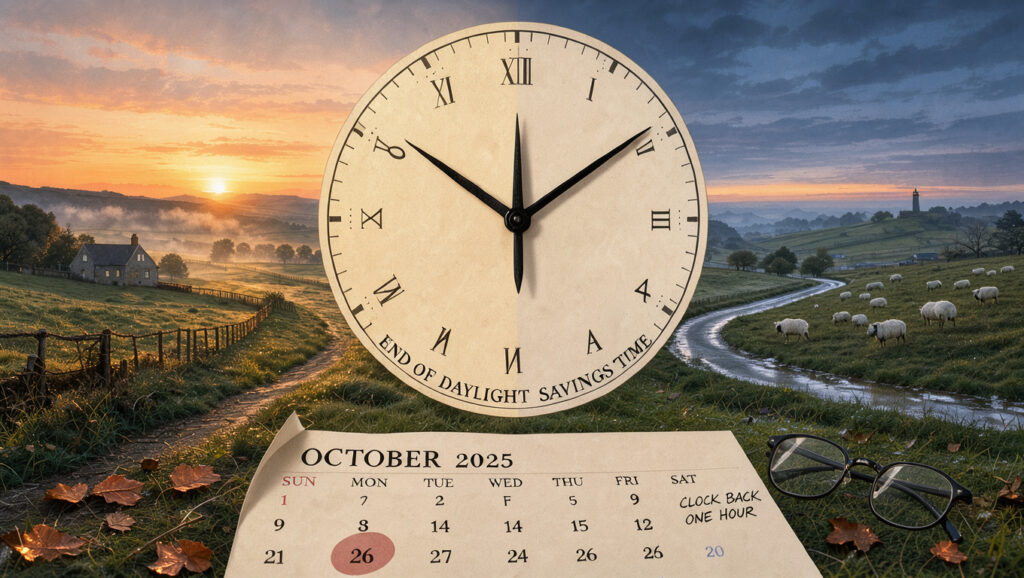
When Does Daylight Savings End? 2026 UK, Ireland and US Dates
Clocks in the UK and Ireland go back on Sunday 25 October 2026, while US clocks wait until Sunday 1 November, which leaves New York four hours behind London that week instead of five (BBC Weather (UK public broadcaster); WorldTimeData (time reference site)). The autumn change also repeats one local hour, and that second pass through 01:00 is where most people get caught out.
UK and Ireland clocks go back: Sunday 25 October 2026 (Time and Date (clock-change reference)) · US clocks fall back: Sunday 1 November 2026 (Cleveland.com (US regional newspaper)) · UK change instant: 01:00 UTC (02:00 BST to 01:00 GMT), according to WorldTimeData (time reference site) · Repeated local hour: 01:00 to 01:59 occurs twice · Clock change size: 1 hour
Quick snapshot
- UK and Ireland clocks go back on Sunday 25 October 2026, from 02:00 BST to 01:00 GMT (BBC Weather (UK public broadcaster))
- US daylight saving time ends on Sunday 1 November 2026 at 2:00 a.m. local time (Cleveland.com (US regional newspaper))
- Clocks change by one hour in the autumn (Time and Date (clock-change reference))
- Whether the US Sunshine Protection Act becomes law; SunnyTracker (clock-change tracker) reports a House vote of 308 to 117 on 14 July 2026, though the figure rests on this tracker alone
- Whether EU clock changes end; Farmers’ Almanac (almanac publisher) says the 2019 Parliament vote has not been implemented
- UK and Ireland clocks moved forward on Sunday 29 October 2026 (Time and Date (clock-change reference))
- US daylight saving time began on Sunday 8 October 2026, according to DaylightSavingTime.info (reference site)
- The UK change falls exactly seven days before the US change (WorldTimeData (time reference site))
- US daylight saving time starts again on Sunday 14 March 2027 (Palm Beach Post (US regional newspaper))
- UK and Ireland clocks go forward again on Sunday 28 October 2026, according to Stats-data.com (statistics site)
Eight dates and instants, one pattern: the UK and Ireland move first, and the US follows a week later.
| Item | Value |
|---|---|
| UK and Ireland end date (2026) | Sunday 25 October 2026, 02:00 BST to 01:00 GMT (BBC Weather (UK public broadcaster)) |
| US end date (2026) | Sunday 1 November 2026, 2:00 a.m. local time (Cleveland.com (US regional newspaper)) |
| UK change instant | 01:00 UTC, according to WorldTimeData (time reference site) |
| Repeated local hour | 01:00 to 01:59 occurs twice (Time and Date (clock-change reference)) |
| UK start date (2026) | Sunday 29 March 2026, 1:00 am to 2:00 am (Time and Date (clock-change reference)) |
| US start date (2026) | Sunday 8 March 2026, 2:00 a.m. to 3:00 a.m., according to DaylightSavingTime.info (reference site) |
| Next UK start | Sunday 28 March 2027, according to Stats-data.com (statistics site) |
| Next US start | Sunday 14 March 2027 (Palm Beach Post (US regional newspaper)) |
Do the clocks go forward or back in October?
Clocks go back in autumn, not forward
- UK and Ireland clocks go back one hour on the last Sunday in October, which is Sunday 25 October 2026 (BBC Weather (UK public broadcaster)).
- The clocks move from 02:00 BST back to 01:00 GMT (Time and Date (clock-change reference)).
- Spring runs the other way: UK clocks moved forward on 29 March 2026 (Time and Date (clock-change reference)).
The last Sunday in October for the UK and EU
- According to WorldTimeData (time reference site), EU Directive 2000/84/EC sets the autumn change on the last Sunday in October at 01:00 UTC.
- The UK keeps the same schedule, so the two sides change clocks on the same day.
The implication: a reader in Dublin, Manchester or Brussels changes clocks on the same Sunday, so the clock change is a shared European event rather than a local quirk.
Will the UK time change earlier in 2026?
The 2026 UK end date
- UK clocks return to GMT on Sunday 25 October 2026 (BBC Weather (UK public broadcaster)).
- The rule is the last Sunday in October, so the date does not move earlier in the year, according to WorldTimeData (time reference site).
Where the US date differs
- US daylight saving time ends on Sunday 1 November 2026, the first Sunday in November (Cleveland.com (US regional newspaper)).
- The US rule sits in the Uniform Time Act, which sets the change to the first Sunday in November, according to Security Boulevard (repost aggregator).
Anyone booking a call between London and New York during that week should expect a four-hour gap rather than the usual five, according to WorldTimeData (time reference site).
The catch: the one-week gap is the reason the same meeting can land at a different local hour for a short stretch in late October.
Why do the clocks go back at 2am?
The switch happens at 01:00 UTC
- The UK change happens at 01:00 UTC, which reads as 02:00 BST before the change, according to WorldTimeData (time reference site).
- Both UK and Irish sources list the switch at 2:00 a.m. local time (Time and Date (clock-change reference)).
Local clock readings at the moment of change
- Clocks go from 2:00 back to 1:00 on the night (Time and Date (clock-change reference)).
- Northern Ireland follows the same switch, from 2:00 am to 1:00 am on 25 October 2026 (Time and Date (clock-change reference, Northern Ireland)).
The implication: the switch is one instant across the UK and Ireland, so there is no staggered local rollout to plan around.
Do I get an extra hour in bed when the clocks go back?
The 01:00 to 01:59 hour repeats
- Because clocks go from 2:00 back to 1:00, the local hour from 01:00 to 01:59 happens twice on the night (Time and Date (clock-change reference)).
- The second pass through that hour is the part that catches people out on the night.
Alarms, meetings and manual clocks
- Phones and computers update automatically, according to Yahoo News (news aggregator).
- Analog wall clocks, car dashboards, microwaves and ovens typically need changing by hand, according to the same report.
A car dashboard or oven clock will still show the old time after the change, so anyone with an early flight or shift should reset those devices by hand.
The implication: the extra hour is real on paper, but the devices that do not update themselves decide whether it helps or causes a missed alarm.
Is the UK the only country that changes the clock?
Most of the EU changes clocks on the same date
- Most of Europe turns clocks back on the same day as the UK, Sunday 25 October 2026 (BBC Weather (UK public broadcaster)).
- The European Parliament voted in 2019 to abolish the seasonal clock change, but the law has not been implemented, according to Farmers’ Almanac (almanac publisher).
Countries that do not use daylight saving time
- Hawaii and most of Arizona do not observe daylight saving time, according to DaylightSavingTime.info (reference site).
- US territories including Puerto Rico, Guam, American Samoa, the US Virgin Islands and the Northern Mariana Islands also skip it, per the same reference.
- In North America the clocks go back on the first weekend of November (BBC Weather (UK public broadcaster)).
The pattern: Europe moves as one block, while North America runs on its own calendar and a separate week.
Timeline signal
- Sunday 8 March 2026: US daylight saving time began, according to DaylightSavingTime.info (reference site).
- Sunday 29 October 2026: UK and Ireland clocks moved forward from 1:00 am to 2:00 am (Time and Date (clock-change reference)).
- Sunday 25 October 2026: UK and Ireland clocks go back, reading 01:00 GMT after 02:00 BST (BBC Weather (UK public broadcaster)).
- Sunday 1 November 2026: US daylight saving time ends at 2:00 a.m. local time (Cleveland.com (US regional newspaper)).
- Sunday 14 March 2027: US daylight saving time starts again (Palm Beach Post (US regional newspaper)).
- Sunday 28 October 2026: UK and Ireland clocks go forward again, according to Stats-data.com (statistics site).
- Sunday 7 November 2027: US daylight saving time ends (Palm Beach Post (US regional newspaper)).
The pattern: the calendar repeats each year, so the two October-November changes are the ones to diarise each autumn.
Confirmed facts
- UK and Ireland clocks go back on Sunday 25 October 2026 (BBC Weather (UK public broadcaster)).
- US daylight saving time ends on Sunday 1 November 2026 (Cleveland.com (US regional newspaper)).
- The autumn change repeats one local hour (Time and Date (clock-change reference)).
What’s unclear
- Whether the Sunshine Protection Act becomes law; the bill still needed Senate approval, according to SunnyTracker (clock-change tracker).
- Whether the Navajo Nation within Arizona observes daylight saving time, a point that DaylightSavingTime.info (reference site) reports and that rests on a single low-confidence source.
- Whether the UK will end seasonal clock changes; no change has been adopted in the supplied evidence.
- Whether every EU member state follows the last-Sunday-in-October rule under Directive 2000/84/EC, a point WorldTimeData (time reference site) states without primary legal text.
The catch: most of the open questions concern future rules, so the dates in this article hold for 2026 but could change later.
What the sources say
Clocks in the UK and Ireland go back on Sunday 25 October 2026, moving from 02:00 BST to 01:00 GMT.
BBC Weather (UK public broadcaster)
The European Parliament voted in 2019 to abolish the seasonal clock change across the EU, but the law has not been implemented.
US daylight saving time starts again on Sunday 14 March 2027.
Palm Beach Post (US regional newspaper)
The pattern: the UK and Ireland dates agree across the broadcaster and reference sites cited here, while the US dates and their future rules rest mainly on newspapers and aggregators.
What’s next for the clocks
The bigger open question is whether the US keeps changing clocks at all, since the Sunshine Protection Act reportedly passed the House but has not cleared the Senate, according to SunnyTracker (clock-change tracker). For travellers and schedulers working between London, Dublin and New York, the choice is clear: put the one-week gap into the calendar before 25 October, or accept a four-hour difference with New York for that week.
Related reading: Matariki 2026 trading hours
timeanddate.com, openmaplab.com, tickward.com, timeanddate.com, timeanddate.com
Frequently asked questions
Did we gain or lose an hour?
In the autumn change, clocks go back one hour, so local time effectively gains an hour on the night (Time and Date (clock-change reference)).
Is this the end of daylight savings?
Not yet. The Sunshine Protection Act reportedly passed the US House 308 to 117 on 14 July 2026, according to SunnyTracker (clock-change tracker), but it still needs Senate approval.
What is daylight saving time and can you provide an example?
Daylight saving time moves clocks forward in spring and back in autumn. For example, UK clocks moved forward on Sunday 29 March 2026, from 1:00 am to 2:00 am (Time and Date (clock-change reference)).
What date does daylight saving start in the UK?
In 2026 it started on Sunday 29 March, and the next UK start is Sunday 28 March 2027, according to Stats-data.com (statistics site).
Does Northern Ireland change clocks on the same day?
Yes. Clocks go back on 25 October 2026 at 2:00 am, shifting to 1:00 am, as in the rest of the UK (Time and Date (clock-change reference, Northern Ireland)).
More related posts
 110 USD to NZD Live Exchange Rate: 1.7079 (187.77 NZD)
 Motor Home Hire NZ: Costs, Age Limits & Camping Rules (2025 Guide)
 Partner of New Zealander Resident Visa: Eligibility and Guide
 Staglands Wildlife Reserve Photos: Best Spots Guide
 When Does Zootopia 2 Come Out? Release Date & Streaming Info
 5 Month Old Sleep Schedule: Bedtime and Awake Windows
 Michelin Star Restaurants NZ: Guide to Fine Dining 2026
 Happy New Year Wishes: 100+ Messages and Ideas for 2026