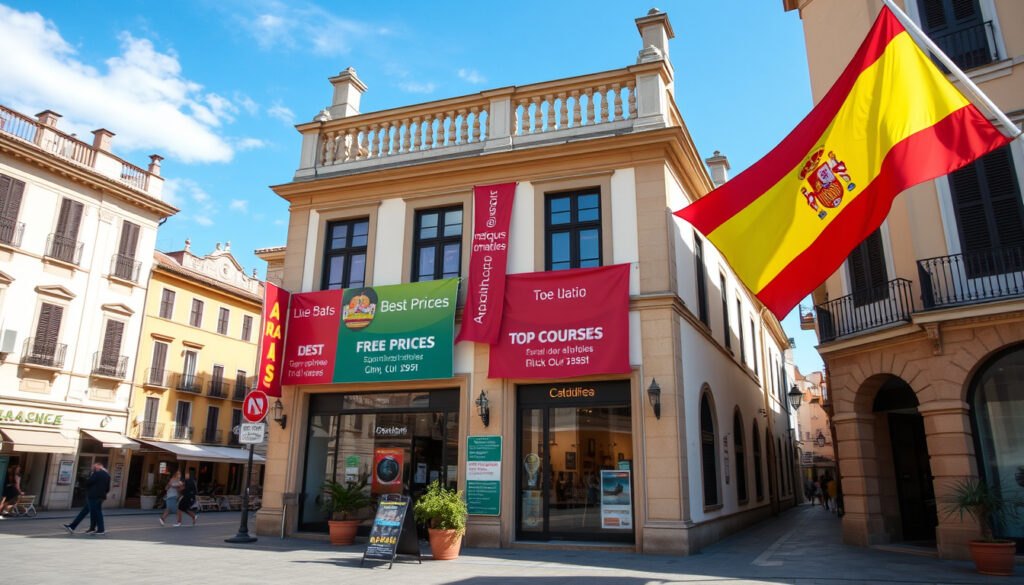
Spanish Courses in Spain: Best Prices, Free Options & Top Schools
Nothing beats learning Spanish in Spain for anyone who’s spent an afternoon wrestling with verb conjugations. Prices vary wildly — from completely free university programs to private schools charging hundreds per week — and the gap between a budget immersion and a splurge-level course isn’t always obvious. This guide cuts through the noise with current pricing, verified free options, and the locations where students consistently rate their progress highest.
Courses available: 2,106 · Cheapest weekly price: $40 · Top locations: Malaga, Salamanca · Max class size example: 10 students · Program lengths: 2 weeks to 1 year
Quick snapshot
- 2,106 courses via aggregators (Language International)
- Prices from $40 at listed schools (Language International aggregator)
- Exact 2026 prices for some university programs
- Specific free in-person options in Malaga/Salamanca beyond Madrid
- Cervantes EI Malaga founded in 1986 (Cervantes Escuela Internacional)
- University courses start each semester (Cervantes Escuela Internacional)
- Complutense free courses offered at semester start
- Courses run year-round at most schools
| Metric | Value |
|---|---|
| Total courses listed | 2,106 |
| Starting price | $40/week |
| Popular cities | Malaga, Salamanca |
| Program durations | 2 weeks to 1 year |
How much does it cost to learn Spanish in Spain?
Spanish courses in Spain span a wide price range — from genuinely free university programs to premium private schools charging over €1,000 for a single week. For most students, the real cost question isn’t just the course fee: it’s accommodation, meals, and whether you qualify for tuition-free options. According to UniSpain’s education consultant analysis, intensive university courses start from as little as 323€ for two weeks of 15 Spanish classes per week — a figure that undercuts many private language schools.
Weekly prices from top schools
Private language schools in popular destinations like Malaga and Salamanca tend to cluster between €150 and €450 per week for standard group courses. Colegio de España in Salamanca charges $410 for a Standard Group course over two weeks (20 lessons), while its Intensive option runs $440 for the same duration at 25 lessons. Cervantes Escuela Internacional in Malaga — operating since 1986 — keeps classes capped at 10 students and starts every Monday across all proficiency levels, with pricing that positions it in the mid-range category.
Factors affecting total cost
The three biggest cost variables are accommodation, lesson intensity, and program duration. Full immersion packages that bundle lodging with meals can double the weekly outlay compared to self-catering arrangements. Enforex Malaga illustrates the intensity spectrum: students can choose 10, 20, or 25 lessons weekly, with Super Intensive courses adding workshop components for those preparing for official DELE examinations.
Courses with accommodation
Many schools partner with local apartments or host families specifically to simplify logistics for international students. Language International’s aggregator database lists dozens of Malaga options that bundle housing with tuition, typically adding €80–150 per week to the course fee. For long-term stays, sharing accommodation with other students brings weekly costs down significantly.
Can I learn Spanish for free in Spain?
The short answer is yes — but free options come with eligibility strings attached. Spain’s public universities reserve their zero-cost Spanish courses primarily for incoming mobility students, while nationwide distance programs offer self-guided materials anyone can access.
Free Spanish course at Complutense University of Madrid
Complutense University of Madrid (UCM) operates the Centro Complutense para la Enseñanza del Español, which offers two free Spanish courses per semester specifically for accepted Erasmus and other mobility students. Levels covered span A1 through B2. To enroll, students must request the course in their application form, pass a level assessment, and maintain 80% attendance to receive a completion certificate.
Free options in Malaga
Fully free in-person courses in Malaga proper remain limited for non-students. However, UNHCR Spain documents free 25-hour basic Spanish courses from UNED (Cursos de Español I and II) that anyone can start anytime and complete for a certificate. GoGoEspaña also offers a free online beginner course from LAE Madrid with 30-day access — useful as a precursor before arriving in Spain.
Eligibility for international students
The pattern across Spain’s public universities is consistent: tuition-free Spanish courses require active enrollment in another degree program. University of Salamanca’s Cursos Internacionales offers paid courses year-round for all levels (2, 3, 4, 6, and 10-week durations), while its free offerings mirror UCM’s model for visiting students only. Prospective learners should confirm eligibility requirements directly with each institution before planning their budget.
What is the best place to learn Spanish in Spain?
Two cities consistently outperform on student satisfaction, price, and Spanish-language purity: Malaga on the Costa del Sol and Salamanca in the northwest heartland. Each attracts distinct learner profiles, and the choice between them often comes down to lifestyle preference as much as curriculum quality.
Top cities: Malaga, Salamanca
Cervantes Escuela Internacional in Malaga exemplifies why this city ranks among the 15 best destinations according to Language International. Founded in 1986, the school runs classes capped at 10 students with Monday start dates year-round — a flexibility that suits short-stay visitors. Malaga’s coastal location means affordable beach accommodation and an established expat infrastructure if learners need English-language backup.
Salamanca offers a fundamentally different immersion. GoStudySpain’s pricing breakdown shows university-led programs at lower price points than private schools: Monthly Intensive Courses run 3,282€ per month, while the one-term (three-month) option costs 6,016€. Salamanca’s compact historic center and large student population create a Spanish-only environment that coastal cities simply cannot match.
School reviews and accreditations
When evaluating Spanish schools, look for accreditation from the Instituto Cervantes — Spain’s official language promotion body — which certifies that institutions meet standards for teacher qualification, curriculum design, and facilities. Don Quijote Salamanca is one of the larger chains with multiple campus cities, offering private, semi-private, and specialized courses alongside conversation workshops.
Malaga suits learners prioritizing beach lifestyle and flexible scheduling. Salamanca delivers purer immersion at lower cost — but requires commitment to a city with fewer English speakers and less tourist infrastructure.
How long does it take to become fluent in Spanish?
Language learning timelines vary so dramatically that any single answer risks misleading readers. That said, the common framework cited by immersion programs suggests roughly 600–750 classroom hours to reach professional working proficiency in Spanish.
3-month fluency realistic?
Achieving conversational fluency in three months requires either prior romance-language knowledge or intensive daily study — typically 20–25 hours per week minimum. GoStudySpain documents Salamanca University’s Summer Courses at 3,611€ for one month and monthly intensives at 3,282€ — programs designed for concentrated immersion rather than casual pacing. Most learners treating Spanish study as a secondary activity while traveling or working part-time should adjust expectations to six months or longer.
80/20 rule application
Learners applying the Pareto principle to Spanish study prioritize high-frequency vocabulary and common sentence structures first — roughly 2,000 words covering 80% of daily conversations. LearningPath.org notes that MIT offers 11 free online Spanish courses including Spanish I–IV and culture topics with assignments and quizzes, serving as useful supplements to in-person instruction. Supplementing a 20-lesson-per-week course with structured online study accelerates progress without adding cost.
Intensive course timelines
A standard intensive week (20–25 lessons) translates to roughly 20–25 classroom hours. University of Salamanca’s Cursos Internacionales offers 2, 3, 4, 6, and 10-week programs year-round, while Santiago de Compostela University runs 2-week summer intensives at 328€ for 20 lessons per week — positioning university programs as cost-effective alternatives to private schools for learners with fixed schedules.
The most realistic fluency timeline for most adult learners: 6–12 months of consistent study in Spain to reach B1–B2 level, with significant acceleration possible through 80/20 prioritization and daily immersion outside class.
Types of Spanish courses in Spain
Spain’s language education market breaks down into three main tiers: private language schools, public university programs, and online or hybrid options. Each tier serves different learner needs — from casual tourists to degree-seeking international students.
For adults and international students
Most private schools structure offerings around adult learners, with Language International listing Malaga options that include evening classes on Tuesdays and Thursdays (7–9pm) alongside intensive morning tracks starting Mondays. University programs like those at Complutense University of Madrid primarily target enrolled students but accept external applicants for paid courses.
Short vs long-term
Short courses (2–8 weeks) dominate the private school market and suit tourists or business visitors wanting conversational skills without long commitment. Colegio de España’s beginner start dates demonstrate typical flexibility: intakes roughly monthly from January through November. Long-term programs (3 months to a full academic year) appeal to serious learners — including university term courses at 6,016€ for three months at University of Salamanca or semester packages from Complutenses starting at 1,155€ for 12 lessons weekly.
1-year programs
For learners committing to a full year, the economics improve significantly. Most schools offer 10%–20% discounts on long-term bookings, and Estudia-España’s broker model shares commission with students to undercut direct booking prices. Combined with off-season accommodation (October–April), a full year in Spain including courses and shared housing runs roughly €8,000–15,000 depending on city and lifestyle.
Spanish course comparison
Four programs, two cities, three pricing tiers — the table below consolidates real options for learners evaluating where and how to study.
| School / Program | Location | Duration | Price | Lessons/Week |
|---|---|---|---|---|
| Cervantes Escuela Internacional | Malaga | Week to year | Mid-range | Flexible |
| Colegio de España Standard | Salamanca | 2 weeks | $410 | 20 |
| Colegio de España Intensive | Salamanca | 2 weeks | $440 | 25 |
| Complutense University (2-week intensive) | Madrid | 2 weeks | 323€ | 15 |
| Complutense University (full term) | Madrid | Semester | 1,155€ | 12 |
| Santiago Compostela Summer Intensive | Santiago de Compostela | 2 weeks | 328€ | 20 |
| University of Salamanca Monthly Intensive | Salamanca | 1 month | 3,282€ | Flexible |
The pattern across these programs: university courses offer the best hourly value but require longer commitments or semester enrollment, while private schools charge premiums for flexibility and smaller classes.
Pros and cons of Spanish courses in Spain
Upsides
- Genuine immersion accelerates vocabulary and accent acquisition beyond classroom-only study
- 2,106 courses listed through aggregators means price transparency and competitive options
- Free university programs for Erasmus students eliminate tuition cost entirely
- Year-round starts at most private schools accommodate tight travel schedules
- Small class sizes (10 students max at Cervantes EI) ensure personalized attention
Downsides
- Accommodation costs in coastal Malaga rival or exceed course fees for short stays
- Free programs require university enrollment — not accessible to independent tourists
- Some 2026 prices remain unconfirmed due to older source data for university programs
- Short courses (under 4 weeks) rarely produce lasting fluency without follow-up study
- Limited English infrastructure in Salamanca requires stronger commitment to Spanish-only immersion
How to choose a Spanish course in Spain
Choosing the right program means matching your budget, timeline, and immersion preference — not simply picking the cheapest or highest-rated option.
- Define your primary goal. Conversational fluency for travel differs from DELE exam preparation or academic Spanish. Schools like Enforex Malaga offer specialized tracks; university programs lean toward academic rigor.
- Calculate total cost including accommodation. A $200/week course looks attractive until you add €500/week for housing in Malaga. University towns like Salamanca offer lower living costs alongside quality instruction.
- Verify start date flexibility. Private schools (Cervantes EI, Enforex, Don Quijote) start weekly; university programs typically align with academic semesters. Mismatched timing wastes money on waiting periods.
- Check class size caps. Cervantes EI limits classes to 10 students — a meaningful differentiator for learners wanting speaking practice. Larger chain schools may run 12–15 per class.
- Confirm accreditation. Instituto Cervantes certification ensures teacher qualifications, curriculum standards, and facilities meet official benchmarks.
Learners choosing Malaga for its flexibility and beach lifestyle pay a daily premium that learners in Salamanca avoid — but only if they can sustain immersion without the English-language support infrastructure that coastal cities provide.
What we know — and what remains unclear
Given low research confidence for current pricing data, transparency about confirmed facts versus open questions helps readers calibrate their own research.
Confirmed
- 2,106 Spanish courses listed through aggregators across Spain
- Prices from $40/week at listed private schools
- Complutense University of Madrid offers free Spanish courses (A1–B2) for Erasmus mobility students requiring 80% attendance
- Cervantes EI Malaga operates since 1986 with classes capped at 10 students, starting every Monday
- UNED offers free 25-hour self-guided basic Spanish courses open to anyone
- University of Salamanca 3-month term course priced at 6,016€
- Colegio de España Salamanca charges $410 for a 2-week Standard Group course (20 lessons)
Unclear
- Current 2026 prices for Salamanca University courses (source data older)
- Specific free in-person course options in Malaga or Salamanca for non-university students
- Exact pricing for Cervantes EI and Enforex Malaga beyond aggregator estimates
- Scholarship application deadlines and eligibility criteria for international learners
Readers should verify current pricing directly with schools before committing funds — particularly for university programs where 2026 rates may have shifted from documented figures.
What people are saying
Incoming mobility students who wish to improve their level of Spanish during their stay at the Complutense University can enrol in one of the two free courses offered.
Complutense University of Madrid (Official University Site)
Intensive courses start from as little as 323€ (£274 or $419) for a two-week intensive course containing 15 Spanish classes per week.
UniSpain Blog (Education Consultant Analysis)
Founded in 1986, Cervantes Escuela Internacional has almost 40 years of experience in teaching Spanish as a Foreign Language.
Cervantes Escuela Internacional (School Information)
Summary
Spanish courses in Spain range from completely free (for Erasmus students at Complutense and UNED self-learners) to €450 per week for small-group immersion in Malaga. The 2,106 programs listed through aggregators cover every duration, intensity level, and price point — but navigating those options requires matching your eligibility, timeline, and immersion preference before committing. For learners who qualify, Spain’s public university system delivers genuine value; for everyone else, private schools with flexible weekly starts offer the most accessible entry point, provided you account for accommodation costs that often exceed tuition. Salamanca’s university programs remain the strongest case for budget-focused learners who can commit to three months or longer, while Malaga’s established expat infrastructure makes short stays practical despite higher daily costs.
Related reading: Cheapest school fees and enrollment options
Frequently asked questions
What are Spanish courses in Spain for adults?
Most private language schools in Spain cater specifically to adult learners, with programs ranging from casual conversation workshops to intensive exam preparation. Cervantes EI, Enforex, and Don Quijote represent the largest chains, while university programs at Salamanca, Complutense, and Santiago de Compostela serve both enrolled students and external enrollees for additional fees. Prices start around $40/week for basic group courses through aggregators, with premium options running €200–450 depending on class size and lesson intensity.
Do Spanish courses in Spain include accommodation?
Many private schools offer accommodation packages bundling lodging with tuition — typically through partnered apartments, host families, or residence halls. Language International and similar aggregators filter for “with accommodation” options, adding roughly €80–150 per week to the course fee. University programs generally do not include housing, though Salamanca’s student-centric infrastructure offers affordable shared apartments at €300–500 per month.
What is the 80/20 rule for Spanish?
The Pareto principle applied to Spanish learning prioritizes the roughly 2,000 most frequent vocabulary items and common sentence patterns — the core that covers 80% of daily conversations. Learners using this approach focus on high-utility words first before expanding to specialized vocabulary. MIT’s free online Spanish courses (11 available through LearningPath) provide structured progression that aligns with 80/20 methodology, serving as effective supplements to in-person immersion programs.
Are there free Spanish courses in Malaga?
Fully free in-person courses in Malaga for non-university students remain rare. The most accessible genuinely free option is UNED’s 25-hour self-guided basic course (Spanish I and II), documented by UNHCR Spain, which anyone can start and complete for a certificate. Completing this before or alongside an in-person program reduces the cost of paid instruction by providing foundational vocabulary and grammar before attending a more intensive school.
What are long-term Spanish courses in Spain?
Programs lasting three months to a full academic year deliver the best per-week pricing and deepest immersion depth. University of Salamanca offers a 3-month term at 6,016€ (roughly €67 per day), while monthly intensives run 3,282€ per month. Private schools typically discount 10–20% for bookings of eight weeks or longer. For learners committing to a full year, combined course-and-housing packages from brokers like Estudia-España can reduce costs below direct booking prices.
What are short Spanish courses in Spain?
Short courses lasting two to eight weeks dominate the private school market and suit tourists, business travelers, or anyone testing immersion before committing long-term. Colegio de España Salamanca exemplifies the model: $410 for a Standard Group 2-week course (20 lessons) with roughly monthly intake dates. Cervantes EI in Malaga starts every Monday, providing maximum scheduling flexibility. Short courses rarely produce lasting fluency without follow-up study but effectively build conversational confidence for travelers.
How to choose a Spanish school in Spain?
Evaluate schools by class size caps (Cervantes EI limits 10 students), accreditation (Instituto Cervantes certification), start date flexibility (weekly vs. semester), and total cost including accommodation. Malaga suits learners prioritizing flexibility and lifestyle; Salamanca delivers purer immersion at lower cost. University programs offer the best hourly value for committed learners but require longer commitments or semester enrollment. Verify current pricing directly with schools before booking — particularly for university programs where 2026 rates may differ from documented figures.
More related posts
 Renew Your NZ Driver Licence Online? In-Person Process & Costs
 Southern Cross Easy-Claim: How to Claim & Find Providers
 Rugby This Weekend NZ – Fixtures Times Teams and Streams
 Doc (2025 TV Series) Episodes: Season 2 & Release Dates
 Latest Ukraine War News: Russia’s Army Losses & Ukraine’s Forces
 The Good Oil NZ: Health, Cardiologist Tips & Where to Buy
 The Silence of the Lambs: Plot, Real Killers, Oscar Wins
 Contact Energy co nz: How to Contact, Cheapest Plans & More