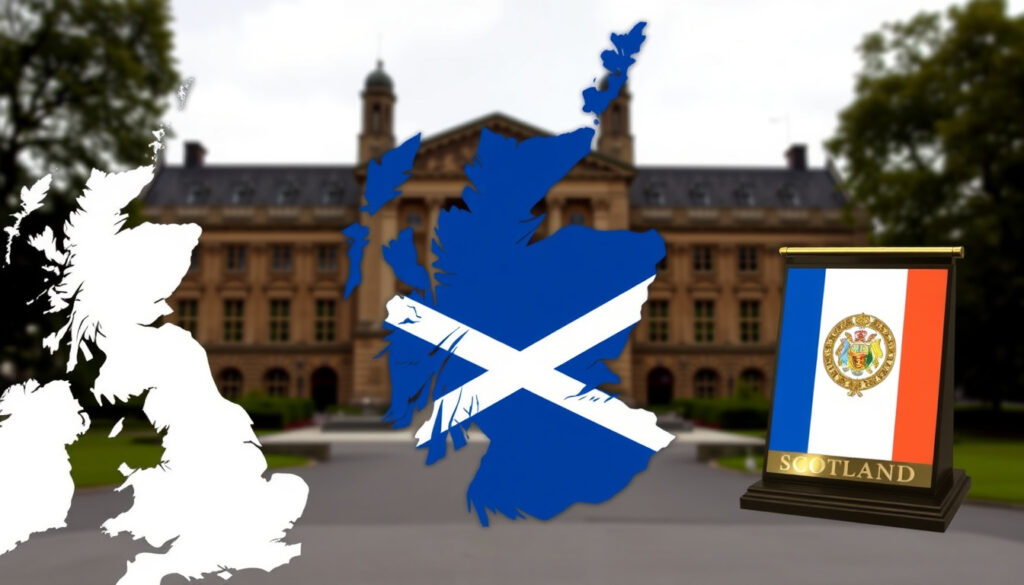
Is Scotland a Country? Legal Status & International Recognition
If you’ve ever tried to answer the simple question “Is Scotland a country?” you’ve probably run into a surprising amount of confusion. The answer depends on which definition you use — legal, political, or cultural. This article breaks down Scotland’s status across all those lenses, with concrete sources and a clear comparison.
Population: 5.4 million (est. 2024) · Land area: 78,387 km² (part of UK) · UN member status: No (UK is member) · UNESCO member status: No (represented by UK) · Own legal system: Scots law (retained 1707) · Own parliament: Scottish Parliament (re-established 1999)
Quick snapshot
- Scotland is a country within the United Kingdom (Scottish Government (official government site))
- Scotland has its own legal and education systems (Scottish Government)
- Scotland is not a UN member state (United Nations (UN Member States))
- Whether Scotland’s country status will lead to full independence
- Future relationship with the EU post-Brexit
- 1707: Acts of Union joined Scotland and England into the Kingdom of Great Britain
- 1999: Scottish Parliament re-established after a referendum
- Any future independence referendum requires Westminster’s consent (UK Supreme Court (judgment on competence))
Six key facts, one pattern: Scotland meets the ordinary definition of a country but not the international-law definition of a sovereign state.
| Fact | Value |
|---|---|
| Official name | Scotland (Alba) |
| Capital city | Edinburgh |
| Population (mid-2024) | 5,490,000 |
| Land area | 78,387 km² |
| Official flag | Saltire (St Andrew’s Cross) |
| Patron saint | St Andrew (30 November) |
Is Scotland a Country or Is the UK a Country?
What makes a country a country?
There is no single global authority that decides Montevideo Convention (treaty defining statehood criteria). That 1933 treaty lists a permanent population, defined territory, government, and capacity to enter relations with other states as the hallmarks of a sovereign state. Scotland ticks the first three boxes but not the fourth: the UK conducts foreign relations on its behalf, and the UK, not Scotland, is the entity listed at the United Nations.
- Scotland has a permanent population and defined territory.
- Scotland has its own government and parliament.
- Scotland does not independently enter relations with other states.
How does Scotland fit the definition of a country?
The question turns on the difference between “country” (a cultural, geographical, and historical unit) and “sovereign state” (the legal entity recognised internationally). The Scottish Government (official government site) explicitly calls Scotland “a country in a voluntary union of nations.” The UK government also refers to Scotland as a country in official documents. In everyday language and cultural identity, Scotland is clearly a country. In international law, it is a constituent country of the sovereign state known as the United Kingdom.
Scotland is simultaneously a country (by ordinary definition) and not a country (by the strict legal definition used at the UN). The tension isn’t confusion — it’s different definitions serving different purposes.
Bottom line: Scotland is a country in the ordinary sense, but not a sovereign state in international law. For identity and day-to-day life, calling Scotland a country is accurate. For diplomacy and UN membership, the UK is the state.
Why Is Scotland Not Recognised as a Country by the UN?
What is the difference between a country and a sovereign state?
A sovereign state possesses full independence and the ability to enter into treaties, join international organisations, and be recognised by other states. Countries can be part of a sovereign state. The United Nations (UN Member States list) shows the UK as a member; Scotland is not separately listed. That is because UN membership is reserved for sovereign states.
- The UK is a sovereign state under international law and a UN member.
- Scotland is a constituent country of that sovereign state.
- UN General Assembly Resolution 1514 (XV) affirms the right to self-determination, but that applies to non-self-governing territories, not to Scotland, which is voluntarily part of the UK (United Nations General Assembly Resolution 1514 (XV)).
Can a non-sovereign country be a member of the UN?
No. UN Charter Article 3 opens membership to “peace-loving states.” Non-sovereign entities like constituent countries are not eligible. The United Nations (full list of Member States) therefore includes the UK but not Scotland, Wales, or Northern Ireland.
For a constituent country like Scotland to join the UN, it would need to become a sovereign state — either through independence or by some other change in its constitutional status.
Is Scotland Legally a Country?
What does UK law say about Scotland’s status?
Under UK constitutional law, Scotland is a country that voluntarily entered the Union. The Scottish Government (official government site) states: “Scotland is a nation and voluntarily entered into Union with England as a partner and not as a dependency.” The Scotland Act 1998 and the Scotland Act 2016 devolved a wide range of powers to the Scottish Parliament, but sovereignty (ultimate legal authority) remains with the UK Parliament at Westminster.
“Scotland is a nation and voluntarily entered into Union with England as a partner and not as a dependency.”
— Scottish Government publication, Scottish Government
Does Scotland have its own legal system?
Yes. Scotland has retained its own legal system (Scots law) separate from England and Wales since the 1707 Acts of Union. This is a key indicator of its status as a country, even within the UK. The UK legislation (Scotland Act 1998) recognises the continued operation of Scots law.
- Scots law is distinct from English and Northern Irish law.
- Scotland has its own courts: the Court of Session (civil) and the High Court of Justiciary (criminal).
- The Scotland Act 1998 received Royal Assent on 19 November 1998.
“The Scottish Parliament cannot legislate for a referendum on independence without Westminster’s consent.”
— UK Supreme Court, judgment in Reference by the Lord Advocate (UKSC 2022/0098, 23 November 2022), UK Supreme Court (judgment on competence)
Six comparisons, one pattern: Scotland is a country in domestic law and everyday speech, but not a sovereign state in international law.
| Criterion | Scotland | UK (sovereign state) |
|---|---|---|
| Ordinary “country” status | Yes | Yes |
| UN membership | No | Yes |
| Own legal system | Yes (Scots law) | Mixed (multiple systems) |
| Control over foreign affairs | No (Westminster) | Yes |
| Seat at international organisations | No (except in some sports) | Yes |
| Monetary sovereignty | No (Bank of England) | Yes |
Is Scotland Considered a Country by International Bodies?
Does the EU treat Scotland as a region or a country?
The European Union treats Scotland as a region within the UK for trade and political representation. After Brexit, Scotland is no longer in the EU. Yet during the pre-2016 period, Scotland had its own regional seat on EU committees and could apply for structural funds — a status reflecting its regional character, not country-level recognition.
How do international sports organisations see Scotland?
Scotland competes as a separate team in FIFA, the Commonwealth Games, the Six Nations (rugby), and many other international competitions. This is one of the most visible signs of Scottish countryhood. The United Nations (UN Member States) does not grant that privilege, but sports federations use their own definitions, often based on historical and cultural identity.
Scotland’s separate sports teams reinforce its country identity, but they have no bearing on its legal status or UN recognition. The two systems — sports and international law — operate under different rules.
Frequently asked questions
Can I call Scotland a country?
Yes. In ordinary language, Scotland is widely called a country. The Scottish Government itself uses that term. However, if you mean “sovereign state,” that applies to the UK, not Scotland alone.
Is Scotland a country or a state?
Scotland is a country but not a sovereign state. A state typically has full independence and UN membership. Scotland has its own identity and legal system but is part of the UK sovereign state.
Is Scotland a country or part of England?
Scotland is a separate country, not part of England. It is part of the United Kingdom, which also includes England, Wales, and Northern Ireland. The two are distinct entities within the same sovereign state.
Does the UN recognise Scotland as a country?
No. The UN does not list Scotland as a member state. Only the United Kingdom is a member. The UN’s list of Member States contains no constituent countries.
How is Scotland a country if the UK is also a country?
The term “country” can be used at two levels: Scotland is a constituent country, and the UK is a sovereign state. Both are commonly called countries in different contexts. For example, the UK is a “country” in the sense of being a sovereign state; Scotland is a “country” in the sense of being a historic nation with its own identity.
What is the difference between a country and a sovereign state?
A country is a geographic and cultural unit. A sovereign state is a legally independent entity with full authority over its affairs and the capacity to enter into international relations. Not all countries are sovereign states — Scotland, Wales, and England are examples of non-sovereign countries within the UK.
Scotland’s status as a country is clear in everyday language and cultural identity, but it falls short of sovereign statehood. For Scots, the UK, and the international community, the distinction matters: it affects passports, embassies, UN seats, and the ability to sign treaties. The choice for readers is straightforward: use “country” for Scotland in informal contexts, but remember that when you ask “Is Scotland a country?” the answer is yes only if you don’t mean a sovereign state.
More related posts
 FIFO Jobs NZ to Australia: A Guide for Kiwis
 Cooks Garden Motor Lodge: Reviews, Prices, Location
 Ride On Lawn Mowers 2026: Best Brands & Reliability
 How to Make Money Online NZ – 10 Proven Ways for Kiwis
 NZD to Samoan Tala: Convert New Zealand Dollars to WST
 Driving Range Lower Hutt: Prices, Bays & Tips
 Grow a Garden Script 2026: Get It Safely Without Getting Banned
 Nilavuku En Mel Ennadi Kobam: Meaning, OTT & Review