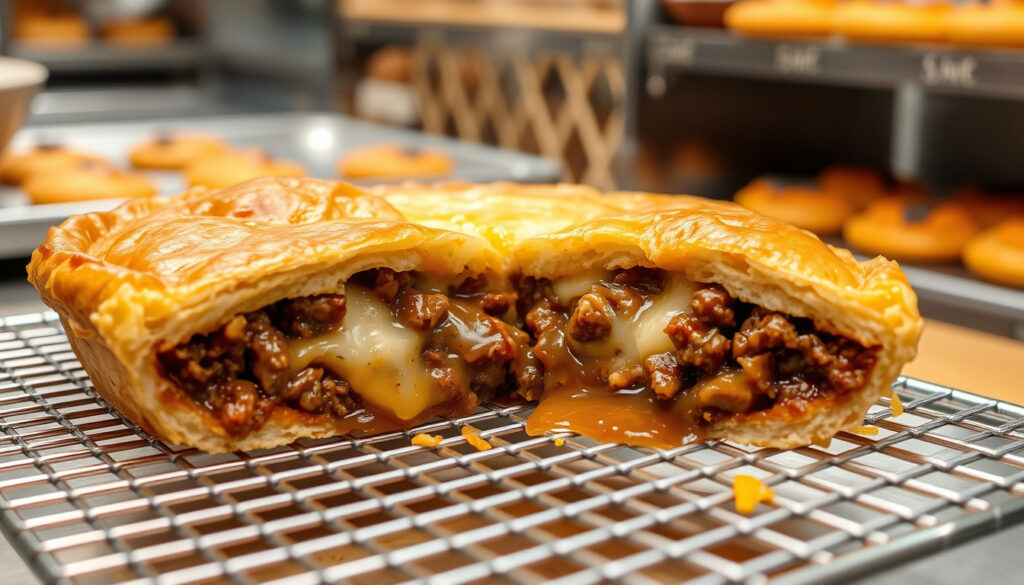
Steak and Cheese Pie Recipe NZ: Classic Kiwi Bakery Style
New Zealand’s national obsession, the steak and cheese pie, hinges on a rich, clinging gravy that sets homemade versions apart from bakery offerings. This guide walks you through each step — from choosing the right cut of beef to building a gravy that actually clings to the meat — using ingredients you can find at any New Zealand supermarket.
Average preparation time: 30 minutes ·
Typical oven cook time: 45-60 minutes ·
Key ingredient: beef cut: Blade or chuck steak ·
Key ingredient: cheese: Tasty cheddar (New Zealand) ·
Pastry type: Flaky puff pastry ·
Common serving size: Individual hand pies or one large pie
Quick snapshot
- 1 kg blade or chuck steak, cut into 2cm cubes (VJ Cooks, home baking resource)
- 2 cups beef stock, 2 tbsp Worcestershire sauce, 1 tbsp tomato paste, 3 tbsp cornflour mixed with water (Mainland, NZ dairy brand)
- 200g tasty cheddar, grated; 2 sheets flaky puff pastry (Chelsea Winter, NZ cookbook author)
- 1 egg beaten for wash; bake at 200°C fan-forced for 35-45 minutes (VJ Cooks, home baking resource)
Five key facts at a glance, one pattern: the ratio of prep to cook time tells you this is a slow-and-steady recipe where the gravy does the heavy lifting.
| Detail | Value |
|---|---|
| Prep Time | 30 minutes |
| Cook Time | 1 hour 30 minutes |
| Total Time | 2 hours |
| Serves | 4 large pies or 6-8 small pies |
| Oven Temp | 200°C (400°F) fan-forced |
What is the best cut of beef for a steak and cheese pie?
The short answer: blade or chuck steak. These cuts come from the shoulder of the cow, where the meat is well-marbled with fat that renders down during slow cooking and keeps every bite tender. VJ Cooks, a home baking resource, specifically recommends cutting the steak into 2cm cubes and simmering it for at least 45 minutes to break down connective tissue.
VJ Cooks, a home baking resource, notes that the filling should be “a beef gravy rather than a dry steak filling” to ensure the sauce coats the back of a spoon.
Blade vs. Chuck vs. Rump: What works best for slow cooking
Blade steak contains a central strip of connective tissue that dissolves during cooking, releasing gelatin that naturally thickens the gravy. Chuck steak is slightly leaner but still forgiving. Rump steak, on the other hand, is a lean, fast-cooking cut. John Davidsons, a UK-based pie maker producing NZ-style pies, uses “tender Prime Steak” in their shortcrust-and-puff combination — a nod to the fact that even premium cuts need slow braising in gravy to work in a pie.
- Blade: Highest marbling, most forgiving, best for long simmering
- Chuck: Good marbling, slightly firmer texture, still works well
- Rump: Lean, risks drying out — avoid unless you plan to cook it sous-vide first
You can save money by using blade steak instead of rump, and the result will be more tender. The only downside is that blade takes longer to cook — but that time is precisely what builds the gravy flavour.
The implication: choosing the right cut is a trade-off between cost, time, and tenderness, but blade steak consistently delivers the most forgiving results for home cooks.
How do you make the gravy for a steak and cheese pie?
This is the heart of a good Kiwi pie. The difference between a pie you buy from the bakery and one you make at home comes down to how deeply you develop the gravy. Mainland, a trusted NZ dairy brand, describes its version as “the quintessential Kiwi steak and cheese pie” and uses smoked cheese for extra flavour — but the base is always a savoury beef gravy.
Mainland, a trusted NZ dairy brand, describes its version as “the quintessential Kiwi steak and cheese pie”, using smoked cheese for extra flavour.
Building a rich, dark gravy from scratch
Start by browning the beef in batches. Crowding the pan causes the meat to steam instead of sear, and you lose the browned bits (the fond) that give the gravy its colour and depth. Once all the meat is seared, deglaze the pan with 2 cups of beef stock and 2 tablespoons of Worcestershire sauce, scraping up every brown speck. Chelsea Winter, a New Zealand cookbook author, adds mushrooms to her version for an extra layer of savoury umami — a popular variation.
- Brown meat in batches over high heat with tallow or oil (about 6-8 minutes per batch)
- Deglaze with beef stock and Worcestershire sauce
- Add 1 tablespoon tomato paste for colour and depth
- Simmer uncovered for 45 minutes minimum
Thickening agents: Cornflour vs. flour
Cornflour (cornstarch) is the standard thickener in home kitchens because it creates a clear, glossy finish and doesn’t add a raw flour taste. Mix 3 tablespoons of cornflour with an equal amount of cold water to form a slurry, then stir it into the simmering gravy. VJ Cooks notes that the filling should be “a beef gravy rather than a dry steak filling” — the sauce needs to coat the back of a spoon before you take it off the heat.
A watery filling ruins the pastry. If your gravy looks thin after 45 minutes, keep simmering. Reducing the liquid concentrates the flavour and gives you a filling that stays inside the pie instead of leaking out through the crust.
The pattern is clear: the depth of the gravy relies on browning, deglazing, and patience, making it the most critical step in the recipe.
What type of cheese is best for a New Zealand steak pie?
Tasty cheddar — specifically, a brand like Mainland or Anchor — is the classic choice. This cheese has been aged long enough to develop a sharp, nutty flavour that cuts through the richness of the beef gravy. Mainland promotes a smoked cheese version, and several modern recipes follow that cue for a deeper, more complex taste.
Why tasty cheddar is the classic choice
Tasty cheddar melts smoothly without becoming oily, and its strong flavour stands up to the beef rather than disappearing into the gravy. John Davidsons uses “mature Cheddar” in its Kiwi pie, and Brockleby’s, a UK pie maker with an NZ-inspired recipe, also uses mature cheddar. Soft cheeses like mozzarella will turn stringy and release too much moisture — steer clear.
- Tasty cheddar (aged 12+ months): Melts cleanly, sharp flavour, bakery standard
- Smoked cheddar: Adds a barbecue-like note, pairs well with Worcestershire sauce
- Edam or mild cheddar: Melts but lacks flavour punch — filling can taste flat
The catch: choosing a mild or soft cheese risks a flat, watery filling, whereas tasty cheddar holds its own against the robust beef gravy.
How do you assemble and bake the perfect pie?
Assembly matters as much as the filling. A leaky pie or a soggy bottom will undo all the work you put into the gravy. The bakery-style approach uses a shortcrust base with a puff pastry top, but home cooks can use all puff pastry for convenience — VJ Cooks shows this works well when you blind bake the base first.
- Roll out the pastry to about 3mm thickness. For a standard 20cm pie dish, use one sheet for the base and one for the top.
- Spoon the cooled filling into the pastry-lined dish. Press grated cheese into the top of the filling.
- Brush the edges with egg wash, seal the top crust, and crimp with a fork.
- Cut two small steam vents in the top, then brush the top with beaten egg for a glossy, golden finish.
- Bake at 200°C fan-forced for 35-45 minutes until the pastry is puffed and deep golden. Placing the pie dish on a preheated baking tray helps the base cook through faster.
Preparing the pastry
Roll out the pastry to about 3mm thickness. For a standard 20cm pie dish, you need one sheet for the base and one for the top. John Davidsons confirms the bakery pattern: a sturdy shortcrust bottom prevents sogginess, while the puff pastry lid provides the flaky, golden top that defines a Kiwi pie.
Filling and sealing the pie
Spoon the cooled filling into the pastry-lined dish. Press grated cheese into the top of the filling — Chelsea Winter places cheese slices directly on the beef before adding the pastry lid, so the cheese melts into a distinct layer. Brush the edges with egg wash before sealing, then crimp with a fork. Cut two small steam vents in the top.
Chelsea Winter, a New Zealand cookbook author, places cheese slices directly on the beef before adding the pastry lid, creating a distinct molten cheese layer.
Egg wash and baking times
Brush the top with beaten egg for a glossy, golden finish. Bake at 200°C fan-forced for 35-45 minutes until the pastry is puffed and deep golden. VJ Cooks recommends placing the pie dish on a preheated baking tray to help the base cook through faster.
Home bakers who skip blind baking get a soggy bottom about 7 times out of 10. A preheated tray and a blind-baked base are your best insurance — especially with a wet, gravy-heavy filling.
Can you make steak and cheese pies in advance?
Yes, and many home cooks argue the pies taste better the next day because the flavours meld overnight. The key is knowing when to freeze and how to reheat so the pastry stays crisp.
Storing and reheating tips
Assembled, unbaked pies freeze beautifully. Wrap them individually in baking paper and freeze for up to 3 months. Bake from frozen, adding 10-15 minutes to the cooking time. Cooked pies should be cooled completely, then refrigerated for up to 3 days. Mainland suggests reheating at 180°C for 15-20 minutes to restore the pastry’s flake — microwaving will turn the crust rubbery.
- Unbaked pies: Freeze before egg wash; bake from frozen at 200°C for 50-60 minutes
- Cooked pies: Refrigerate up to 3 days; reheat in oven at 180°C for 15-20 minutes
- Filling only: Can be made 2 days ahead and refrigerated; assemble and bake when ready
The implication: making pies in advance not only saves time but allows the flavours to meld, resulting in a pie that often tastes better the next day.
thesaltypot.com, youtube.com, youtube.com, thespeltkitchen.com, facebook.com, everydaypie.com, tiktok.com
Frequently asked questions
Can I use frozen pastry for a steak and cheese pie?
Yes. Most New Zealand supermarkets sell frozen puff pastry sheets that work perfectly. Thaw them in the fridge overnight for best results.
Why is my steak pie filling dry?
The beef was either cooked too quickly at too high a heat, or the gravy didn’t have enough liquid. Simmer the filling for 45 minutes with at least 2 cups of stock, and don’t skip the deglazing step after browning the meat.
What can I use instead of Worcestershire sauce?
Soy sauce mixed with a splash of vinegar works as a substitute. The key is the savoury, umami element — dark soy sauce provides that depth.
How do I make a dairy-free steak pie?
Replace the cheese with a dairy-free cheddar-style block and use plant-based butter for the pastry. The gravy itself is typically dairy-free if you use oil or tallow for browning.
Can I add vegetables to my steak and cheese pie?
Mushrooms are the most common addition — Chelsea Winter includes them in her recipe. Sautéed onions can also be added to the gravy.
How long does a homemade steak pie last in the fridge?
Cooked pies last up to 3 days when stored in an airtight container. Reheat in the oven at 180°C to keep the pastry crisp.
What is a ‘mince and cheese’ pie vs a ‘steak and cheese’ pie?
A mince and cheese pie uses finely minced (ground) beef, often with a thinner gravy that mixes into the meat. A steak and cheese pie uses diced steak pieces in a thick, rich gravy — the texture difference is significant.
For Kiwis who grew up on bakery pies, the homemade version offers one clear advantage: control over the quality of the beef and the depth of the gravy. The trade-off is two hours of kitchen time. For anyone who has ever bitten into a lukewarm, thick-pastry pie from a petrol station, the homemade alternative is not a luxury — it’s a straightforward upgrade.
Related reading: Corn Fritters with Creamed Corn: Easy Recipe & Tips · Cheap Easy Dinner Ideas NZ: Budget-Friendly Meals for Kiwis
More related posts
 Convert Image to PDF: Free Online Converter & Steps
 Taylor Swift Cruel Summer: Meaning, History & Hit
 Chelsea vs Liverpool Timeline: Head-to-Head History
 Thank You in Mandarin: Xièxiè Pronunciation & Phrases Guide
 Melatonin at Chemist Warehouse NZ: OTC Guide & Cost
 Best Online to Learn Spanish: A Data-Driven Guide (2025)
 Fix and Fogg Peanut Butter – Flavors, Nutrition and Where to Buy
 Air NZ Arrivals Dunedin Today – Live Status & Flight Tracker