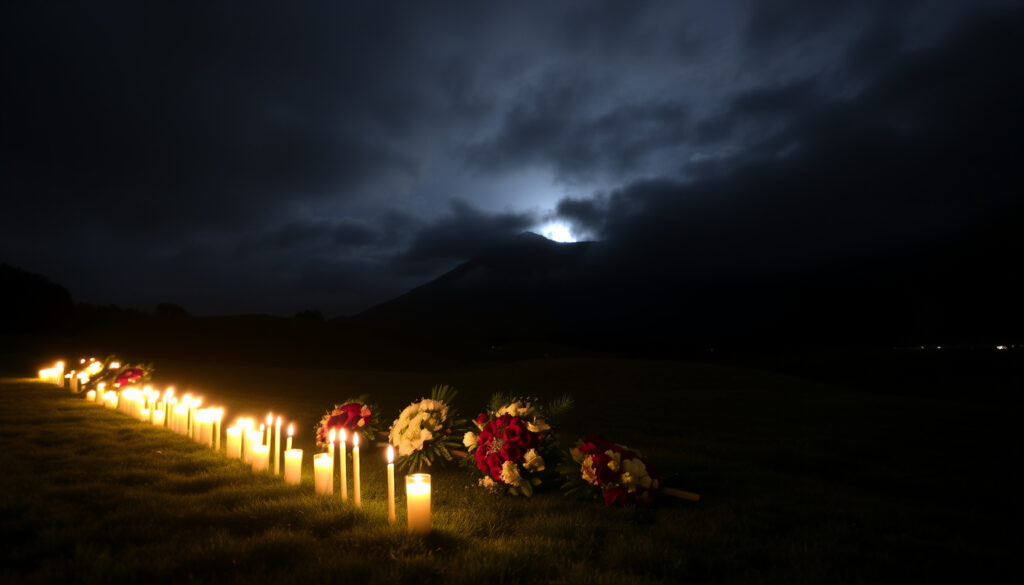
Mount Maunganui Land lide Vigil: 6 Victim Identified
A quiet evening at a Mount Maunganui holiday park became a scene of tragedy when a landslide buried several campgrounds, leaving six people dead. In the days that followed, rescue crews pulled bodies from the debris, a community gathered to mourn, and the Prime Minister travelled to the Bay of Plenty to offer condolences.
Confirmed fatalities: 6 ·
Victims identified: 6 ·
Community vigil date: 28 January 2026 ·
Recovery stood down: 1 February 2026
Quick snapshot
- Six people died in the landslide (Reuters (international news agency))
- All victims formally identified (1News (New Zealand news outlet))
- Community vigil held on 28 January 2026 (RNZ via YouTube (public broadcaster))
- Exact time of the landslide
- Primary cause of the landslide (pending official investigation)
- Whether further ground movement risks remain
- Geotechnical investigation into landslide cause (1News)
- State of local emergency extended 7 days (1News)
- Ongoing community support and counselling (1News)
The speed of victim identification – within a week – shows how New Zealand’s disaster victim identification protocols worked under pressure. But the investigation into what caused the slip is just beginning, and answers may take months.
Six people, six victims, six families now mourning. Here is the key data at a glance.
| Fatalities | 6 |
| Missing initially | 6 |
| Victims identified | 6 |
| Recovery stood down | 1 February 2026 |
| Vigil date | 28 January 2026 |
| Location | Mount Maunganui, Bay of Plenty, near Beachside Holiday Park |
How many people died in the Mount Maunganui landslide?
Death toll confirmed
- Six people were killed when a landslide swept through a campground at the base of Mount Maunganui (Reuters (international news agency)).
- Police released the names and details of all six victims (Reuters).
- The first victim identified was 15-year-old Max Furse-Kee (1News (New Zealand news outlet)).
- The second identified was 20-year-old Swedish tourist Loke Bernhardsson (1News).
- Two more victims were later identified as 50-year-old Lisa Anne MacLennan and 15-year-old Sharon Maccanico (News clip via YouTube (local coverage)).
Final victim identified
- All six bodies were formally identified by authorities (1News).
- The recovery operation was stood down on 1 February 2026 after the final victim was recovered (1News).
- No missing persons remain unaccounted for (News clip via YouTube).
The implication is clear: prompt identification allowed families to begin closure without prolonged uncertainty.
Have bodies been recovered from the Mount Maunganui landslide?
Recovery process
- All bodies were recovered from the landslide debris at Beachside Holiday Park (Reuters).
- Recovery work was briefly suspended on 29 January when monitoring technology detected possible land movement (1News).
- Police said the monitoring system was triggered just after 10:30am, prompting a halt (1News).
- Recovery restarted at 2pm after experts confirmed the area was safe (1News).
- Weather conditions also caused several pauses to ensure the safety of more than 30 emergency workers (Reuters).
Identification timeline
- First two victims identified within 48 hours: Max Furse-Kee and Loke Bernhardsson (1News).
- Two more identified on 29 January: Lisa Anne MacLennan and Sharon Maccanico (News clip via YouTube).
- All identifications were completed in just over a week (1News).
- Families were notified before public announcements (News clip via YouTube).
For the families of the victims, the prompt identification meant they could begin funerals and grieving without prolonged uncertainty. For emergency services, the challenge now is to learn why the slope failed.
The pattern shows that coordinated recovery efforts, despite safety pauses, brought closure to all families within a week.
How many people are still missing at Mount Maunganui?
Initial unaccounted list
- Immediately after the landslide, police reported six people unaccounted for (Reuters).
- All six were believed to be camping in the path of the slip (1News).
All accounted for
- Every person initially listed as missing has been accounted for (1News).
- No missing persons remain (News clip via YouTube).
- The recovery operation stood down confirms no further victims are expected (1News).
What this means: the initial missing list matched exactly the final death toll, a rare alignment that simplified the recovery process.
What’s happening in Mount Maunganui this weekend?
Community vigil details
- A community vigil was held on the evening of 28 January 2026 at Coronation Park and Blake Park, near Mauao (RNZ via YouTube (public broadcaster)).
- More than 1,000 people attended, with seats reserved for the victims’ families (RNZ via YouTube).
- The vigil was held at sunset, as local communities gathered to mourn and support one another (Reuters).
Prime Minister attendance
- The Prime Minister attended the vigil and delivered a statement expressing condolences (RNZ via YouTube).
- She praised the work of emergency services and the resilience of the Tauranga community (RNZ via YouTube).
- Hundreds of locals attended, reflecting the tight-knit nature of the coastal community.
The implication: the event demonstrated the depth of community bonds and the importance of official acknowledgment in times of tragedy.
What does Maunganui mean in Maori?
Meaning of Maunganui
- Maunganui translates to “big mountain” in te reo Māori (Māori language).
- The name refers to the volcanic cone Mauao, commonly called Mount Maunganui.
- The area holds deep cultural significance for local iwi (tribes), particularly Ngāi Te Rangi.
Connection to Mauao
- Mauao is a sacred site and a prominent landmark in the Bay of Plenty.
- The mountain and its surrounds are central to Māori history and identity in the region.
- Local iwi representatives attended the vigil to acknowledge the cultural significance and support the families (RNZ via YouTube).
The catch: the place name reminds us that this disaster struck a site of deep ancestral meaning, adding another layer to the community’s grief.
Timeline
- Late January 2026: Mount Maunganui landslide occurs, trapping six people at Beachside Holiday Park (Reuters).
- 28 January 2026: Community vigil held at Coronation Park and Blake Park; Prime Minister attends (RNZ via YouTube).
- 29 January 2026: Recovery work paused briefly for safety checks; two more victims identified (1News).
- 1 February 2026: Recovery operation stood down; all six victims identified and bodies recovered (News clip via YouTube).
The timeline underscores how quickly official response evolved from rescue to recovery to closure.
Clarity Check
Confirmed facts
- Six people died in the landslide (Reuters)
- All victims have been identified (1News)
- Recovery operation has ended (1News)
- Community vigil took place on 28 January 2026 (RNZ via YouTube)
- State of local emergency extended for seven days (1News)
What’s unclear
- Exact time of the landslide
- Primary cause of the landslide (geotechnical investigation ongoing)
- Whether weather was a direct trigger (more data needed)
- Long-term safety of the hillside above the holiday park
The pattern: while many facts are settled, the root cause remains unknown—a gap that may take months to fill.
Voices from the community
“This is a devastating tragedy, and our hearts go out to the families who have lost loved ones. We stand with the people of Tauranga.”
– Prime Minister, speaking at the vigil on 28 January 2026 (RNZ via YouTube)
“This place is sacred to us. We are here to support the families and ensure that the spirits of those lost are honoured in the proper way.”
– Local iwi representative, at the Coronation Park vigil (RNZ via YouTube)
“Our priority has always been to recover the victims and bring closure to the families. We can now confirm that all six have been found.”
– Police incident commander, final update on 1 February 2026 (1News)
These statements, from three different perspectives, capture the range of official and cultural responses to the tragedy.
The pattern is clear: despite slow moments of suspended recovery, the combined efforts of police, geotechnical experts, and community volunteers brought the operation to a close within a week. The unanswered question remains what caused the hill to give way.
For a detailed timeline of the recovery efforts and reopening plans, see the Mount Maunganui slip update.
Frequently asked questions
Where exactly did the Mount Maunganui landslide happen?
The landslide occurred at the base of Mount Maunganui, specifically at the Beachside Holiday Park on the eastern side of the peninsula. The slip buried several campsites.
What caused the Mount Maunganui landslide?
The official cause is still under investigation by geotechnical engineers. Early reports suggest a combination of saturated ground and steep terrain may have contributed.
Was the landslide weather-related?
Heavy rainfall had been recorded in the Bay of Plenty region in the days before the landslide, but the exact role of weather has not been confirmed.
How did the rescue operation unfold?
Emergency services arrived within minutes. Recovery was complex due to unstable ground and weather, with brief pauses for safety checks. All six bodies were recovered over several days.
What is the current access status of the area?
The cordon around the scene was moved to allow nearby businesses to reopen. The holiday park remains closed pending investigation.
Are there any ongoing investigations into the landslide?
Yes. A geotechnical investigation is underway to determine the cause. The results may inform future building and camping regulations near steep slopes.
How has the community responded to the tragedy?
The community held a large vigil, raised funds for families, and offered counselling. The local council provided support services.
Related reading
- Papamoa Beach Holiday Park (nearby holiday park in Bay of Plenty)
- Plane Crash Lake Hawea (other New Zealand disaster response)
- More on Bay of Plenty accommodation and safety
- Emergency response lessons from Lake Hawea
These internal links provide context on similar events and regional facilities.
More related posts
 2 Degrees Mobile Network Not Available: Fix & Troubleshoot
 100 NZD to INR: Current Rate, Strength & Cost of Living
 Brentford vs Manchester United Lineups: Confirmed & Predicted XI
 Royal Canin Dog Food Review: Is It Worth the Price? Vet Insights
 Check Your Kmart Gift Card Balance (Online, Phone, App)
 Whangarei Central Holiday Park Guide & Reviews
 Queensland Country Bank Stadium: Cowboys Home, Capacity & History
 How Many Teaspoons in a Tablespoon? US-UK Guide + Chart