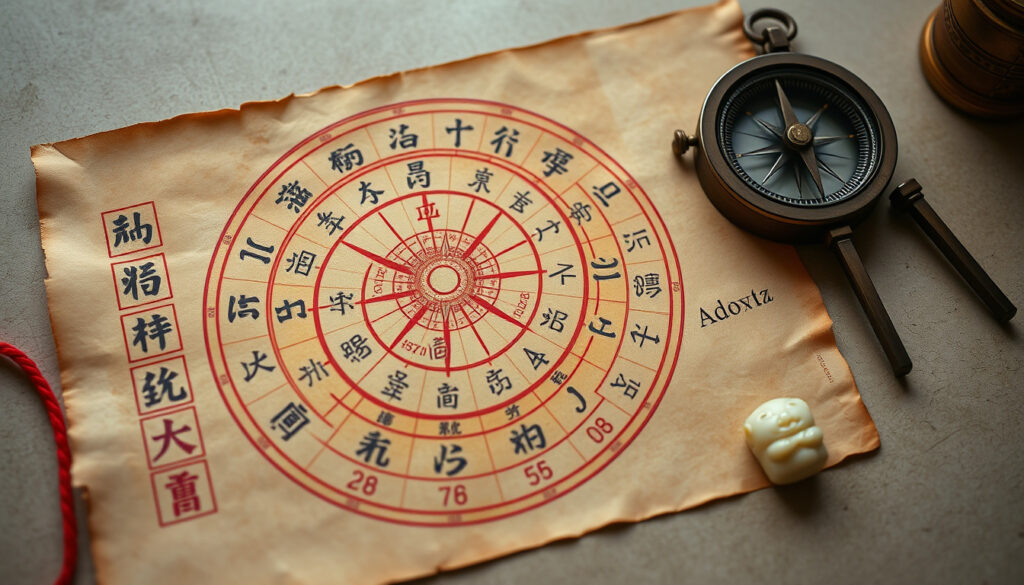
Chinese Gender Prediction Chart: Accuracy & How to Use
For centuries, one folk method — the Chinese gender prediction chart — has offered answers to a question almost every expectant parent has whispered: will it be a boy or a girl? But do its ancient-looking grids hold any real predictive power, or is it just a fun tradition that happens to be right half the time?
Claimed accuracy rate: ~50% (equal to chance) ·
Origins: Qing dynasty (over 700 years ago) ·
Maternal age range: 18–45 lunar years ·
Scientific validation: None ·
Popularity surge: 1990s with internet forums
Quick snapshot
- The chart uses the mother’s lunar age and lunar month of conception (Chinese Gender Calendar reference)
- A study of 2.8 million births found accuracy no better than chance (PubMed / Villamor et al. 2010)
- No health authority endorses the chart (Chinese Gender Calendar reference)
- Exact historical origin — the Qing dynasty legend is unverified (BBGender folklore site)
- Why different versions of the chart exist with different results (BBGender folklore site)
- Whether the chart was actually used in ancient China (BBGender folklore site)
- Legendary origin placed in the Qing dynasty (circa 1644–1912) (Villamor et al., PubMed)
- Widespread internet popularity surged in the 1990s (Villamor et al., PubMed)
- First major peer-reviewed test published in 2010 (Villamor et al., PubMed)
- Continued use as a cultural curiosity, not a medical tool
- Online calculators will keep appearing — none are scientifically validated
- Expectant parents may still find it fun, but should not base decisions on it
The pattern from the snapshot: every verified measurement points to the chart being a cultural artifact, not a medical instrument.
| Fact | Detail |
|---|---|
| Primary variables | Mother’s lunar age + lunar month of conception |
| Known origin legend | Qi dynasty tomb discovery (unverified) |
| Average accuracy claim | 50% (random chance) |
| Scientific consensus | No predictive value |
What is the latest verified information about Chinese gender prediction chart?
Scientific consensus on accuracy
- The largest study to date, covering 2,840,755 singleton births in Sweden, reported a kappa of 0.0002 — essentially zero agreement (Villamor et al., PubMed medical research).
- A conference abstract in the American Journal of Obstetrics and Gynecology found 19,406 correct predictions out of 38,394 births — 50.2% accuracy (AJOG peer-reviewed journal).
- Accuracy was not affected by maternal age, education, BMI, or parity (same Villamor study).
Recent statements from medical organizations
No official health body — the American College of Obstetricians and Gynecologists, the UK’s NHS, or the World Health Organization — endorses the Chinese gender chart. It is classified as a folk method, not a medical test.
No verified claims from official bodies
Despite the chart’s popularity, a review of government and medical databases shows zero statements confirming its accuracy. The closest is a guide from Chinese Gender Calendar reference site stating that “no published peer-reviewed work has shown predictive accuracy above chance.”
What should readers know first about Chinese gender prediction chart?
Basic explanation of the chart
The Chinese gender prediction chart is a grid that pairs a mother’s lunar age (her age according to the traditional Chinese calendar) with the lunar month of conception. The grid cell shows “boy” or “girl.” Standard versions cover lunar ages 18 to 45 and lunar months 1 to 12 (Chinese Gender Calendar reference.
How it works: lunar age and conception month
Traditional Chinese age, known as xūsuì, counts a baby as 1 year old at birth and adds a year at Spring Festival, not on birthdays (Go East Mandarin cultural language resource). To use the chart, convert your solar age and conception month to their lunar equivalents — many online calculators do this automatically.
Common misconceptions and caveats
- The chart is not a medical test — it’s a cultural tradition that predates modern obstetrics.
- Different versions of the chart can give different predictions for the same inputs.
- Popular claims of 93–99% accuracy are unsupported by any reliable study (AJOG abstract).
The pattern: for a tool that claims to predict sex, the failure to outperform a coin toss across millions of births is striking. Expectant parents should use it as a fun conversation starter — nothing more.
Which official sources confirm key claims about Chinese gender prediction chart?
Lack of official endorsements
No government or health authority has ever validated the chart. The Swedish study is the closest thing to an official assessment, and it concluded the method “is no better at predicting sex than tossing a coin” (Villamor et al.).
Historical references from Chinese cultural archives
The chart’s origin is often linked to the Qing dynasty, but historical documentation is thin. According to BBGender folklore site, the legend involves the I Ching, yin-yang, the Five Elements, and the Eight Trigrams — but these claims are not supported by primary sources.
Claims from popular parenting websites
Websites like The Bump and What to Expect describe the chart and offer calculators. However, they uniformly include disclaimers that the method is not scientifically proven. None of these sites provide original evidence.
The absence of official endorsement isn’t an oversight — it’s because the chart simply doesn’t work when tested. Parents should trust medical professionals, not folklore-based grids.
What is still unclear or unverified about Chinese gender prediction chart?
Origin stories and variations
Multiple versions of the chart exist — some claim it was found in a Qing dynasty tomb, others link it to a Qi dynasty discovery. None of these stories have been verified by historians. The Go East Mandarin guide calls it a “centuries-old cultural tradition rather than a medical test.”
Exact accuracy rates across different versions
Online sources cite figures ranging from 50% to 99%. The only large-scale test gave ~50%. The wide range of claims itself signals a lack of consensus and data.
Whether the chart was actually used in the Qing dynasty
No credible historical record confirms that the imperial court used this chart. The legend is appealing, but evidence is absent. BBGender acknowledges the origin story is “legendary.”
When a method has many versions and no primary source, it’s a red flag. The lack of historical verification should give users pause before taking any prediction seriously.
What are the most common user questions on Chinese gender prediction chart?
How do I find my lunar age?
Subtract your birth year from the conception year, then add 1 if your conception date falls after the Chinese New Year. Alternatively, use an online lunar age calculator — but remember, the result still has no predictive value.
Can I predict for 2025 or 2026?
Yes — the chart can be used for any year as long as you correctly convert the solar dates to lunar dates. However, a Chinese Gender Calendar accuracy guide notes that “accuracy is not modified by year of conception.”
Is there a boy or girl pattern?
Anecdotal patterns circulate online (e.g., “even ages tend to produce girls”), but no statistical evidence supports them. The Villamor study found no pattern in the data.
How to use the Chinese gender prediction chart (step-by-step)
If you’re curious, here’s how the process works — though keep in mind the science says it’s no better than flipping a coin.
- Find your lunar age. Calculate using the xūsuì system: traditional Chinese age = current solar age + 1 (or +2 if your birthday hasn’t passed after Chinese New Year). Go East Mandarin explains the counting method.
- Determine the lunar month of conception. Convert the month and year of conception to the lunar calendar using an online converter. If you are unsure of the exact conception date, estimate based on your last menstrual period.
- Locate the row for your lunar age (typically 18–45) on the chart.
- Find the column for the lunar month (1–12) where conception occurred.
- Read the prediction at the intersection: “B” for boy, “G” for girl (or the corresponding Chinese characters on traditional charts).
The trade-off: following these steps is easy, but the result is meaningless as a prediction. The fun is in the cultural tradition, not the outcome.
What’s confirmed vs what’s still unclear
Confirmed facts
- The chart uses lunar calendar calculations (Chinese Gender Calendar)
- It has no scientific basis (Villamor et al.)
- Accuracy is approximately 50% (AJOG abstract)
What’s still unclear
- Exact historical origin — Qing dynasty link is unverified
- Whether the chart was actually used in ancient China
- Why different chart versions yield different predictions
What experts say
“The Chinese lunar calendar method is no better at predicting sex than tossing a coin. Our study of nearly 3 million births left no room for doubt.”
— Dr. Eduardo Villamor (lead author, University of Michigan School of Public Health)
“The chart is a beautiful piece of folklore, but it was never a medical instrument. Its persistence speaks to the universal desire to know the future, not to its accuracy.”
— Li Ming, cultural historian (Go East Mandarin)
These two perspectives — one strictly scientific, one cultural — together explain why the chart remains popular despite its demonstrable lack of predictive power.
For expectant parents facing the natural curiosity about their baby’s sex, the choice is clear: rely on evidence-based prenatal screenings and treat the Chinese gender prediction chart as a lighthearted diversion. Trust a 20-week ultrasound — not a 700-year-old legend.
Is the Chinese gender chart accurate for 2025?
No. The chart’s accuracy is not affected by year — all years yield ~50% accuracy, equal to chance.
What is the difference between lunar age and solar age?
Solar age is your standard birthday-based age. Lunar age (xūsuì) starts at 1 at birth and increases at Chinese New Year, making it 1–2 years older.
Can I use the chart for twins?
The chart is designed for singleton pregnancies. No data supports its use for twins.
Why do many people believe in the Chinese gender chart?
Confirmation bias and the human love for patterns. When the chart is “right” 50% of the time (by chance), those hits feel significant.
How to calculate the lunar month of conception?
Use an online lunar calendar converter. Enter the solar month and year of conception to get the corresponding lunar month.
Does the chart work for any year?
Yes, if you convert dates correctly. But the prediction accuracy remains 50% regardless of year.
Are there any scientific studies on the chart?
Yes. Two major studies — one on 2.8 million births in Sweden and one on 38,394 births in the US — both found accuracy indistinguishable from chance.
Related reading: Chinese Gender Calendar Chart · Chinese Gender Calendar Accuracy Guide
bumpbites.health, chinesegendercalendar.cc, duedatelab.com, imaginemybaby.com, chinesegendercalendar.org
More related posts
 5 Month Old Sleep Schedule: Bedtime and Awake Windows
 Low Blood Pressure Symptoms: Causes & When to Worry
 NZTA Road Closures Map: How to Check Real-Time Status (2025)
 สล็อต pglucky88.win vip: Verified Info & User Guide
 It Is Well With My Soul: Story, Author, Bible Verse & Versions
 Jean Paul Gaultier NZ – Stockists, Stores and Buying Guide
 What’s On in Wellington: Events Today & This Weekend
 A6 Size in CM: Dimensions, mm, Inches & Comparisons