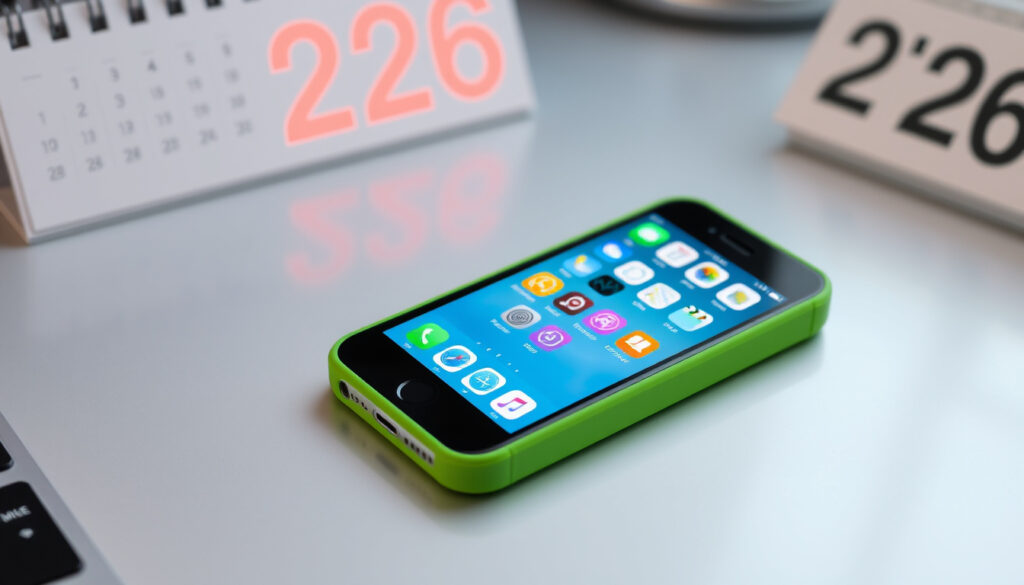
iPhone 5c to Buy: Prices, Usability & Value in 2026
A decade ago, Apple’s colorful plastic iPhone was the budget entry point into the iOS ecosystem. Today, you can find unlocked units for under $50 — but whether that’s a bargain or a waste of money depends entirely on what you expect from a phone in 2026. I dug into current resale markets, real-world usability tests, and Apple’s own support timelines to give you a straight answer before you buy.
Release Year: 2013 ·
Display Size: 4-inch Retina ·
Processor: A6 chip ·
Current Price Range: EUR 29-50 ·
Storage Options: 8/16/32GB
Quick snapshot
- Released in 2013 as Apple’s first entry-level iPhone (PhoneArena)
- Prices on resale platforms range from $29–$46 depending on storage (Swappa)
- Maximum iOS version is iOS 10, stuck since 2019 (YouTube usability test)
- Exact timeline for carrier network compatibility as 3G/4G layers change globally
- Whether rare color variants command meaningful collector premiums in 2026
- Long-term battery viability after replacement cycles
- Original 16GB model launched at $549 in September 2013 (PhoneArena)
- Current resale values represent a 93% depreciation from original retail (PhoneArena)
- Canada already restricting older iPhones as 3G networks phase out (Orchard blog)
- Pre-owned unlocked units remain available but supply is drying up
- Carrier-locked variants have essentially vanished from resale markets
- Best buying windows likely before broader 4G sunset announcements
| Specification | Value |
|---|---|
| Display | 4-inch Retina |
| Camera | 8MP iSight |
| Chip | A6 |
| Wireless | Ultra-fast |
| iOS Max | Up to iOS 10 |
| Avg Price | EUR 30-50 |
How much is my iPhone 5c worth?
Three data points tell the full story. Swappa, which updates pricing daily, shows the unlocked 16GB averaging $35 across 14 active listings in April 2026. The 32GB variant sits just above at $39. On Walmart’s pre-owned section, a white 8GB unit in acceptable condition runs $45 — slightly premium compared to Swappa’s $27–$29 floor for that capacity.
Swappa’s daily pricing data shows the iPhone 5C unlocked 16GB averaging $35 across 14 active listings as of April 2026 — that’s roughly a 93% drop from the original $549 launch price.
Current market prices
Storage capacity creates the clearest price stratification. An 8GB unit is essentially unsellable to anyone who actually intends to use it — even basic app installations eat into that space immediately. The 16GB tier is the sweet spot for buyers who want flexibility without overspending. The 32GB models attract a small premium, though listings are thinner on the ground.
Factors affecting value
Condition matters enormously. A cracked screen or failing battery can drop a 16GB unit below the $20 threshold, while a cosmetically perfect example with functional battery commands $40–$50. Color variants don’t show meaningful collector premiums yet — blue and yellow units sell for nearly the same as white. Original retail pricing from 2013 puts the 16GB at $549 and 32GB at $649, meaning current resale represents roughly a 93% value collapse over thirteen years.
Resale platforms
Swappa leads for transparency — their pricing feed pulls from active listings, not asking prices. Walmart offers the convenience of one-click purchasing with retailer backing. Alibaba serves wholesale buyers willing to navigate quality uncertainty for bulk deals. Carrier-locked variants from Sprint, Cricket, or regional carriers have essentially disappeared from major platforms, limiting options to unlocked units only.
Is the iPhone 5c still usable?
The honest answer from multiple 2026 usability tests: sort of, with major asterisks. YouTube reviewers who put the iPhone 5C through daily routines report that basic calling and texting still function. Web browsing works, albeit slowly. Some compatible apps from the iOS 10 era remain downloadable from the App Store if you can find them — but Apple’s curation has largely buried older software.
After testing the iPhone 5C through a full day of normal use, the device struggles — not because the hardware fails, but because the software ecosystem has left it behind.
Daily functionality in 2025
The A6 chip handles simple tasks adequately when you’re not pushing the device hard. The 4-inch screen becomes a genuine limitation — streaming video, reading long-form content, or navigating maps feels cramped compared to anything released in the last five years. Battery degradation is nearly universal at this age, with reviewers noting the device dying before noon under moderate use.
App compatibility
This is where the iPhone 5C fails most buyers. iOS 10 is a dead-end — the version cap means no modern apps, no updates, no security patches. Banking apps, streaming services, and ride-sharing platforms have all dropped iOS 10 support. Apple Pay never worked on this model and never will. Music streaming apps have largely abandoned the platform, leaving users with a device that can technically browse but can’t run the software they actually need.
Battery and performance
Real-world testing shows the battery as the primary failure point. After thirteen years of charge cycles, original batteries hold perhaps 40–60% of rated capacity. Swapping in a replacement extends usable life, but quality cells are increasingly scarce. Performance remains adequate for basic functions, but demanding anything beyond the simplest apps triggers noticeable slowdowns.
Can you still use an iPhone 5c in 2026?
The question isn’t whether the hardware works — it largely does — but whether the ecosystem still supports it. Apple ended iOS 10 support years ago. That means no security updates, no new app installations from the modern App Store, and increasing incompatibility with services that matter to most users.
Canada has already begun restricting older devices as networks upgrade, a pattern likely to spread globally as 3G and 4G infrastructure phases out.
iOS support status
The device peaked at iOS 10.3.3 in 2018 and has received no updates since. Apple’s support pages confirm no further development. For context, iOS 10 was deprecated from a security standpoint years ago, leaving users vulnerable to known exploits if they connect to any network.
What stops working
Modern services have systematically dropped iOS 10 compatibility. Google dropped older iOS support across most core apps. Banking applications require minimum iOS versions that exclude this device. Even simple tasks like streaming video from major platforms trigger compatibility errors. Regional variations matter — in Canada, older iPhones face hard limits as 3G networks phase out, a pattern likely to spread globally.
Workarounds
Some users report success with legacy app versions — older Spotify builds, archived navigation software. These workarounds require sideloading or using App Store archives, and they break regularly as servers update. A phone requiring constant technical maintenance isn’t a phone most people want.
How rare is the iPhone 5c?
The iPhone 5C sold well enough that it’s not genuinely rare — Apple moved millions of units during its production run. What makes it notable is the shift it represented: the first time Apple deliberately targeted budget-conscious buyers rather than premium customers. That distinction gives it mild collector interest without commanding premium prices.
PhoneArena confirms the iPhone 5C was Apple’s first entry-level, lower-priced iPhone model — a strategic pivot that gives it mild collector interest without premium pricing.
Production numbers
Apple never disclosed exact production totals, but the device remained on sale for over a year and shipped to every major market. Compared to the original 4GB iPhone — which Apple recalled due to poor sales — the 5C was a commercial success by any reasonable measure. You’re not buying a unicorn.
Collector appeal
The plastic body aged poorly compared to the aluminum 5S. Yellow units show UV damage. Rose pink versions became brittle. Working examples in excellent condition do command slightly higher prices, but the collector premium rarely exceeds $10–15 over functional units. No color variant has achieved the status of first-generation iPhones or limited-run colors like Product Red.
Compared to rarest models
The rarest iPhones are early models with specific storage configurations — the original 4GB version, factory-unlocked units from certain regions, or developer edition devices. The 5C never achieved that status. Its production volume was too high, its design too ordinary, and its cultural moment too brief. Collectors remember it as a pivot point in Apple’s strategy, not a holy grail.
What should I do with my old iPhone 5c?
If you already own one, you have four realistic options. Each carries trade-offs depending on your priorities — money, convenience, environmental impact, or sentimental value. The decision isn’t universal; it depends on the device’s condition and what you want from it.
Sell options
Swappa and eBay remain the strongest platforms for seller proceeds. Swappa’s buyer protection and pricing transparency mean slightly better final sale prices than eBay’s more variable marketplace. CeX offers instant cash or store credit if you prefer certainty over maximization. Expect $25–45 for working units in good condition. Broken devices with cracked screens or dead batteries fetch $5–15 from specialty recyclers.
Recycle process
Apple’s recycling program accepts the iPhone 5C at no charge. The company claims to recover materials from devices regardless of condition, though they don’t pay for older hardware. Third-party recyclers often offer small payments for functional units. Environmental benefit is real — electronic waste contains valuable metals and hazardous components that shouldn’t enter landfills.
Repurpose ideas
Several creative uses keep older iPhones in service. As an iPod for workouts, the 4-inch form factor actually works well — small and light enough for a pocket. As a dedicated music streaming device in a car with aux input. As an emergency backup phone. As a retro gaming device for older titles that still run on iOS 10. Each use case trades on the device’s limitations as features in specific contexts.
The iPhone 5C asks you to accept yesterday’s software limitations for today’s prices. At $35 for a 16GB model, it’s genuinely cheap — but cheap and useful aren’t the same thing. For most buyers, that money buys frustration rather than value.
Original retail pricing was $549 for the 16GB model. Thirteen years later, resale values represent a 93% collapse. That depreciation curve tells you everything about where this device sits in the product lifecycle — past usefulness, into nostalgia territory.
Upsides
- Extremely cheap entry point to iOS ecosystem
- Unlocked units work on most GSM carriers worldwide
- Basic calling and texting still function reliably
- Compact 4-inch form factor suits specific use cases
- No modern privacy concerns from active tracking
Downsides
- Stuck on iOS 10 with no security updates
- Most modern apps incompatible or unavailable
- Apple Pay and modern payment systems unsupported
- Battery degradation nearly universal at 13 years old
- 3G/4G network compatibility increasingly uncertain
- 8GB and 16GB storage too small for any practical use
Related reading: Best sleep tracking apps for iPhone
While scouting iPhone 5c deals from €29, compact phone fans may value the iPhone SE 1st gen guide detailing SE 1st gen prices starting at $49.
Frequently asked questions
Where to buy iPhone 5c unlocked?
Swappa offers the most transparent pricing with verified listings. Walmart provides retailer-backed purchasing with faster shipping. eBay gives broader selection with more price variation. Alibaba suits wholesale buyers comfortable with longer delivery times and quality uncertainty.
What is the cheapest iPhone 5c price?
Swappa’s February 2026 listings show 8GB units starting at $29. That’s the floor for working, unlocked devices. Walmart’s pre-owned 8GB white unit runs $45, reflecting their retail markup for guaranteed condition. Anything below $25 typically means damaged or non-functional units.
Does iPhone 5c work with 5G?
No. The iPhone 5C predates 5G entirely — it lacks the required hardware. The device maxes out at 4G LTE, which remains widely available but is itself subject to gradual network sunsetting in some regions.
Can iPhone 5c run latest apps?
No. iOS 10 compatibility means most modern apps require minimum versions the device cannot reach. Banking apps, streaming services, ride-sharing platforms, and social media have all dropped older iOS support. The App Store does still host some legacy compatible software, but selection is thin.
How to check iPhone 5c condition before buying?
Request the seller’s battery health reading via Settings > Battery > Battery Health (if accessible). Inspect screen for scratches and cracks. Test cellular connectivity and Wi-Fi. Verify the device isn’t iCloud locked by attempting a factory reset. Ask for photos showing the device powered on and running.
Is iPhone 5c compatible with modern carriers?
Unlocked units work on most GSM carriers globally — AT&T, T-Mobile, and their international equivalents. CDMA networks (Verizon, Sprint legacy) have largely sunset, making those variants useless. Canada has already begun restricting older devices as networks upgrade.
What accessories work with iPhone 5c?
Standard Lightning cables charge the device. Standard earbuds with Lightning connector work. The case ecosystem is limited to older models — finding new cases is difficult. Third-party chargers and cables work as long as they meet basic USB standards.
For buyers in the secondary market, the choice narrows to a single question: what do you actually need this phone to do? If you need a working smartphone with access to modern apps, $35 on Swappa buys frustration. If you need a nostalgic backup, a car music player, or a workout companion with no data exposure, the iPhone 5C delivers exactly that at a price that can’t be beaten. The device found its level — a $35 piece of Apple history that still blinks on when you press the button.
More related posts
 Contact Energy co nz: How to Contact, Cheapest Plans & More
 2 Degrees Mobile Network Not Available: Fix & Troubleshoot
 New Plymouth to Taupo: Best Routes, Driving & Stops Guide
 Home Decorating Advice: Rules, Trends & Free Makeover Ideas
 Power Outage Lower Hutt: How to Check, Report, and Stay Safe
 Hot Water Beach Accommodation: Top 10 Park & Rentals
 Cast of How to Get to Heaven from Belfast: Full List & Roles
 Nigel Latta’s First Wife: What We Know About His Family Life