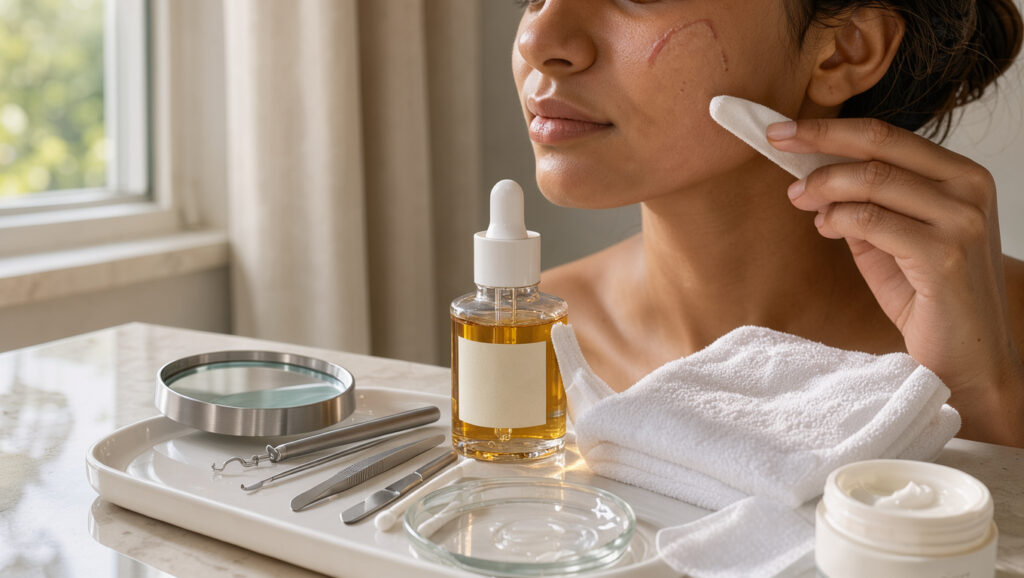
How to Get Rid of Acne Scars: Treatments by Scar Type
Most people with acne scars have already tried a drugstore cream and hoped one bottle would smooth things out. Acne scars can fade, but they rarely go away completely on their own, as the American Academy of Dermatology (dermatology professional body) notes, and sunken scars and dark marks need different fixes, which is why one cream rarely does the whole job.
Common scar types: Atrophic (sunken) and hypertrophic (raised) · Natural fading: Acne scars can fade but rarely go away completely without treatment · Professional input: Board-certified dermatologist recommended for diminishing scars · Named in-office options: Laser therapy, microneedling, chemical peels, fillers
Quick snapshot
- Reducing acne scars takes over-the-counter medication or dermatologist-performed procedures (Cleveland Clinic (academic medical center))
- For mild scarring, a retinoid or salicylic acid can make marks less noticeable (American Academy of Dermatology (dermatology professional body))
- Whether one treatment clears all scarring remains open; no single treatment is best for everyone (Mayo Clinic (academic medical center))
- Treatment can take multiple sessions and months to show improvement, according to Curology (dermatology telehealth provider)
- A mild chemical peel course runs 3 to 5 treatments every 2 to 4 weeks (American Academy of Dermatology, dermatology professional body) (Cleveland Clinic (academic medical center))
- Laser courses typically run three to five sessions (Cleveland Clinic (academic medical center))
- Daily sunscreen limits the contrast between unscarred skin and a scar (Mayo Clinic, academic medical center) (Healthline (health information publisher))
- Clear active acne before starting scar treatment, according to Healthline (health information publisher)
Most of the decision comes down to two questions: how deep the mark sits, and how many visits a treatment needs.
| Fact | Detail |
|---|---|
| Scar types | Atrophic (sunken) and hypertrophic (raised) (Mayo Clinic, academic medical center) |
| Natural fading | Acne scars can fade but rarely disappear completely without treatment (American Academy of Dermatology, dermatology professional body) |
| Professional input | Board-certified dermatologist recommended for diminishing scars (American Academy of Dermatology, dermatology professional body) |
| In-office options | Laser therapy, microneedling, chemical peels, fillers (Cleveland Clinic, academic medical center) |
| Mild chemical peel course | 3 to 5 treatments every 2 to 4 weeks (American Academy of Dermatology, dermatology professional body) |
| Dermal filler results | Most temporary fillers last 3 months to 2 years; some are permanent (American Academy of Dermatology, dermatology professional body) |
| Laser sessions | Three to five sessions (Cleveland Clinic, academic medical center) |
| Non-ablative laser downtime | Two to four days of swelling or redness, according to NewBeauty (beauty magazine) |
What are the treatment options for acne scars?
Acne scar care splits into two groups: products you buy and procedures a dermatologist performs in an office. Reducing acne scars takes over-the-counter medication or one or more dermatologist-performed procedures (Cleveland Clinic, academic medical center), and the right mix depends on the scar.
What are the hardest acne scars to treat?
- Sunken scars: soft tissue fillers plump indented scars, but results are temporary and repeat treatments are needed (Mayo Clinic, academic medical center)
- Raised scars: dermatologists can use laser treatments, corticosteroid or other medication injections, or prescription topical medication (American Academy of Dermatology, dermatology professional body)
- Severe scarring: dermabrasion is usually reserved for it and carries risks of scarring and skin color changes (Mayo Clinic, academic medical center)
Laser resurfacing carries an increased risk of side effects for people with darker skin or a history of keloids (Mayo Clinic, academic medical center), which is why a skin-tone check belongs in the first consultation.
Can microneedling help with acne scars?
- Skin needling is described as a safe, simple, and possibly effective technique with minimal risk of discoloring the skin, though results are subtle and repeat treatments can be needed (Mayo Clinic, academic medical center)
- Professional microneedling typically takes four to six treatments (Cleveland Clinic, academic medical center)
- Microneedling should not be used on open acne or pustules because it can spread bacteria, according to Marie Claire (beauty and wellness magazine)
Acne scar surgery is usually done in a medical office or outpatient center under local anesthesia, so the patient stays awake without pain (American Academy of Dermatology, dermatology professional body). Office procedures typically take 15 to 30 minutes per visit, according to GoodRx (prescription price and health site).
Sunken scars and dark marks need different tools, so one product or procedure rarely covers both. Pick the treatment by the scar you have, not by the ad you saw.
The trade-off: in-office procedures do more for depressed scars, but each one brings downtime, repeat visits, and skin-tone risks that home products avoid.
Dermatologists match the tool to the scar, so a shelf product cannot cover both sunken and dark marks. Patients with sunken scars who skip the consultation risk spending money on fillers, lasers, or microneedling without a plan built for their skin.
Are acne scars permanent?
Acne scars rarely disappear completely without treatment, so most people end up choosing between partial improvement and a longer plan. No single treatment is best for everyone (Mayo Clinic, academic medical center).
The American Academy of Dermatology ties the outcome to the individual, noting that a dermatologist plan weighs scar type, number of scars, age, skin tone, and budget (American Academy of Dermatology, dermatology professional body).
- Stopping breakouts reduces inflammation and helps prevent new scars (American Academy of Dermatology, dermatology professional body)
- Treatment can take multiple sessions and months to show improvement, according to Curology (dermatology telehealth provider)
- Stubborn scars rarely clear on their own, so a plan with a clear goal beats waiting (American Academy of Dermatology, dermatology professional body)
What this means: a realistic goal is visible improvement, and a dermatologist can judge how much improvement a given scar can take.
What is the best skincare to remove acne scars?
The sources reviewed here do not name one product that removes acne scars. They do name ingredient groups, and over-the-counter creams with alpha hydroxy acids, lactic acid, retinoids, or salicylic acid are described as the best at-home options (Cleveland Clinic, academic medical center).
Brand rankings are not supported by the evidence gathered for this piece, so no brand is named as best. A shelf label that promises scar removal is selling a claim, not a result.
- Mild scarring: a retinoid or salicylic acid can make scarring less noticeable (American Academy of Dermatology, dermatology professional body)
- Prescription retinoid: tretinoin can reduce acne scars, even long-standing and severe ones, according to WebMD (consumer health publisher)
- At-home peel pads with around 5% glycolic acid or 2% salicylic acid are unlikely to improve true atrophic scarring, according to Marie Claire (beauty and wellness magazine)
- Daily sunscreen can limit the contrast between unscarred skin and a scar (Mayo Clinic, academic medical center)
The catch: research on many over-the-counter scar products is limited, and the American Academy of Dermatology recommends speaking with a board-certified dermatologist before using them (American Academy of Dermatology (dermatology professional body)).
How to prevent pimple scars after a pop?
Prevention starts at the breakout itself, and the sources agree on the basics. Picking, popping, scratching, or squeezing breakouts increases inflammation and scar risk (American Academy of Dermatology, dermatology professional body).
- Leave the pimple alone, since each pick or squeeze adds inflammation and scar risk (American Academy of Dermatology, dermatology professional body)
- Clear active acne first, because scar treatment starts after breakouts stop, according to Healthline (health information publisher)
- Wear daily sunscreen so a healing mark stands out less against unscarred skin (Mayo Clinic, academic medical center)
- Bring in a board-certified dermatologist when marks persist, since a dermatologist partnership can help diminish them (American Academy of Dermatology, dermatology professional body)
The implication: the scar you avoid is the only one you never have to treat.
How to get rid of acne scars at home?
Home care can help with surface marks, but it has hard limits. Medicated creams containing azelaic acid or hydroxy acids can help, according to Mayo Clinic (academic medical center), but at-home peels and creams are generally not enough for deep atrophic scars (Marie Claire, beauty and wellness magazine).
Black seed oil, rosehip seed oil, honey, and aloe vera appear in natural-remedy coverage, but the sources reviewed for this piece contain no clinical trial data for them. Treat these options as unproven, and do not expect removal within a week or a month, because the evidence does not support those timelines.
Home care does not replace clinician-directed procedures for deep or sunken scars. Over-the-counter topicals can help mild or superficial scarring, but deep atrophic scars generally require professional procedures (Marie Claire, beauty and wellness magazine).
Why this matters: a home routine can delay the dermatologist visit that deep scars need, and the months lost are the real cost.
Four options, one pattern: at-home products act on mild or surface marks, while deep scars move into the clinic.
| Option | Best suited for | Main limit |
|---|---|---|
| Over-the-counter topicals (retinoids, AHAs, salicylic acid) | Mild or superficial scarring and discoloration | Generally not enough for deep atrophic scars (Marie Claire, beauty and wellness magazine) |
| Microneedling at home | Not endorsed by dermatologists | Cannot reach deeper layers (Marie Claire, beauty and wellness magazine) |
| Professional microneedling | Deeper penetration with medical-grade needles | Typically four to six treatments (Cleveland Clinic, academic medical center) |
| Non-ablative laser resurfacing | Shorter recovery across multiple sessions | Two to four days of swelling or redness (NewBeauty, beauty magazine) |
| Ablative laser resurfacing | Deeper resurfacing with a longer recovery window | One to two weeks of downtime (NewBeauty, beauty magazine) |
| Hyaluronic acid fillers | Sunken (indented) scars | Temporary, lasting 3 months to 2 years (American Academy of Dermatology, dermatology professional body) |
| Bellafill (collagen filler) | Longer-lasting correction | Requires an allergy test and has a permanent component (NewBeauty, beauty magazine) |
Confirmed facts
- Acne scars can fade but rarely go away completely on their own (American Academy of Dermatology (dermatology professional body))
- Squeezing, popping, scratching, or picking breakouts increases scar risk (American Academy of Dermatology, dermatology professional body)
- Reducing acne scars takes over-the-counter medication or dermatologist procedures (Cleveland Clinic, academic medical center)
What’s unclear
- Whether any single treatment removes all scarring; no single treatment is best for everyone (Mayo Clinic, academic medical center)
- Chemical peel side effects, including skin color changes on dark skin, are described, but the sources reviewed give no frequency figures (Mayo Clinic, academic medical center)
- Exact timelines for natural remedies, since the sources reviewed contain no clinical data for them
- Whether Korean-style at-home routines outperform clinical procedures, since no comparison exists in the sources reviewed
“Acne scars are stubborn, and no single treatment is best for everyone.”
Mayo Clinic (academic medical center)
“While acne scars can fade, they rarely go away completely on their own.”
American Academy of Dermatology (dermatology professional body)
“Acne scars are more difficult to treat than standard keloid scars and wrinkles, however there are in-office options to improve them and, with patience, the results can be significant.”
Heidi Waldorf, MD, New York dermatologist, quoted by NewBeauty (beauty magazine)
Sunken scars and dark marks respond to different tools, and the American Academy of Dermatology points to a dermatologist-led plan rather than a shelf product for deep scars (American Academy of Dermatology, dermatology professional body). For readers with deep or sunken scars, the choice is clear: book a dermatologist consultation before buying another cream, or accept that home care will only address the surface.
Related reading: CeraVe Resurfacing Retinol Serum guide
Readers with deep atrophic scars who rely on home care alone risk losing months before a dermatologist visit, because at-home peels and creams are generally not enough for those scars.
Related reading: CeraVe Resurfacing Retinol Serum guide
Frequently asked questions
Do acne scars fade on their own over time?
Some fade partly, but acne scars can fade and rarely go away completely on their own (American Academy of Dermatology, dermatology professional body).
How long does it take to see results from acne scar treatment?
Results can take multiple sessions and months, according to Curology (dermatology telehealth provider). Laser courses typically run three to five sessions (Cleveland Clinic, academic medical center).
Does sun exposure affect the appearance of acne scars?
Daily sunscreen can limit the contrast between unscarred skin and a scar (Mayo Clinic, academic medical center).
What is the difference between atrophic and hypertrophic acne scars?
Atrophic scars are sunken, and hypertrophic scars are raised (Mayo Clinic, academic medical center). Dermatologists can treat raised scars with laser treatments, corticosteroid injections, or prescription topical medication (American Academy of Dermatology, dermatology professional body).
When should someone see a board-certified dermatologist for acne scars?
Before starting any treatment, because individualized plans weigh scar type, number of scars, age, skin tone, and budget (American Academy of Dermatology, dermatology professional body). The same body recommends speaking with a board-certified dermatologist before using over-the-counter scar products (American Academy of Dermatology (dermatology professional body)).
Does picking at pimples raise the chance of scarring?
Yes. Picking, popping, scratching, or squeezing breakouts increases inflammation and scar risk (American Academy of Dermatology, dermatology professional body).
More related posts
 Cast of Fire Country: Main Actors, Departures, New Additions
 Art Deco Masonic Hotel Napier: Reviews, Prices, Photos
 Cast of How to Get to Heaven from Belfast: Full List & Roles
 สล็อต pglucky88.win vip: Verified Info & User Guide
 Dyson Stick Vacuum NZ 2026: Best Model, Price & Reviews
 Face Vitamin C Serum: Benefits, Daily Use, and Best Picks
 Find Sticky Rice Lotus Leaf Near Me: Lo Mai Gai Guide & Delivery
 How to Clean Washing Machine: Vinegar & Baking Soda Guide