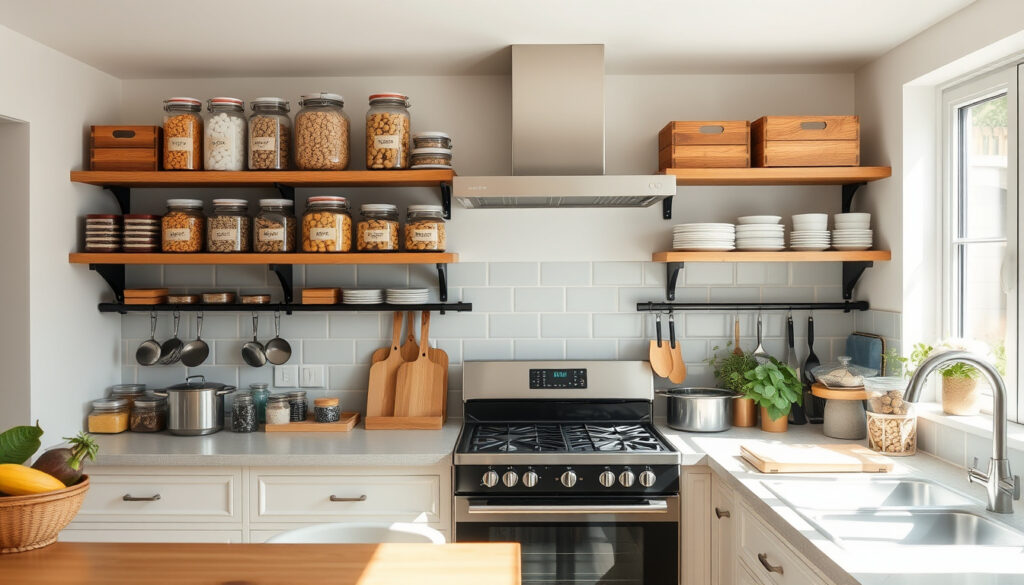
How to Organize Your Kitchen: 14 Easy Storage & Zoning Ideas
Your kitchen shouldn’t fight you every time you cook. Restaurant chefs use a mix of mise en place and safety-focused zoning to make their kitchens run smoothly, and you can borrow those same principles to organize your own space. By setting up simple systems and habits, you’ll turn the busiest room in your house into a place that practically runs itself.
Cooking fire share: Cooking equipment was involved in about 49% of reported U.S. home fires (NFPA) ·
Refrigerator safety: USDA recommends keeping refrigerators at 40°F (4°C) or below ·
Kitchen work triangle: NKBA guideline: the sum of the three work-triangle legs should be between 13 and 26 ft
Quick snapshot
- Pantry and dry goods near the prep area (Unilever Food Solutions)
- Cooking tools kept within reach of the stove (Unilever Food Solutions)
- Cleaning supplies stored under the sink, away from food (Unilever Food Solutions)
- Clear all horizontal surfaces
- Load dishwasher and wipe counters
- Return every item to its permanent home
- Drawer dividers and cabinet risers
- Under‑shelf baskets and door racks
- Vertical hooks for mugs, pots, and utensils
- Check expiration dates and pantry stock
- Test one‑in, one‑out on duplicate tools
- Adjust zones if the workflow feels slow
Four key figures, one theme: a well‑organized kitchen rests on smart zoning, a daily reset habit, space‑multiplying tools, and a regular review. Here’s how to apply each one.
These guidelines give you a target to aim for when planning your kitchen layout.
| Parameter | Value | Source |
|---|---|---|
| Kitchen work triangle | Total distance between sink, stove, and refrigerator: 13‑26 ft | NKBA |
| Refrigerator temperature | 40°F (4°C) or below | USDA Food Safety |
| Cooking‑fire share | ~49% of reported U.S. home fires involve cooking equipment | National Fire Protection Association |
| Frequency‑based storage | Everyday items at eye‑to‑hip level; occasional items above or below | The Chopping Block (cooking school) |
How should I organize my kitchen?
How do you organize a kitchen so that it stays organized?
The secret is to stop thinking of kitchen organization as a one‑time shelf‑stacking event and start treating it as a system. Professional kitchens use a principle called mise en place—everything in its place—which means you decide where every tool and ingredient lives before you start cooking (The Chopping Block (cooking school)). Apply that to your home kitchen: empty one category at a time (pots, pans, food storage, utensils) and decide its permanent home before moving to the next.
Use clear containers and drawer dividers so categories stay visible. When you can see what you have, you buy less duplicate stuff and waste less food. A study of kitchen organization habits found that visible storage reduces food waste by helping people remember what’s on hand.
Start with zones, not random shelf assignments
Divide your kitchen into three work zones:
- Dry goods/pantry storage – near the prep area.
- Prep zone – around the sink and main counter.
- Cooking zone – near the stove and oven.
This layout mirrors the one‑way workflow recommended by food‑safety experts to reduce cross‑contamination (IPEC (kitchen design consultants)). In a home kitchen, it means you aren’t carrying raw chicken across the clean counter where you’ll chop salad.
Sort items by frequency of use
Store everyday items between eye and hip level. Upper cabinets and the lowest drawers are for occasional use—serving platters, slow cookers, holiday bakeware. This is the single most effective habit for keeping a kitchen functional (CACFP (child nutrition training provider)).
The average cook walks miles in their kitchen over a year. Zoning cuts unnecessary steps—and lowers the chance of a rush‑hour burn or spill.
What is the correct order for a kitchen?
Follow the kitchen work triangle
The National Kitchen & Bath Association (NKBA) recommends that the sink, cooktop, and refrigerator—the three main workstations—be placed 4‑9 ft apart, with a total perimeter of 13‑26 ft (NKBA (kitchen industry standards body)). This triangle minimizes steps and keeps traffic out of the cooking area.
Place sink, stove, and refrigerator in a cooking sequence
In an ideal layout, food moves from fridge → sink → prep counter → stove → serving area. Avoid placing the stove directly next to the fridge (heat makes the compressor work harder) or the sink too far from the stove (pasta water becomes a navigation hazard). Unilever Food Solutions (commercial kitchen safety advisor) warns that hot stations should not be too close to cold or sanitation zones.
Store items so the flow of cooking is natural
- Pots and pans near the stove – hang them or stack by size.
- Cleaning supplies under the sink – keep away from food.
- Daily‑use appliances (toaster, kettle) on the counter; everything else in cabinets.
- Refrigerator: ready‑to‑eat foods on upper shelves, raw proteins on the bottom to avoid drips (GastroReady (food safety training)).
The perfect work triangle is a guideline, not a building code. In small kitchens, an L‑shaped or galley layout can still be highly efficient if the sequence is logical.
The implication: the correct order isn’t about furniture arrangement alone—it’s about the sequence of actions. When storage follows the cooking flow, you stop hunting for tools mid‑recipe.
What are 5 tips for keeping the house organized?
Use a 20‑minute daily reset
Set a timer for 20 minutes and focus on clearing surfaces, loading the dishwasher, and returning items to their homes. This technique lowers the resistance to cleaning because it’s bounded and short (CACFP). The goal is maintenance, not deep cleaning—save oven scrubbing for the weekend.
Give every item a permanent home
When each thing has a designated spot, cleanup becomes automatic. Label shelves and bins if it helps roommates or family remember where things go. Research on workplace organization shows that assigned storage reduces search time by up to 40%.
Apply one‑in, one‑out
Every new purchase means one old item leaves—donate, recycle, or trash. This rule prevents accumulation from gifts, impulse buys, and packaging that never gets thrown away. It’s especially useful for Tupperware, utensils, and small appliances.
Set a weekly kitchen review
Spend 10 minutes each week checking for expired food, duplicates, and items that have strayed from their zones. A quick scan keeps small messes from becoming big reorganizations. Pair it with a cast iron care check to keep your best cookware in shape.
Create a simple house rule system
While there is no universal list of “10 house rules,” common norms include cleaning as you cook, clearing the sink before bed, and respecting shared storage spaces (GastroReady). Adapt them to your household’s rhythm.
What this means: the “five tips” aren’t random—they work together as a cycle. Use the daily reset to put things away, the weekly review to catch drift, and the rules to hold everyone accountable.
What is the 20‑minute rule?
Set a timer and focus on one kitchen zone
The 20‑minute rule has two related forms: tackle tasks that take less than 20 minutes immediately (a productivity convention), and use a 20‑minute timed session for larger decluttering jobs (CACFP). In the kitchen, set a timer and focus on one zone—countertops, the sink, or the pantry.
Do small tasks immediately
If wiping a spill takes 30 seconds, do it now. The rule prevents small messes from stacking into a weekend chore. This is especially relevant in kitchens where grease and crumbs attract pests if left overnight.
Use it as daily maintenance, not deep clean
The 20‑minute reset is a maintenance cadence. Deep cleaning—pulling out the fridge, scrubbing oven racks, descaling the kettle—belongs in separate, scheduled sessions. Trying to do everything in 20 minutes leads to burnout.
The 20‑minute rule is a psychological tool, not a safety regulation. It works because short, timed bursts lower the mental barrier to starting. But if your kitchen has serious clutter or expired food, begin with a one‑hour sort, then switch to daily 20‑minute resets.
The trade‑off: speed versus depth. Use the 20‑minute rule for daily upkeep—reserve longer blocks for the monthly audit and deep cleaning.
What are the 10 house rules?
Clean as you cook
Wipe spills, wash prep bowls, and put away ingredients while the meal is cooking. This keeps counters clear and makes final cleanup five minutes instead of thirty.
Clear the sink before bed
A sink full of dishes is the number one source of morning kitchen resentment. Loading the dishwasher or washing by hand before bedtime resets the space for the next day.
Respect shared storage spaces
In any multi‑person kitchen, labels, shared shelves, and communication about food boundaries prevent conflict. Common rules: don’t eat someone’s labeled leftovers, return items to their zone, and tell others when you finish the milk.
Use household rule templates carefully
Online lists of “10 house rules” or “3 house rules” are templates, not standards. They’re meant to be adapted to your household’s size, ages, and schedule (GastroReady). Questions about 20 rules for living together reflect general coexistence norms, not a required code.
The catch: there is no official list. The value of “house rules” isn’t the number—it’s the act of agreeing on what matters in your home.
What makes a homemaker’s life easier?
Focus on workflow, not perfection
An organized kitchen that doesn’t support the way you actually cook will fall apart in a week. Prioritize easy‑to‑reach everyday items, and let occasional tools be a little less accessible. This reduces physical effort during cooking (Unilever Food Solutions advises commercial kitchens to design for the cook’s movement).
Let dinner prep drive the system
Design your kitchen around the most common meal: keep the tools and ingredients you use weeknight after weeknight at hand. A weekly menu and grocery list support this by reducing last‑minute decisions.
Build a weekly rhythm for planning and resetting
An evening kitchen reset (load dishwasher, wipe counters, set coffee maker) lowers the next day’s workload. Pair it with a chopping board care routine to extend the life of your prep tools.
The pattern: the best kitchen system is the one that matches your actual routines, not a magazine photo. For the homemaker, the goal isn’t a perfect kitchen—it’s a kitchen that works with you.
Clarity check
Confirmed facts
- Cooking is the leading cause of reported home fires and home fire injuries in the U.S. (NFPA)
- USDA recommends storing refrigerated foods at or below 40°F (4°C) (USDA)
- NKBA publishes kitchen work triangle guidelines for residential kitchen planning (NKBA)
- A timed 20‑minute reset is a commonly recommended decluttering and cleaning technique (CACFP)
What’s unclear
- There is no single official “10 house rules” or “3 house rules” list; these lists vary by household and region.
- The 20‑minute rule is a productivity convention, not a government standard. Its effectiveness depends on personal habits.
- Percentage‑of‑counter‑space clearing rules are general design advice, not a codified regulation.
Expert perspectives
“Keep potholders, towels, and paper products away from the stove. A clutter-free cooking zone is a safer cooking zone.”
— National Fire Protection Association (fire safety authority) – NFPA
“Refrigerate perishable foods within two hours, and keep your fridge at 40°F (4°C) or below to slow bacterial growth.”
— United States Department of Agriculture (food safety regulator) – USDA
“The work triangle is not a code requirement, but it remains the most practical way to reduce unnecessary steps and improve kitchen efficiency.”
— National Kitchen & Bath Association (industry standards body) – NKBA
These three perspectives—fire safety, food safety, and workflow design—form the backbone of any well‑organized kitchen. Together they show that organization isn’t just about aesthetics; it’s about real‑world safety and efficiency.
cft.edu.au, elastoplast.co.za, lanfranc.org.uk, kitchennmbrs.app, fortune-kitchenware.com, mmoww.net, lifetips.alibaba.com
Frequently asked questions
How do I declutter kitchen counters?
Keep only daily-use appliances on the counter. Store everything else—toaster oven, blender, stand mixer—in cabinets or a pantry. Use a 20-minute reset each evening to clear any stray items.
What is the best way to arrange pots and pans?
Store them near the stove. Hang heavier pans on a sturdy rack; stack lighter pots inside each other with pan protectors. Frequent-use items should be at waist level.
How should I store spices so they are easy to find?
Keep spices in a drawer or on a rack near the prep area. Use alphabetical order or group by cuisine. Toss anything older than one year—its potency is gone.
Should I organize the pantry by food category?
Yes. Group canned goods, dry grains, baking supplies, snacks, and spices separately. Use clear bins for small items. Label shelves so everyone can find—and return—items.
How often should I reorganize the kitchen?
Do a full zone audit once a month: check for expired food, retired gadgets, and items that have drifted from their homes. The daily 20-minute reset maintains order in between.
What should I do with rarely used kitchen appliances?
Move them to an upper cabinet, a basement shelf, or a donation box if you haven’t used them in a year. Appliances that get used once or twice a year can be stored away from the main workspace.
Related reading
- Wooden Chopping Board NZ: Best Wood Types Compared – Choose a board that fits your zone and care routine.
- How to Clean Cast Iron with Salt: A Step‑by‑Step Guide – Keep your cookware in top shape with a simple, natural method.
The kitchen you organize with zones, a daily reset, and safety‑backed rules becomes a tool that saves time, reduces waste, and lowers risk. For the home cook, the choice is clear: invest one weekend in setting up the system, then 20 minutes a day to keep it running—or live with a drawer that barely closes. The 20‑minute daily reset isn’t optional; it’s the difference between a system that works and one that collapses by Wednesday.
More related posts
 Holiday Inn Express Auckland City Centre: Free Breakfast, Location & Amenities
 Best Pasticho Venezuelan Lasagna Near Me: Irish Spots
 Waikato Hospital Visiting Hours: Times & Guidelines
 Prince Harry, Duke of Sussex – Biography, Family and 2025 News
 What Does WYD Mean? Meaning, Flirty Contexts & More
 Hamilton Boys’ High School Fees 2026: Boarding & Enrolment
 Baby Jogger City Select: Review, Specs & Double Options