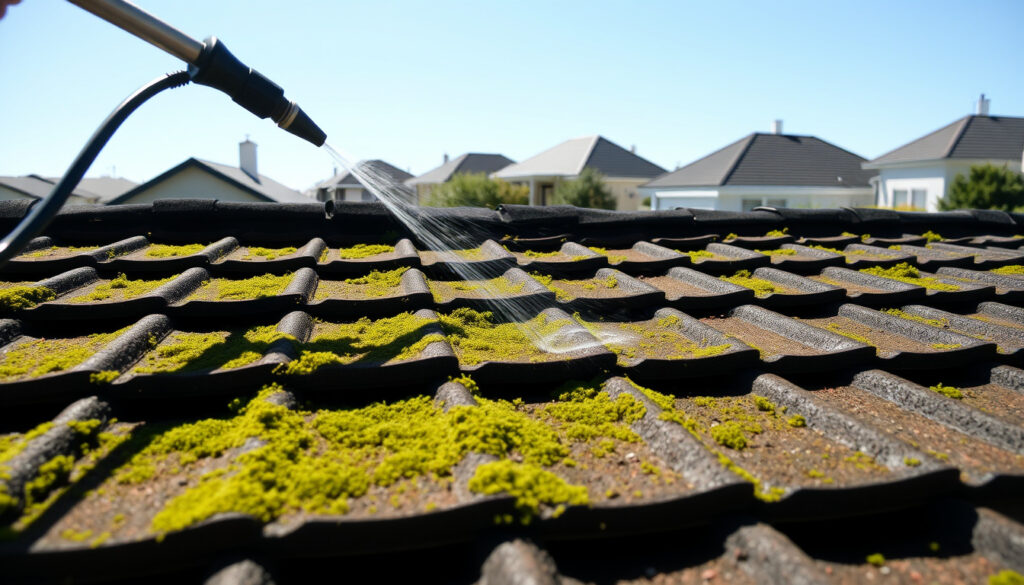
Roof Moss Treatment Auckland: Cost, Timing & Methods
Anyone who owns a roof in Auckland has probably looked up at green patches spreading across the tiles and felt a small wave of resignation. Moss loves the city’s damp, shaded winters, and once it takes hold, a tidy roof becomes a recurring chore. Spray-only moss treatment typically runs between NZ$180 and NZ$450, according to Metro Water Blasting (Auckland roof cleaning specialists), so the real question is which method earns the longest break between scrubs.
Minimum treatment cost (Auckland): $190 + GST ·
Zinc strip lifespan: 10–20 years ·
Best season for moss removal: Spring or autumn ·
Most recommended removal method: Soft washing with biocide ·
DIY moss killer active ingredient: Sodium hypochlorite (bleach) or zinc compounds
Quick snapshot
- In Auckland and Northland, autumn, winter, and spring are all described as workable seasons for roof moss treatment (Blast Away Guys (Auckland roof care provider)).
- Treatment-only work in Auckland typically lands between NZ$250 and NZ$500, separate from a full roof wash. (Blast Away Guys (Auckland roof care provider))
- The exact lifespan of copper strips on Auckland roofs.
- Which commercial moss-killer powder performs best in local conditions.
- How long a treated roof stays moss-free before regrowth begins.
- Moss and lichen treatment results usually improve over 2–6 months, so patience is part of the process (Metro Water Blasting (Auckland roof cleaning specialists)).
- Peak-season rates apply from September to March; off-peak pricing from April to August tends to run lower (Blast Away Guys (Auckland roof care provider)).
- Book treatment in spring or autumn so the biocide gets dry weather to work.
- Heavy moss growth may need specialist removal rather than a standard clean.
Five minutes of price research, one pattern: the lower the quote, the more likely it covers spray-only treatment, and the number climbs steeply once access, roof size, and moss severity enter the conversation.
| Pricing and treatment facts | Typical value |
|---|---|
| Minimum treatment cost (Auckland) | $190 + GST |
| Spray-only moss/lichen treatment | NZ$180–NZ$450 |
| Light growth, treatment only | NZ$180–NZ$350 |
| Medium growth, cleaning + treatment | NZ$299–NZ$750 |
| Typical Auckland roof cleaning budget | NZ$300–NZ$800+ |
| Heavy growth, specialist removal | NZ$499–NZ$1,500+ |
| Best treatment season | Spring or autumn |
| Zinc strip lifespan | 10–20 years |
| Visible results window | 2–6 months |
What is the cost of roof moss treatment in New Zealand?
In Auckland, the market this guide focuses on, pricing covers a wide spectrum — and the gaps between quotes are usually explained by what is included. Using Metro Water Blasting’s 2026 pricing guide (Auckland roof cleaning specialists) as a baseline:
How much should it cost to clean moss off a roof?
- Spray-only treatment: NZ$180–NZ$450
- Light growth, treatment only: NZ$180–NZ$350
- Medium growth, cleaning plus treatment: NZ$299–NZ$750
- Heavy growth, specialist removal: NZ$499–NZ$1,500+
- Typical full roof cleaning job: NZ$300–NZ$800+
A typical Auckland home roof cleaning budget lands between NZ$300 and NZ$800+ (Metro Water Blasting (Auckland roof cleaning specialists)), and quotes shift with property size, number of storeys, roof pitch, access difficulty, travel distance, and how much moss has built up (Blast Away Guys (Auckland roof care provider)).
Calendar timing is another lever: rates are peak-season from September to March, and off-peak pricing from April through August is typically lower, according to the same Blast Away Guys (Auckland roof care provider) guide.
A NZ$180–NZ$450 quote buys a treatment, not a restoration. Heavy growth that has been ignored for years moves the job into specialist removal at NZ$499–NZ$1,500+, so the cheapest number is rarely the final one.
What this means: budget for the NZ$300–NZ$800+ midpoint if you want a realistic figure, and read any quote below NZ$200 as the start of a conversation rather than a total.
What is the best time of year to remove moss from a roof?
Timing matters less in Auckland than in drier parts of the country, because the region is never truly dry for long. Still, some months give a treatment a much better chance to work.
Why spring and autumn are preferred
- Dry, mild weather gives biocide time to bind to the moss before the next rain arrives.
- Late summer and early autumn treatments let moss dry out before the cold, damp stretch of the year.
- Local providers describe autumn, winter, and spring as workable in Auckland and Northland, thanks to the region’s milder winters.
Can moss removal be done in winter?
- Yes, but wet tiles make the treatment less effective and regrowth more likely.
- A winter job may need a follow-up in spring.
- If you book in winter, pick a dry stretch and accept that results may take longer to show.
The pattern: timing is a risk-management decision in Auckland, not a hard rule. The best season is the one that gives the treatment a dry week afterwards.
What is the most effective way to remove moss from a roof?
Local providers and experienced homeowners converge on the same point: a biocide treatment that stays on the roof beats a pressure wash that strips it off.
Pressure washing vs soft washing
- Soft washing applies a biocide that kills moss at the base, then rinses it away — the lower-risk option for tiles.
- Pressure washing is fast and visually satisfying, but it can damage roof tiles if used too aggressively.
- Professional services often combine manual scraping with biocide application for heavy growth.
DIY vs professional treatment
- DIY: low upfront cost, real roof risk, and a result that usually has to be repeated.
- Professional: a bigger invoice, a longer-lasting result, and a crew that handles ladders, pitches, and access.
One comparison table, one pattern: the gap between DIY and professional work is a safety and durability gap as much as a price gap.
| Aspect | DIY treatment | Professional treatment |
|---|---|---|
| Upfront cost | Low — basic sprayer, bleach, brush | NZ$300–NZ$800+ typical; large roofs NZ$600–NZ$1,000+ (Metro Water Blasting (Auckland roof cleaning specialists)) |
| Method | Bleach-and-water spray, 20–30 minute dwell, soft brush, rinse | Biocide soft wash, often with manual scraping |
| Roof safety | Pressure washing can crack or lift tiles if misused | Crews are equipped for access and trained on tile-safe technique |
| Results window | Immediate after rinse, but regrowth is common | Biocide keeps working; visible improvement over 2–6 months |
| Follow-up | Expect to repeat at least once a year | Longer intervals, especially with strips installed afterwards |
A DIY job on a steep, damp Auckland roof saves money today but can cost more later if a tile cracks, a coating gets stripped, or the moss simply comes back before summer ends.
If you are leaning DIY, here is the honest list:
Upsides
- Costs little beyond basic supplies.
- You can act immediately instead of waiting for a booking slot.
- Small moss patches respond well to a gentle bleach treatment.
Downsides
- Roof work is risky, especially on wet, steep, or two-storey roofs.
- Bleach runoff can damage plants and gardens below.
- A DIY spray rarely suppresses regrowth as long as a professional biocide treatment.
DIY roof moss treatment in five steps
Wet roofs are slippery, and bleach solutions make tiles slicker. If your roof is steep, high off the ground, or surrounded by plants you value, this is the moment to call a professional instead.
The method that keeps appearing in homeowner threads goes like this:
- Mix a bleach-and-water solution in a garden sprayer.
- Spray the mossy areas thoroughly and let the solution sit for 20–30 minutes.
- Lightly scrub the moss with a soft-bristled brush.
- Rinse the roof with clean water.
- Once the roof is dry, install zinc or copper strips along the ridges to slow regrowth.
What kills moss off a roof?
Two families of products dominate the answers: metal strips that release moss-killing ions every time it rains, and powders or liquids sprayed or sprinkled directly onto the roof.
What is the white powder people put on their roofs?
- It is usually a zinc- or copper-sulfate-based moss killer.
- Rain dissolves the powder and carries the active compound across the tiles, killing moss spores in its path.
- You will also see it sold in sprinkle-on granules for ridge lines.
What type of powder can be used to remove moss from roofs?
- Zinc sulfate and copper sulfate are the two common chemical options.
- Bleach-and-water sprays are the liquid alternative, but runoff can harm plants.
- Zinc or copper strips are the slow-release version of the same chemistry.
What is the best moss removal powder?
The best powder is the one that gets reapplied before the moss returns. Most commercial brands work; consistency is what separates a clean roof from a green one.
What this means: the moss-killing ingredient matters less than the follow-up. Moss spores are everywhere in Auckland, so the roof that stays clean is the one treated on a schedule, not once.
How long does a zinc strip last on a roof?
Zinc strips are the low-maintenance favourite because they sit on the roof and keep working for years without a ladder or a sprayer.
Is zinc or copper better for roof moss?
- Zinc strips typically last 10–20 years before they need replacing.
- Copper strips last longer but cost more upfront.
- Copper releases ions more effectively per gram, making it the more aggressive option for stubborn moss.
Think of strips as slow-release tablets for the roof: rain does the distributing, so placement matters more than the material choice.
How do I apply zinc strips to my roof?
- Weave strips under ridge caps so rainwater runs over them on its way down the roof.
- Or secure strips along ridge lines with roofing screws, exposed to rainfall.
Strips prevent regrowth; they do not remove moss that is already there.
The catch: install strips only after a treatment, so the roof surface starts clean — otherwise you are just protecting the moss beneath them.
Here is where the research stands once you strip out the sales pitch:
Confirmed facts
- Spray-only moss treatment in Auckland runs roughly NZ$180–NZ$450, with treatment-only jobs around NZ$250–NZ$500 (Metro Water Blasting).
- Moss and lichen treatment results usually improve over 2–6 months (Metro Water Blasting).
- Pricing depends on property size, storeys, roof pitch, access, travel distance, and moss severity (Blast Away Guys).
What’s unclear
- How long copper strips last on Auckland roofs.
- Which commercial moss-killer powder is the best local buy.
- How long a professionally treated roof stays fully moss-free.
- Whether pressure washing is ever a better bet than soft washing on older tiles.
What the pros and the DIY crowd say
Auckland homeowners split into two camps: those who pay for a professional soft wash, and those who climb up with a sprayer and a brush. Both get results; only one keeps the moss away for years.
“Spray a mix of bleach/water on roof, allow to sit for 20-30 mins, then lightly scrub off moss with soft bristled brush and clean water.”
Homeowner describing a DIY roof moss treatment on Reddit
“A typical Auckland home roof cleaning budget is about NZ$300 to NZ$800+.”
Metro Water Blasting (Auckland roof cleaning specialists)
Choosing between DIY and professional roof moss treatment in Auckland is not really a contest of prices; it is a contest of convenience, safety, and how long you want the result to last. The evidence points one direction: a soft-wash biocide treatment booked in spring or autumn, with zinc or copper strips added afterwards if you want to slow the next round of regrowth. For the typical Auckland homeowner staring at a mossy roof, the decision is clear: pay for a proper treatment while the growth is still moderate, or keep a sprayer, a soft brush, and a yearly reminder on the calendar for as long as you own the house.
roofcare.co.nz, metrowaterblasting.co.nz, metrowaterblasting.co.nz, metrowaterblasting.co.nz, sprayandwash.co.nz, mosscrew.co.nz, pwb.co.nz, northshorehousewash.co.nz, roofingexpert.co.nz, raccoonwash.co.nz
Frequently asked questions
How long does a 25 year roof really last?
A 25-year rating is an estimate, not a promise. In damp, moss-prone climates, a roof that is never cleaned can wear out faster than the label suggests, and roof care specialists warn that moss, mould, and lichen can damage roofing materials over time.
Does roof moss affect the lifespan of asphalt shingles?
Yes. Moss traps moisture against the shingle surface, and when that moisture never fully dries out, the material degrades more quickly. In Auckland’s humid climate, a moss-covered shingle roof is under constant damp stress.
Can I use bleach to remove roof moss safely?
Yes, with care. The common DIY method uses a bleach-and-water mix, a 20–30 minute dwell time, a soft-bristled brush, and a clean-water rinse. Protect plants below from runoff, and avoid pressure washing, which can damage tiles.
How often should I schedule roof moss treatment?
A reasonable rhythm in Auckland is an annual check, with treatment every 12–24 months depending on shade, roof orientation, and how quickly moss regrows.
Is professional roof moss treatment worth the cost in Auckland?
For heavy growth, steep roofs, or roofs that have never been cleaned, yes — the alternative is a DIY job that may crack tiles or fail to stop regrowth. A typical professional budget is NZ$300–NZ$800+ (Metro Water Blasting).
Do zinc strips stop moss from coming back?
They reduce regrowth by releasing zinc ions into rainwater, but they will not remove moss that is already on the roof. Install strips after a treatment so the roof starts clean.
What happens if I ignore roof moss?
Moss holds moisture against the roof surface, and roof care specialists describe moss, mould, and lichen as a genuine cause of roofing damage when left untreated.
More related posts
 Chelsea vs Liverpool Timeline: Head-to-Head History
 Fiji vs Samoa Rotorua 2025: Score, Highlights, and How to Watch
 Heat Pump Installation Christchurch – 2025 Costs & Top Installers
 Land for Sale Waikato: Prices, Foreign Rules & Build vs Buy Guide
 High Performance Sport NZ: Role, Top Sports, Top Paid Athletes
 Plane Crash Lake Hawea: Ivan Van de Water Killed, 1 Injured
 Pacers vs Charlotte Hornets Match Player Stats: Full Breakdown
 Signs of Colon Cancer: Early Warning Signs to Know