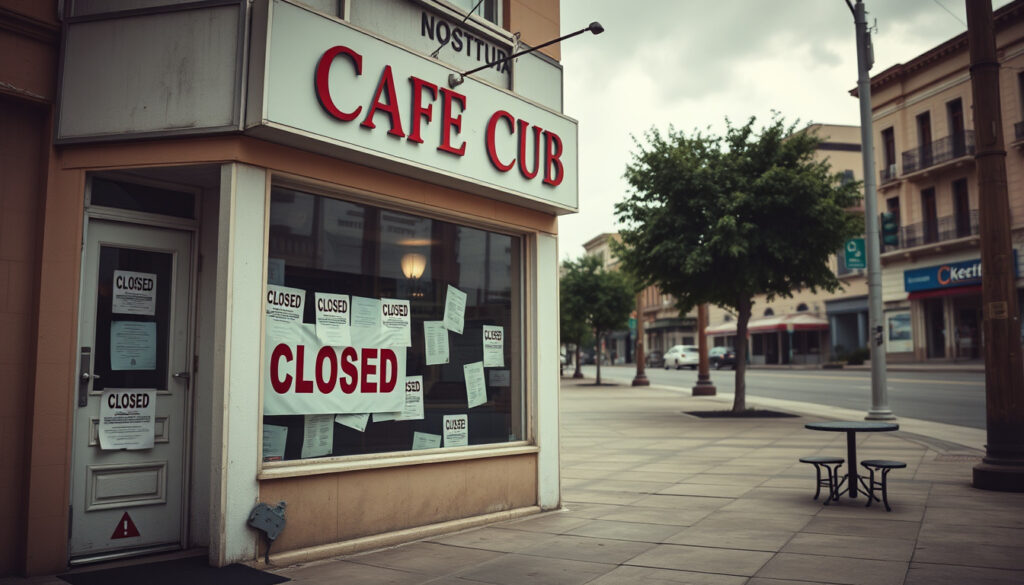
Cafe Cuba Liquidation Palmerston North: Closure, $1.6M Debts
For years, Cafe Cuba held down a prime spot overlooking Palmerston North’s Square, serving as a neighbourhood anchor for locals who drifted in for coffee, lunch, or just a change of scenery. Now the cafe is closed, its parent company in liquidation, and creditors owed more than $1.6 million — including a $1.5 million tax bill to Inland Revenue. The story raises uncomfortable questions about what happens when a community favourite folds, and whether the site might ever see service again.
Closure Date: 19 August · Creditors Owed: $1.6m · Tax Bill: $1.5m · Trading As: Castro Ltd · Assets Status: Sold to local business
Quick snapshot
- Castro Limited placed into liquidation (Newstalk ZB)
- Owners: Darlene and Paul Woodhead (Newstalk ZB)
- Closed 19 August (Newstalk ZB)
- Full timeline of tax debt accumulation
- Exact cause of business failure
- Whether local buyer will reopen the site
- 19 August: Facebook closure post
- August 2025: Liquidation entered
- 29 August 2025: NZ Herald reports $1.5m tax debt
- Assets sold to local business
- Staff partly repaid from sale (March 2026)
- Revival potential flagged by NZ Herald
Key details about Cafe Cuba’s liquidation emerge from official sources and news reporting, as summarised below.
| Field | Value |
|---|---|
| Status | Closed and liquidated |
| Closure Date | 19 August |
| Total Debts | Over $1.6m |
| Tax Owed | $1.5m |
| Company | Castro Ltd |
| Assets | Sold to local business |
Why did Cafe Cuba close down?
Cafe Cuba shut its doors permanently in August 2026 after its parent company, Castro Limited, entered liquidation owing creditors more than $1.6 million. The scale of the debt — particularly a $1.5 million tax bill — made survival impossible, even for a venue that had served the Palmerston North community for years.
Financial debts and tax issues
The tax bill alone tells most of the story. According to NZ Herald reporting, Inland Revenue was owed $1.5 million — a figure that dwarfs what most mid-sized hospitality businesses carry in working capital. The debt appears to have accumulated over an extended period, and once liquidators were appointed, the legal framework for continuing operations simply did not exist.
Kieran Jones and Steven Khov of Khov Jones Ltd were named as liquidators of Castro Limited (Newstalk ZB). Under New Zealand insolvency law, when a company enters liquidation, secured creditors — including the tax authority — are paid first from asset sales. Unsecured creditors, including customers with outstanding vouchers, rank lower in the repayment hierarchy.
Insolvency report details
The first liquidator’s report for Castro Limited was due on August 26, 2026 (Newstalk ZB). That report would formally document the company’s financial position, asset holdings, and the likely dividend — if any — to creditors.
What the report does not yet explain is why the tax debt reached $1.5 million. The breakdown by tax type — whether income tax, GST, payroll tax, or a combination — has not been publicly disclosed.
Is Cafe Cuba still open?
No. Cafe Cuba is not operating. The venue closed permanently on 19 August 2025, with the closure confirmed via a Facebook post from the owners and subsequent reporting by Newstalk ZB.
Official closure announcement
The owners posted on Facebook that Cafe Cuba had closed “after many wonderful years of serving the amazing community in Palmerston North” (Newstalk ZB). The post marked the end of service for good — no reopening was announced at that time.
Current status post-liquidation
Castro Limited is now in formal liquidation. Outstanding reservations and vouchers are no longer valid — customers who held gift cards or had prepaid bookings are treated as unsecured creditors in the liquidation process (Newstalk ZB). They rank behind secured creditors such as Inland Revenue, employees owed wages, and any banks with security over assets.
Customers who paid by credit or debit card for future services may be able to request a chargeback from their card provider under consumer protection rules. Those who paid cash or held gift vouchers face more limited options once liquidation is complete.
Who is the new owner of Cafe Cuba?
The assets of Cafe Cuba have been sold to a local business, though the identity of the buyer has not been publicly confirmed. This type of asset sale is standard in liquidation proceedings — the physical contents, equipment, and possibly the lease rights are transferred to a new party, separate from the debts of the defunct company.
Assets sale to local business
NZ Herald reported that a local business snapped up Cafe Cuba’s assets following the liquidation (NZ Herald). The sale proceeds were used, in part, to repay staff who were owed wages — a priority under New Zealand employment law even before general unsecured creditors see any return.
Buyer details from reports
Neither the buyer’s name nor their stated plans have been reported. What is clear is that the acquisition was of physical assets only — the buyer acquired equipment, possibly fittings, and whatever remained of the business’s operational infrastructure. They did not acquire the debt-laden entity Castro Limited.
A business that buys assets from a liquidated company starts fresh with no debts — but also inherits no goodwill, brand recognition, or established customer base. Whether the new operator chooses to continue as a cafe or convert the site to something else is entirely their decision.
Is this closed Palmerston North eatery about to have another life?
Possibly — but it remains unconfirmed. NZ Herald noted that Cafe Cuba “may be set for a revival” following the asset sale (NZ Herald). However, revival hints should be read carefully: the phrase is speculative, and no reopening date or operator has been announced.
Hints of revival
The fact that a local business bought the assets — rather than an equipment liquidator selling off individual items — suggests the buyer saw some ongoing value in the Cafe Cuba setup. A prime location overlooking the Square, existing kitchen infrastructure, and established foot traffic all represent a commercial opportunity for the right operator.
Reopening announcements
As of the most recent reporting, no formal announcement of a reopening has been made. Staff were partly repaid from the sale proceeds in March 2026 (Newstalk ZB), which is a positive sign that the asset sale generated meaningful proceeds — but staff repayment and customer reopening are separate questions.
What is known about Cafe Cuba liquidation?
The liquidation of Castro Limited followed a straightforward trajectory: mounting debt, failure to meet tax obligations, and an inability to continue trading. The key figures are now matters of public record through the liquidators’ reports and news reporting.
Liquidators’ first report
Kieran Jones and Steven Khov of Khov Jones Ltd were appointed liquidators on behalf of the creditors (Newstalk ZB). Their first report, due August 26, 2026, was expected to provide a full accounting of assets, liabilities, and the likely outcome for each class of creditor.
The report would also address the relationship between Castro Limited and a related entity, Little and Friday, whose liquidator’s report showed it owed creditors $1.4 million — including $639,389.19 to Inland Revenue (Newstalk ZB). Whether there was any financial connection between the two entities has not been publicly disclosed.
Asset sales and repayments
The sale of Cafe Cuba’s assets generated enough proceeds to partly repay staff wages — a priority obligation under New Zealand’s Employment Relations Act. Whether any return will flow to general unsecured creditors remains uncertain and depends on the final asset valuations and the total pool of secured claims.
Customers who have paid for undelivered goods or services are treated as unsecured creditors when a company goes into liquidation.
Competition and Consumer Protection Commission, Ireland consumer guidance on business closures
Unsecured creditors rank behind secured creditors such as Revenue, employees owed wages, and banks (CCPC consumer guidance). In practice, this means customers holding gift vouchers or prepaid bookings typically receive little or no compensation from a liquidation — a reminder of the risk of paying fully in advance for services not yet delivered.
What the community lost — and what comes next
Cafe Cuba was more than a restaurant. For the locals who drifted in most days, it was a place that held the shape of their routines — a morning coffee spot, a Thursday lunch place, a fallback when the Square was too quiet for the CBD. That kind of attachment does not show up in liquidation documents, but it colours how the closure lands.
The asset sale means someone local is now sitting on the keys to a prime hospitality site in the centre of Palmerston North. Whether they open a cafe next month, a bar next year, or leave it shuttered will depend on commercial calculations the public will not see coming. What is clear is that the site is no longer owned by Castro Limited — and whatever replaces it will start with a clean slate on the debt side.
For creditors owed money by the old business, the path to recovery is narrow. Inland Revenue sits at the front of the queue. Staff got a partial payout. General unsecured creditors — including any customers who paid upfront — are likely to receive little.
Customers who paid by card should check with their provider about chargeback eligibility immediately. Those with vouchers from a liquidated business should contact the liquidator to register their claim, even if full recovery is unlikely.
What this means: the Cafe Cuba site now belongs to whoever bought the assets, and the community that supported the original business has no formal leverage over what happens next.
Related reading: What is Provisional Tax in NZ · Michelin Star Restaurants NZ
Palmerston North’s retail scene faces headwinds, as seen in Cafe Cuba’s $1.6m debt collapse alongside the recent Smiths City liquidation of a century-old store.
Frequently asked questions
What caused Cafe Cuba’s financial troubles?
The primary publicly disclosed cause was a $1.5 million tax debt to Inland Revenue that the business could not satisfy. The exact timeline of how that debt accumulated, and whether specific management decisions contributed, has not been disclosed in liquidators’ reports released to date.
How much did Cafe Cuba owe in taxes?
Cafe Cuba’s parent company, Castro Limited, owed Inland Revenue $1.5 million (NZ Herald). The breakdown by tax type has not been publicly released.
Was Cafe Cuba sold after liquidation?
Yes. Cafe Cuba’s assets were sold to a local business following the liquidation of Castro Limited (NZ Herald). The identity of the buyer has not been publicly confirmed.
Can customers still visit Cafe Cuba?
No. Cafe Cuba closed permanently on 19 August 2025 and is not operating. Outstanding reservations and vouchers are no longer valid under liquidation rules.
What does the future hold for the Cafe Cuba site?
The site is under the control of whoever acquired the assets. NZ Herald reported that the venue may be set for revival, but no formal reopening announcement has been made. What happens next depends on the buyer’s commercial plans.
Where can I find the insolvency report?
The Companies Registration Office holds records on liquidations, including the details of appointed liquidators. Customers and creditors can contact Khov Jones Ltd directly to inquire about their claim status (CCPC).
Did staff get paid after closure?
Staff were partly repaid from asset sale proceeds in March 2026 (Newstalk ZB). Under New Zealand law, employee wage claims rank ahead of general unsecured creditors but behind secured creditors such as Inland Revenue.
More related posts
 Things to Do in Christchurch, New Zealand: Top Attractions & Tips
 How to Buy Shares in NZ: A Beginner’s Guide (2025)
 Transfer Money to Thailand: Best Ways from UK, USA, India
 Figure Skating Schedule and Results: 2026 Olympics
 Next Rugby World Cup 2027: Host, Tickets, Fixtures & Schedule
 Land for Sale Taupo: Prices Per Hectare & Farm Guide