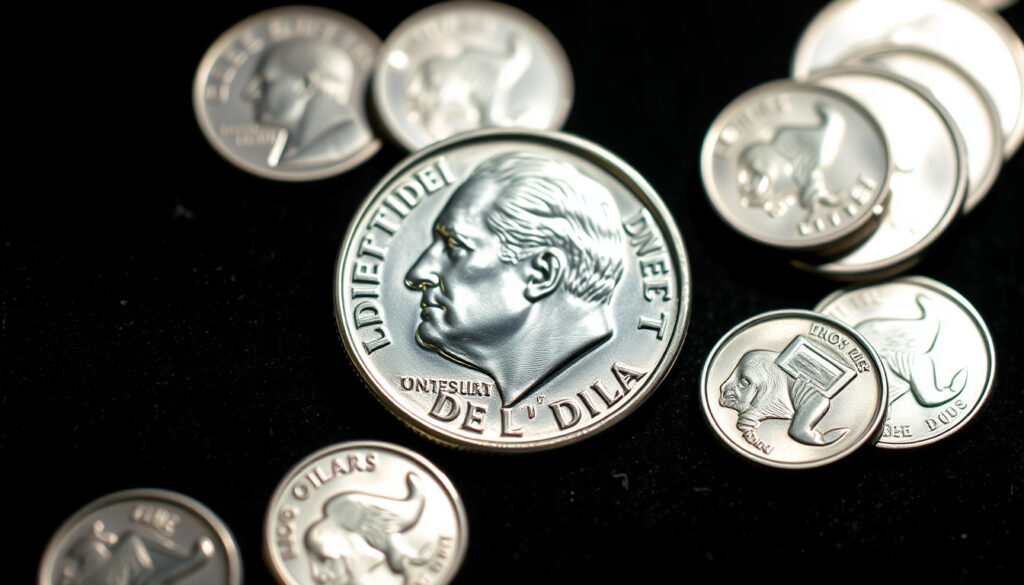
How Much Is a Dime – Value, Specs & History Guide
The United States dime is the smallest and thinnest coin currently in circulation, yet it carries a rich history spanning nearly 230 years. Authorized by the Coinage Act of 1792 and first minted in 1796, this ten-cent piece has undergone significant transformations in design, composition, and cultural significance. While its face value remains constant, the dime’s worth extends far beyond mere currency in collector markets and everyday slang alike.
Understanding the dime requires examining multiple dimensions: its fixed monetary value, physical characteristics, historical evolution, and the various ways the term appears in American culture. From the roped reeded edges to the portrait of Franklin D. Roosevelt that graces the current design, each element tells part of a larger story about American monetary policy and national identity.
How Much is a Dime Worth?
The face value of a United States dime is precisely ten cents, representing one-tenth of a dollar. This denomination has remained constant since the coin’s inception, though its purchasing power and collector value have fluctuated dramatically over time. For transactions, a dime equals $0.10 USD and is accepted as legal tender nationwide.
Several key insights emerge when examining the dime’s monetary role in American commerce and collecting:
- Standard value: Fixed at 10 cents since the coin’s introduction under the Coinage Act of 1792
- Collector premiums: Rare dimes can exceed $1 million at auction, with the 1894-S Barber dime commanding six figures
- Bullion appeal: Pre-1965 silver dimes trade based on silver content, typically 20-30 times face value
- Inflation impact: A dime from 1796 would require over $3.50 in today’s purchasing power
- Gresham’s law effect: Silver dimes vanished from circulation after 1965 as metal value exceeded face value
- Street slang: The term “dime” colloquially refers to $10 in illegal drug transactions
| Attribute | Value |
|---|---|
| Face Value | 10 cents |
| Weight | 2.268 grams |
| Diameter | 0.705 in (17.91 mm) |
| Thickness | 0.053 in (1.35 mm) |
| Edge | Reeded |
| Composition | 91.67% copper, 8.33% nickel |
What Are the Physical Specifications of a US Dime?
Modern dimes possess specific physical characteristics that distinguish them from other U.S. coins. The Roosevelt dime, introduced in 1946 and remaining in production today, measures 17.91 millimeters in diameter, making it the smallest diameter among currently circulating coins. Its thickness of 1.35 millimeters contributes to its lightweight feel of approximately 2.27 grams.
Composition and Materials
The current dime composition represents a significant departure from earlier versions. Since 1965, dimes have been minted as a clad “sandwich” structure, with outer layers of 75% copper bonded to 25% nickel, enclosing a pure copper core. This results in an overall composition of 91.67% copper and 8.33% nickel by weight. The U.S. Mint adopted this material to mimic the mass and electrical properties required for vending machines while eliminating precious metal costs. The transition occurred under the Coinage Act of 1965, which fundamentally restructured American coinage following a silver shortage.
The clad composition means modern dimes contain approximately $0.006 worth of copper and nickel. This intrinsic value falls far below face value, distinguishing base-metal coins from silver-era dimes.
Dimensional Standards
The dime’s dimensions have evolved throughout its history. Early silver dimes measured 19 millimeters under the Draped Bust design (1796-1807) and gradually decreased to 17.9 millimeters by the Seated Liberty era. The current diameter of 17.91 millimeters represents standardization achieved by the late 1800s. The coin’s reeded edge, featuring 118 ridges, serves as both an anti-counterfeiting measure and a heritage element from earlier silver coins.
| Dime Type | Period | Diameter | Weight | Composition |
|---|---|---|---|---|
| Draped Bust | 1796–1807 | 19 mm | 2.7 g | 89.24% Ag, 10.76% Cu |
| Capped Bust | 1809–1837 | 18.5–18.8 mm | 2.7 g | 89.24% Ag, 10.76% Cu |
| Seated Liberty | 1837–1891 | 17.9 mm | 2.5–2.67 g | 90% Ag, 10% Cu |
| Barber | 1892–1916 | 17.9 mm | 2.5 g | 90% Ag, 10% Cu |
| Mercury/Winged Liberty | 1916–1945 | 17.9 mm | 2.5 g | 90% Ag, 10% Cu |
| Roosevelt | 1946–1964 | 17.9 mm | 2.5 g | 90% Ag, 10% Cu |
| Roosevelt (Modern) | 1965–present | 17.91 mm | 2.268 g | 91.67% Cu, 8.33% Ni |
Why Is It Called a Dime and What’s Its History?
The word “dime” derives from the French “dixième,” meaning “one-tenth,” reflecting the coin’s value as one-tenth of a dollar. This etymology traces directly to the original Coinage Act of 1792, which established the decimal monetary system for the United States. Unlike older European currencies with complex subdivisions, America’s new system embraced straightforward decimal fractions, making the dime’s name both descriptive and systematic.
Origins and Early Production
The first official dimes circulated in 1796 under the Draped Bust design, created by engraver Robert Scot. An earlier “disme” prototype had been prepared but never entered circulation. Production remained sporadic, with minting suspended entirely between 1815 and 1819 due to insufficient silver supplies and political turmoil. Engravers John Reich and William Kneass later developed the Capped Bust design in 1809, initiating a series of design iterations that would continue for over a century.
The Seated Liberty design, introduced in 1837 with Christian Gobrecht’s contributions, represented a long era of consistent diameter standards. Arrows appeared at certain dates (1853, 1873) to mark adjustments in weight due to silver market fluctuations. The Mint Act of 1873 standardized specifications to align with the French 5-franc coin, adding 10 milligrams to achieve exactly 2.5 grams. Non-arrow 1873 coins were subsequently melted.
No dimes were struck for circulation in 1932-1933, with only proof specimens produced. This gap occurred during the Great Depression when silver reserves were constrained and mintage numbers dropped significantly.
Design Evolution to Modern Times
The Winged Liberty dime, commonly called the Mercury dime despite depicting Lady Liberty rather than the Roman god, debuted in 1916. Designed by Adolph A. Weinman, this popular coin remains a favorite among collectors who remember finding them in childhood change. The Roosevelt dime, honoring President Franklin D. Roosevelt who passed away in 1945, replaced it in 1946. This marks the longest-running design in dime history, surviving through the 1965 composition change and continuing into the present day.
What Is a ‘Dime Bag’ in Slang?
The term “dime bag” carries a meaning entirely separate from numismatic contexts. In street vernacular, a dime bag refers to a ten-dollar quantity of illegal drugs, most commonly marijuana. The slang derives from the dime’s ten-cent face value, establishing an intuitive numerical correlation between the coin’s denomination and a drug transaction amount.
This terminology gained widespread exposure through music, film, and media depictions throughout the 20th century. While usage varies regionally and among subcultures, the $10 standard remains consistent. The phrase represents one of several monetary references to coins in American slang, alongside terms like “nickel” for five-dollar amounts in certain contexts.
In numismatic contexts, “dime” and “dime bag” refer exclusively to the ten-cent coin and protective storage containers respectively. The drug-related slang has no connection to coin collecting and should not be conflated with legitimate numismatic terminology.
Timeline of Key Dime Milestones
The evolution of the American dime spans multiple centuries, reflecting broader changes in monetary policy, design philosophy, and manufacturing technology:
- 1792: Coinage Act authorizes the ten-cent denomination as part of America’s decimal currency system
- 1796: First Draped Bust dimes enter circulation, marking the coin’s official debut
- 1809: Capped Bust design introduced, establishing the 118-reeded edge standard
- 1837: Seated Liberty design adopted; diameter standardizes to 17.9 mm
- 1853: Arrows added to dates indicating weight increases for silver price adjustments
- 1873: Mint Act standardizes weight; non-arrow 1873 coins melted
- 1892: Charles Barber’s design replaces Seated Liberty
- 1916: Winged Liberty (Mercury) dime debuts; only 264,000 minted in Denver
- 1946: Roosevelt dime replaces Mercury design following FDR’s death
- 1965: Clad composition replaces silver to reduce production costs
What Is Certain and What Remains Unclear
Several aspects of dime history and valuation are definitively established, while others remain subjects of ongoing research or market variability:
| Established Information | Variable Factors |
|---|---|
| Face value: 10 cents USD | Collector market values fluctuate with demand |
| Legal tender status nationwide | Intrinsic metal value changes with commodity prices |
| Current composition since 1965 | Exact production numbers for certain years |
| Diameter: 17.91 mm (modern) | Inflation adjustment calculations vary by methodology |
| Roosevelt design since 1946 | Rarity grades for individual specimens |
The dime’s purchasing power in 1796 would require approximately $3.50 in current currency, though precise calculations depend on which economic indicators form the basis of comparison. Pre-1965 silver dimes maintain “junk silver” status, trading at 20-30 times face value based on spot silver prices, with the exact multiplier shifting daily with market conditions. The dime’s purchasing power in 1796 would require approximately $3.50 in current currency, though precise calculations depend on which economic indicators form the basis of comparison, and for a different perspective on currency conversion, you can explore the 20 euro to aud conversion.
The Dime’s Role in American Culture and Economy
Beyond its monetary function, the dime plays several important roles in American commerce and culture. Its small size facilitates micro-transactions that larger denominations cannot efficiently serve. Retail prices ending in nine cents frequently require the dime as part of change, making it essential for cash transactions despite its modest value.
The dime’s cultural presence extends through music, literature, and everyday language. References to dimes appear throughout American songwriting, while the coin’s relative smallness has generated expressions about finding money in couches and sidewalk locations. For numismatic collectors, the Mercury dime represents a gateway coin—affordable enough for newcomers yet valuable enough for serious accumulation.
In an era of increasing digital payments, physical coins including dimes see reduced everyday usage. However, vending machines, parking meters, and coin-operated devices still require denominations like the dime for proper function. The coin maintains relevance in specific commercial contexts even as card and mobile payments dominate retail transactions.
Verified Sources and Expert Perspectives
The numismatic community recognizes several authoritative sources for dime information and valuation. The Stack’s Bowers auction house provides detailed market analysis and historical records of significant transactions. Professional Coin Grading Services (PCGS) maintains standardized grading guidelines that determine collector values. The United States Mint offers official specifications for current coinage.
“The dime is the workhorse of small change, facilitating transactions that no other denomination can efficiently serve.”
— U.S. Mint historical records
“Arrows at the date marked weight adjustments in response to silver market pressures, demonstrating how commodity values influenced coin design.”
— Numismatic research documentation
Summary
The American dime represents a fascinating intersection of history, economics, and culture. Its face value of ten cents has remained constant for over two centuries, while its composition evolved from 89-90% silver to today’s copper-nickel clad structure. Physical specifications including 17.91 mm diameter and 2.268 gram weight distinguish it as the smallest circulating coin. Collector values range from face value for common specimens to over $1 million for legendary rarities like the 1894-S Barber dime. The term “dime bag” reflects the coin’s cultural penetration into everyday slang, though it refers to drug transactions rather than numismatic contexts. Whether examined through historical documents, market data, or cultural references, the dime offers insights into American monetary evolution and national identity. For readers interested in related monetary topics, the NZD to Singapore Dollar converter provides current exchange information, while ANZ Savings Interest Rates offers context on modern financial considerations.
Frequently Asked Questions
What is a dime bag?
A dime bag is slang for a $10 quantity of illegal drugs, typically marijuana. The term derives from the dime’s ten-cent denomination, not from coin collecting.
How much does a dime weigh?
Modern dimes weigh 2.268 grams. Pre-1965 silver dimes weighed approximately 2.5 grams, reflecting the heavier composition of earlier coinage.
What is the diameter of a US dime?
The current dime measures 17.91 millimeters (0.705 inches) in diameter, making it the smallest circulating coin in the United States.
What are the most valuable dimes?
The 1894-S Barber dime (only 24 struck) and 1873-CC No Arrows are among the rarest. The 1916-D Mercury dime, with a mintage of 484,000, can reach $15,000-$30,000 in high grades.
Why did dimes stop being silver?
The Coinage Act of 1965 eliminated silver from dimes and quarters due to silver shortages and rising metal costs. The clad composition mimics the mass and electrical properties required for vending machines.
How much was a dime worth in 1796?
A 1796 dime had approximately $3.50 in purchasing power adjusted for inflation, though its silver content gave it intrinsic value exceeding its face value during periods of high silver prices.
What is the current composition of a dime?
Modern dimes consist of a copper core bonded to copper-nickel outer layers, resulting in 91.67% copper and 8.33% nickel by weight.
More related posts
 Demazin Cold and Flu: Dosage, Side Effects, and Safety Guide
 Arctic Fox hair dye: safety, fade time, and how to use it
 Southland Boys High School: Fees, Enrollment, Rugby Guide
 Compare Travel Insurance NZ: Best Companies & Coverage Guide
 Fiji vs Samoa Rotorua 2025: Score, Highlights, and How to Watch
 Hard Rated Alcoholic Lemon: 6% ABV, Low Sugar, Where to Buy
 Dancing with the Stars NZ: Winners, Eliminations & Deaths
 Best Sleep Tracking Apps – Free for iPhone Android Watch