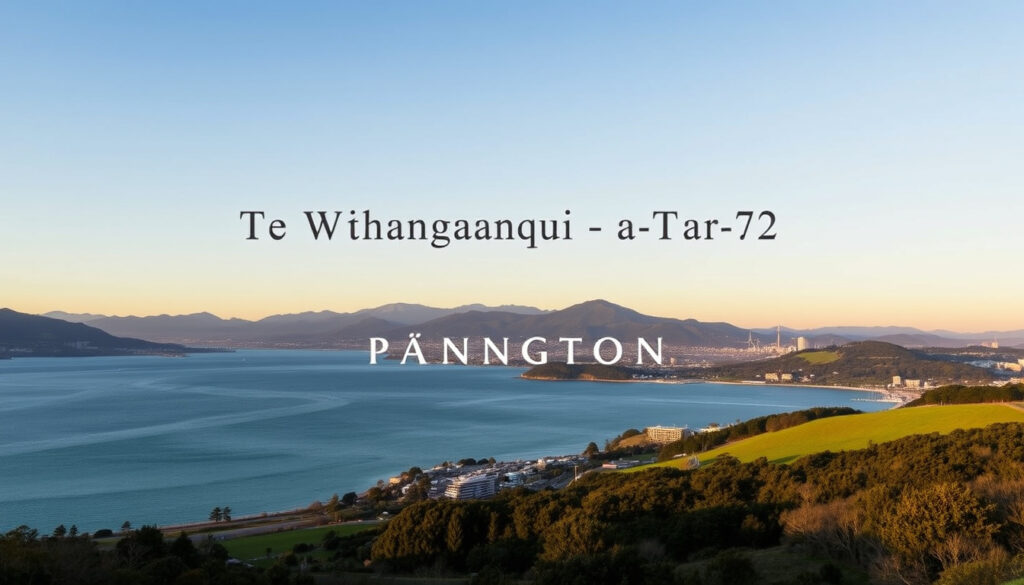
Māori Name for Wellington: Te Whanganui-a-Tara, Pōneke
Ask someone from Wellington what they call their city and you might get three different answers before lunch. Te Whanganui-a-Tara rolls off the tongue at council meetings, Pōneke shows up in casual conversation, and the older legend of Te Upoko o te Ika a Maui lingers in the stories of the harbour itself.
Official Māori name: Te Whanganui-a-Tara ·
Common nickname: Pōneke ·
Legendary name: Te Upoko o te Ika a Maui
Quick snapshot
- Wellington has three attested Māori names — Te Whanganui-a-Tara, Pōneke, and Te Upoko o te Ika a Maui (Wikipedia entry for Wellington)
- Te Whanganui-a-Tara is the traditional name recognised by local iwi and government (Wellington City Council history page)
- Pōneke is a 19th‑century Māori transliteration of “Port Nick” (Wiktionary definition of Pōneke)
- The exact origin of “Pōneke” — some sources suggest it may derive from “Pō Nekeneke” (“the journey into the night”) rather than “Port Nick” (Wiktionary alternate etymology)
- Precise rohe boundaries of iwi in Wellington city centre remain contested in Treaty settlement discussions (University‑hosted PDF on Wellington Tenths Trust)
- Te Whanganui-a-Tara originates from the legendary explorer Tara, son of Whatonga, who explored the harbour centuries before European contact (Wellington City Council)
- Pōneke emerged after European settlement in the 1840s as a Māori rendering of the harbour’s English name (Wikipedia)
- Te Whanganui-a-Tara is increasingly used in official signage, council documents, and civic branding (Greater Wellington Regional Council page)
- Wellington Museum now runs a dedicated exhibition titled “Te Whanganui-a-Tara,” cementing the name in cultural institutions (Wellington Museum exhibition page)
The three names aren’t interchangeable labels — they’re layers of history pressed into the same harbour. For visitors and residents alike, using Te Whanganui-a-Tara in formal contexts and Pōneke in casual speech shows an understanding that Wellington’s identity was never singular, and never will be.
| Label | Value |
|---|---|
| Official Māori name | Te Whanganui-a-Tara (Wellington City Council) |
| Common nickname | Pōneke (Wiktionary) |
| Legendary name | Te Upoko o te Ika a Maui (Wikipedia) |
| Earliest known name from legend | Te Upoko o te Ika a Maui (Wikipedia) |
| English name origin | Arthur Wellesley, 1st Duke of Wellington (Wikipedia) |
| Pronunciation (Te Whanganui-a-Tara) | /te ˈfaŋanʉi a taɾa/ (Wellington City Council) |
| Pronunciation (Pōneke) | /ˈpɔːnɛkɛ/ (Wiktionary) |
| Formal usage context | Council documents, official ceremonies, Treaty settlements (Greater Wellington Regional Council) |
| Informal usage context | Everyday speech, media, local business names (Wikipedia) |
What is the Māori word for Wellington?
The short answer is that Wellington has three Māori names, each with a distinct origin and usage. The most widely recognised traditional name is Te Whanganui-a-Tara, which the Wellington City Council explains means “the great harbour of Tara” — a reference to Tara, son of the Polynesian explorer Whatonga, who is said to have explored the area centuries before European arrival.
The second name, Pōneke, functions as the everyday colloquial term. According to Wiktionary’s entry for Pōneke, it is most commonly understood as a 19th‑century Māori transliteration of “Port Nick” (short for Port Nicholson, the harbour’s English name during early colonial settlement).
The third and oldest legendary name is Te Upoko o te Ika a Maui — “the head of Maui’s fish” — which refers to the Māori tradition that the North Island is a great fish hauled up by the demigod Māui. Wikipedia’s overview of Wellington lists this name alongside the other two, placing it in the realm of mythological geography rather than everyday usage.
Te Whanganui-a-Tara: the great harbour of Tara
- Derived from the legendary explorer Tara, son of Whatonga (Wellington City Council)
- The name refers to the harbour itself, then extended to the city by association (Wikipedia)
- Used formally by Greater Wellington Regional Council in official designations like “Whaitua te Whanganui-a-Tara”
- Analysed in Victoria University of Wellington Law Review as “the big bay of Tara,” with the element whanga corresponding to bay or bight (VUW Law Review article on Māori place naming)
Pōneke: the transliteration of Port Nicholson
- Widely accepted origin: a shortening of “Port Nick” into Māori phonology (Wikipedia)
- Alternate etymology recorded in Wiktionary: “Pō Nekeneke” — “the journey into the night” — referencing the departure of Te Āti Awa after displacement by European colonists
- Used in casual speech, local media, and business names across the city (Wikipedia)
Te Upoko o te Ika a Maui: the head of Maui’s fish
- Rooted in the pan‑Māori legend of Māui fishing up the North Island (Wikipedia)
- In this tradition, Wellington Harbour sits at the “head” of the fish, while the rest of the North Island forms the body
- Used primarily in mythological, educational, and ceremonial contexts
Te Whanganui-a-Tara, Pōneke, and Te Upoko o te Ika a Maui aren’t competing names — they’re different lenses. The first frames the harbour as a place of exploration, the second captures colonial contact, and the third roots the whole city in an origin story shared across Polynesia.
The implication: each name reveals something distinct about the people who gave it. Te Whanganui-a-Tara belongs to the explorers who first found the harbour; Pōneke reflects the encounter between Māori and settlers; Te Upoko o te Ika a Maui connects the city to a much wider Pacific cosmology.
Is Wellington Pōneke or Whanganui a tara?
Both are correct — the question is simply which context you’re in. Te Whanganui-a-Tara is the traditional Māori name, recognised by local iwi and enshrined in official documents from the Wellington City Council and Greater Wellington Regional Council. Pōneke, by contrast, is the name that grew out of everyday speech and colonial-era transliteration, and it dominates informal settings.
Three claims hold firm across sources:
- Te Whanganui-a-Tara is the traditional name with the deepest historical roots (Wellington City Council)
- Pōneke is a transliteration used by settlers and adopted into everyday Māori and English speech (Wikipedia)
- Both names appear on Greater Wellington’s official water catchment page, which uses “Whaitua te Whanganui-a-Tara” alongside “Te tāone o Pōneke” (the city of Pōneke)
When to use Te Whanganui-a-Tara vs Pōneke
- Formal contexts: Treaty settlements, council branding, official signage — use Te Whanganui-a-Tara (Wellington City Council)
- Informal contexts: Conversation, social media, local business names — Pōneke is natural and widely accepted (Wikipedia)
- Cultural/educational contexts: Te Upoko o te Ika a Maui appears in storytelling, museum exhibits, and school resources (Wellington Museum)
The pattern: name choice in Wellington is a social signal, not just a vocabulary lesson. Using Te Whanganui-a-Tara in a formal document acknowledges mana whenua; using Pōneke in casual speech marks you as a local.
How do you say Wellington in Māori?
Pronunciation matters here more than most place names, because vowel length and the rolled r change meaning in te reo Māori. Wellington City Council’s Māori language resources emphasise that correct pronunciation is a form of respect — and that the two main names sound quite different from their English approximations.
Pronouncing Te Whanganui-a-Tara
- IPA: /te ˈfaŋanʉi a taɾa/ (Wellington City Council)
- Break it into syllables: Te Wha-nga-nu-i a Ta-ra
- The “wh” is pronounced as an f sound in standard Māori
- The “ng” is a single nasal sound, as in “singer”
- The “r” is rolled (a tap, like the Italian or Spanish r)
- Vowel length: the a in “Tara” is short, while the a in “Whānɡanui” is long (macron indicates lengthening)
Pronouncing Pōneke
- IPA: /ˈpɔːnɛkɛ/ (Wiktionary)
- Break it into syllables: Pō-ne-ke
- The macron over the ō means a long vowel — hold it roughly twice as long as a short o
- The final e is pronounced like the e in “bet,” not silent
- Two syllables is the most common pattern: “POH-neh-keh”
Common pronunciation mistakes
- Treating the “wh” in Whanganui as an English w or wh — in standard Māori it’s an f
- Shortening the long vowel in Pōneke — saying “PON-eh-keh” instead of “POH-neh-keh” changes the word
- Using an English r — the Māori r is a tap, not a retroflex
- Dropping the final vowel in Tara and Pōneke — Māori syllables are open (vowel‑final) so every vowel gets pronounced
Māori pronunciation isn’t just about sounding “correct” — vowel length distinguishes meaning. A short a vs a long ā can change a word from “harbour” to something else entirely. Getting the vowels right is the single highest‑impact change a non‑speaker can make.
What are the iwi of Wellington?
Understanding who has mana whenua — traditional authority over the land — is central to understanding why the names matter. The Wellington region is home to several iwi (tribes), and their histories are woven directly into the names Te Whanganui-a-Tara and Pōneke.
Te Āti Awa
- One of the major iwi with rohe (tribal territory) in the Wellington region (Wikipedia)
- Descendants from Taranaki who migrated south in the early 19th century
- Connected to the Wellington Tenths Trust (University‑hosted PDF on Wellington Tenths Trust)
Ngāti Toa Rangatira
- Led by the legendary chief Te Rauparaha, Ngāti Toa established a powerful presence across the Kāpiti Coast and Wellington region (Wikipedia)
- Their historical rohe includes much of the western Wellington coastline
- Active participants in Treaty of Waitangi settlements affecting the region
Taranaki Whānui
- Recognised as mana whenua for Wellington city itself (Wellington City Council)
- A collective of iwi and hapū who trace their ancestry to Taranaki and settled in the Wellington area from the 1820s onward
- Key partners in council decisions regarding the use of Te Whanganui-a-Tara in civic life
Other iwi with rohe in Wellington
- Ngāti Kahungunu (extending from Wairarapa into parts of the Wellington region)
- Rangitāne o Wairarapa (eastern Wellington region)
- Muaūpoko (southern Kāpiti Coast and adjacent areas)
What this means: The names Te Whanganui-a-Tara and Pōneke aren’t abstract linguistic curiosities — they belong to living communities. When the Wellington Museum mounts an exhibition called Te Whanganui-a-Tara, it’s an acknowledgment of whose stories shaped the harbour first.
Why is Wellington in New Zealand called Wellington?
The English name is as layered as the Māori ones, but its origin is far more recent and decidedly colonial. Wellington was named in 1840 by the New Zealand Company after Arthur Wellesley, the 1st Duke of Wellington, the British military commander who defeated Napoleon at Waterloo. The choice was a strategic nod to imperial prestige, not local geography.
- Before “Wellington,” the settlement was briefly called “Britannia” and often referred to as “Port Nicholson” by early colonists (Wikipedia)
- The Māori name Te Whanganui-a-Tara had been in use for centuries before any European ship arrived
- The Duke of Wellington never visited the city that bears his name
Wellington’s English name honours a British general who never set foot in the country. Its Māori names honour the explorers and iwi who lived on the harbour for generations. One city, two naming systems, and a quiet tension between imperialism and indigeneity that plays out every time someone says “Wellington” instead of “Te Whanganui-a-Tara.”
The implication: Every time a visitor says “Wellington,” they’re unconsciously repeating a 1840s colonial branding decision. Every time a local says “Pōneke,” they’re drawing on a 19th‑century Māori adaptation. And every time a council document leads with “Te Whanganui-a-Tara,” it’s reversing 180 years of default English naming.
Side‑by‑side comparison: the three names
Seven dimensions, one pattern: each name tells a different story about the same stretch of harbour and hills.
| Dimension | Te Whanganui-a-Tara | Pōneke | Te Upoko o te Ika a Maui |
|---|---|---|---|
| Literal meaning | The great harbour of Tara | Port Nick (or possibly “journey into the night”) | The head of Maui’s fish |
| Origin era | Pre‑European, legendary exploration | 1840s colonial transliteration | Ancient mythological |
| Primary domain | Harbour/geographic feature | Urban settlement | North Island / legendary geography |
| Formality level | Formal, ceremonial, official | Informal, conversational | Mythological, educational |
| Government adoption | Council and regional council official use | Occasional in local branding | Rare in official documents |
| Pronunciation challenge | “wh” as /f/, rolled r, vowel length | Macron on ō, three open syllables | Multiple vowel sequences, long name |
| Who uses it most | Iwi, council, formal Māori contexts | General public, media, businesses | Storytellers, educators, museums |
The most interesting shift is formal: Te Whanganui-a-Tara has moved from being “the Māori name” to being the default on council letterheads and regional signage. Pōneke, meanwhile, has become a marker of local identity — a name that says “I live here” rather than “I read the official history.”
What we know — and what’s still uncertain
Confirmed facts
- Wellington has at least three attested Māori names: Te Whanganui-a-Tara, Pōneke, and Te Upoko o te Ika a Maui (Wikipedia)
- Te Whanganui-a-Tara is the traditional name recognised by iwi and local government (Wellington City Council)
- Pōneke is a 19th‑century Māori transliteration of “Port Nick” (Wiktionary)
- The New Zealand Company named the city after Arthur Wellesley, 1st Duke of Wellington, in 1840
What’s uncertain
- The exact origin of the name Pōneke — some sources suggest it may derive from “Pō Nekeneke” (“journey into the night”) rather than “Port Nick” (Wiktionary alternate etymology)
- Precise boundaries of iwi rohe in Wellington city centre remain subject to ongoing Treaty settlement negotiations (University‑hosted PDF on Wellington Tenths Trust)
- The frequency of each name’s use across different age groups and suburbs has not been systematically measured
Voices on the names
Te Whanganui-a-Tara is derived from Māori legend — the story of Tara, son of Whatonga, who explored the area and whose descendants settled the harbour.
— Wellington City Council
In Māori there are three names for Wellington: Te Whanganui-a-Tara, Pōneke, and Wellington. Pōneke is commonly held to be a transliteration of Port Nick, short for Port Nicholson.
— Wikipedia article on Wellington
During the 2020 election campaign, the Māori Party proposed that the capital be officially renamed Te Whanganui-a-Tara, reflecting growing support for the traditional name in public discourse.
Summary
The three Māori names for Wellington aren’t synonyms — they’re archaeological layers of a single place, each one telling a different story about who lived there, when, and what they valued. For visitors to Aotearoa New Zealand, the choice is straightforward: use Te Whanganui-a-Tara in formal settings, Pōneke with locals, and Te Upoko o te Ika a Maui when you want to acknowledge the deeper Māori geography of the North Island. Use the wrong one in the wrong context and you won’t offend — but you’ll miss the point the harbour has been trying to make for centuries.
Related reading: Wellington to Nelson Flights · Apartments for Rent Wellington
reddit.com, en.wiktionary.org, en.wikipedia.org, mikegravel.org, 1news.co.nz
Frequently asked questions
What is the literal translation of Te Whanganui-a-Tara?
“The great harbour of Tara” — whanga meaning harbour or bay, nui meaning large or great, and Tara referring to the legendary explorer Tara (Wellington City Council).
What is the history of the name Pōneke?
Pōneke emerged in the 19th century as a Māori transliteration of “Port Nick” (short for Port Nicholson). An alternative tradition recorded in Wiktionary suggests it may come from “Pō Nekeneke” — “the journey into the night” — referring to the departure of Te Āti Awa after colonial displacement.
Do iwi have different names for Wellington?
While Te Whanganui-a-Tara is the most widely recognised traditional name among iwi, different hapū (sub‑tribes) may emphasise different aspects of the harbour’s naming history. Taranaki Whānui, as mana whenua, hold the primary authority over the city’s Māori names (Wellington City Council).
Is Te Upoko o te Ika a Maui still used today?
Yes, primarily in educational, ceremonial, and mythological contexts. It appears in museum exhibits like the Wellington Museum’s Te Whanganui-a-Tara exhibition and in school resources teaching Māori place‑name traditions.
What are other nicknames for Wellington?
Beyond the three Māori names, Wellington is commonly called “Windy Wellington” (for its weather), “Welli” by locals, and occasionally “The Capital” in national media. The city also has the affectionate nickname “Welly” in informal English usage.
Are the Māori names official city names?
Te Whanganui-a-Tara is used as an official Māori name by the Wellington City Council and Greater Wellington Regional Council in formal documents. Pōneke is not legally an official name but is widely used. The city’s legal name remains “Wellington” under the Local Government Act.
How do you write Wellington in Māori script?
Māori uses the Latin alphabet, so “Wellington” is written as Whiringa in some older sources, but the standard modern Māori rendering is simply “Te Whanganui-a-Tara” for the formal name and “Pōneke” for the informal one. There is no separate script — Māori uses modified Latin orthography with macrons for vowel length.
More related posts
 Queensland Country Bank Stadium: Cowboys Home, Capacity & History
 Thank You in Mandarin: Xièxiè Pronunciation & Phrases Guide
 TV Warehouse Clearance Sale: Best Deals on Smart TVs & Samsung
 State of Origin 2025 Game 2: Result, Time, Venue & Highlights
 Latest Ukraine War News: Russia’s Army Losses & Ukraine’s Forces
 iPhone 5c to Buy: Prices, Usability & Value in 2026
 Sydney Thunder vs Hobart Hurricanes Timeline: BBL Head-to-Head
 JB Hi-Fi Lower Hutt: Hours, Phone, Location & Prices