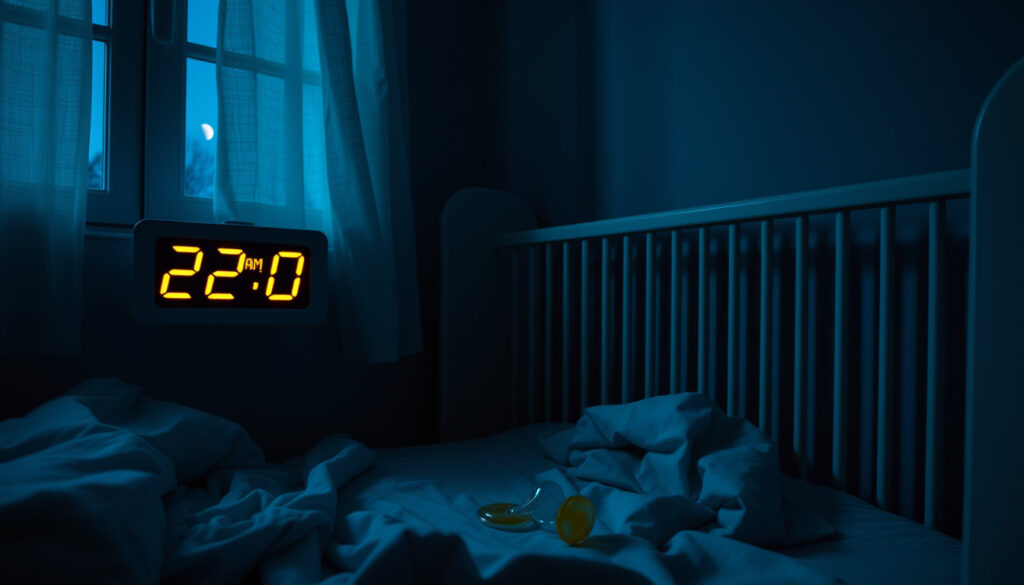
8 Month Sleep Regression: Duration, Signs and Tips
If your 8-month-old went from sleeping through the night to waking every hour, you’re not imagining things. That sudden shift has a name — the 8 month sleep regression — and it affects up to 80% of families navigating this developmental phase.
Common duration of 8-month sleep regression: 2 to 6 weeks ·
Peak age for onset: 8 months ·
Percentage of parents reporting sleep disruption at 8 months: up to 80% ·
Primary cause: Rapid brain development and separation anxiety
Quick snapshot
- Temporary disruption in sleep patterns around 8 months old (Healthline)
- Caused by rapid brain development, separation anxiety, and motor milestones (Happiest Baby)
- Usually lasts 2 to 6 weeks (Healthline)
- Increased night wakings (Happiest Baby)
- Difficulty settling at bedtime (What to Expect)
- Shorter naps or skipped naps (The Baby Sleep Site)
- Increased fussiness and clinginess (Happiest Baby)
- Onset typically between 7 and 9 months (Huckleberry)
- Peak disruption around 8 months (Healthline)
- Gradual improvement over 2–6 weeks with consistent routine (Happiest Baby)
- Nap transition from 3 to 2 naps often occurs during this period (The Baby Sleep Site)
- Separation anxiety peaks and then subsides (Happiest Baby)
- Next regression typically at 12 months if pattern continues (Healthline)
Five key facts, one pattern: the 8-month regression is driven by overlapping developmental leaps rather than a single cause.
| Fact | Value | Source |
|---|---|---|
| Average age of onset | 8 months (range 7–9 months) | Huckleberry |
| Typical duration | 2 to 6 weeks | Healthline |
| Primary trigger | Developmental leap (cognitive and motor) | Happiest Baby |
| Secondary trigger | Separation anxiety and teething | Healthline |
| Nap impact | Often a shift from 3 naps to 2 naps | The Baby Sleep Site |
Parents facing the 8-month regression often feel blindsided because the disruption coincides with teething and major motor milestones. The data-backed perspective: this is a temporary developmental phase, not a permanent sleep problem, and consistent routines shorten the rough patch for most families.
How long does the eight month sleep regression last?
Typical duration range
The 8-month sleep regression usually lasts between 2 and 6 weeks, according to Healthline. That range flexes depending on the underlying cause and how consistently parents respond. Huckleberry notes there is no set timeline because duration depends entirely on what is causing the disruption — whether it’s a developmental leap, teething pain, or separation anxiety.
If the regression stretches beyond 6 weeks, the issue may have shifted from a developmental phase to a learned sleep association. Parents who respond inconsistently by picking up their baby at every cry can inadvertently extend the disrupted period for several additional weeks.
Factors that can extend or shorten the regression
- Consistency of bedtime routine: predictable sleep cues shorten the regression (Healthline)
- Teething severity: swollen gums can compound night wakings (What to Expect)
- Nap schedule alignment: overtired babies tend to wake more frequently (The Baby Sleep Site)
- Parental response pattern: picking up or feeding at every waking may reinforce night wakings (Happiest Baby)
The implication: most regressions resolve on their own within 6 weeks, but parents who maintain a consistent approach tend to see improvement faster than those who keep changing strategies.
Why is my 8 month old suddenly not sleeping?
Brain development and milestone progression
Around 8 months, your baby’s brain undergoes a rapid cognitive leap. Happiest Baby explains that as babies master new motor skills — crawling, pulling up, sitting independently — their brain stays active even at night, processing the day’s new abilities. This mental rehearsal wakes them up.
Separation anxiety at 8 months
- Newfound understanding that you exist even when out of sight (Happiest Baby)
- Peaks between 8 and 10 months (The Baby Sleep Site)
- Triggers clinginess during the day and crying when placed in the crib alone (What to Expect)
Teething discomfort
Lower and upper incisors typically erupt between 6 and 10 months. Healthline advises parents to check for swollen gums, increased drooling, and ear-tugging before assuming all wakefulness is developmental. Teething pain compounds the regression rather than causing it alone.
The pattern: three different triggers — cognitive development, separation anxiety, and teething — often hit simultaneously at 8 months. That convergence is exactly why this regression feels more intense than the one at 4 months.
What ages are sleep regressions common?
Common sleep regression timelines: 4, 8, 12, 18, 24 months
Sleep regressions typically align with major developmental milestones. Healthline lists the common ages: 4 months (the first major sleep reorganization), 8 months (motor and cognitive leap), 12 months (walking onset and language explosion), 18 months (separation anxiety peak and tantrum phase), and 24 months (potty training and independence).
Why 8 months is often considered the hardest
- Separation anxiety and motor development peak at the same time (Happiest Baby)
- Teething discomfort adds a physical dimension missing at 4 months (What to Expect)
- Nap schedule transition from 3 to 2 naps creates additional disruption (The Baby Sleep Site)
- Duration can be longer than the 4-month regression if handled inconsistently (Huckleberry)
The 8-month regression often surprises parents who thought they had the 4-month regression “solved.” The key distinction: the 4-month regression is primarily neurological sleep-cycle maturation, while the 8-month regression adds separation anxiety, teething, and gross motor practice — three forces that make consistent soothing far more challenging.
The trade-off: this regression is harder to manage but also more rewarding because the same developmental leaps that disrupt sleep (crawling, pulling up) are visible progress that parents can celebrate during the day.
What’s the worst sleep regression?
Comparing intensity: 4-month vs 8-month regression
Four regression milestones, one clear pattern: intensity increases as the baby’s developmental complexity grows.
| Regression Age | Primary Cause | Duration Range | Parent Difficulty Rating | Source |
|---|---|---|---|---|
| 4 months | Sleep cycle maturation | 2–4 weeks | Moderate | Healthline |
| 8 months | Motor+cognitive leap + separation anxiety + teething | 2–6 weeks | High | Happiest Baby |
| 12 months | Walking + language explosion | 2–4 weeks | Moderate-High | What to Expect |
| 18 months | Separation anxiety + tantrums | 1–4 weeks | Moderate | The Baby Sleep Site |
Why the 8-month regression feels hardest for many parents
- Triple trigger: cognitive leap, separation anxiety, and teething converge (Happiest Baby)
- Nap transition creates daytime exhaustion that compounds night wakings (The Baby Sleep Site)
- Babies at this age can pull up and stand, so they may cry when they cannot sit back down (Healthline)
- Parents are usually more exhausted by month 8 of disrupted sleep than at month 4 (What to Expect)
Why this matters: the 8-month regression is widely cited as the most challenging not because the wakefulness is inherently worse, but because the combination of causes makes a single-approach solution ineffective. Parents need to address teething, separation anxiety, and nap transitions simultaneously — or risk bouncing between half-solutions that don’t stick.
8 month sleep regression tips: What actually helps?
Maintaining a consistent bedtime routine
Healthline emphasizes that a predictable sequence — bath, book, feeding, lullaby, bed — signals to the baby that sleep is coming. The key is performing the same steps in the same order every night, even during the rough patches. Inconsistent routines confuse babies and can prolong the regression.
Managing nap transitions safely
- Watch for signs the baby is ready to drop the third nap: resisting the late afternoon nap, taking longer to fall asleep, or waking too early from the morning nap (The Baby Sleep Site)
- Transition gradually by shifting the awake windows 15–30 minutes per day (Huckleberry)
- Maintain an early bedtime (around 6:00–6:30 PM) during the transition to prevent overtiredness (What to Expect)
Soothing techniques for night wakings
- Offer comfort in the crib rather than picking up immediately — patting, shushing, and gentle reassurance (Healthline)
- Check for teething signs before assuming it is a developmental wake-up; offer a chilled teether before bed (Happiest Baby)
- Use a lovey or comfort object (once baby can roll and grasp independently) to ease separation anxiety (The Baby Sleep Site)
- Gradually extend the time between responding to encourage self-settling (What to Expect)
Parents who treat the 8-month regression with a multi-layered strategy — addressing teething pain, maintaining the nap transition, and practicing crib-side soothing — tend to resolve the phase in 3–4 weeks. Parents who rely on a single fix (feeding back to sleep, rocking every time) often see the regression stretch toward 6 weeks or longer.
The pattern: consistency across bedtime routine, nap schedule, and soothing approach produces the fastest resolution.
Confirmed facts vs. What’s unclear
Confirmed facts
- 8-month sleep regression is a well-documented developmental phase affecting most infants (Healthline)
- It affects a majority of infants around this age (Happiest Baby)
- Duration is typically 2 to 6 weeks (Healthline)
- Common signs include increased night wakings, shorter naps, and clinginess (What to Expect)
What’s unclear
- Exact biological mechanism triggering regression is not fully understood (Huckleberry)
- Why some babies experience severe symptoms and others mild remains unclear (The Baby Sleep Site)
- Long-term impact on sleep habits is not consistently studied (Healthline)
- Happiest Baby suggests recovery can occur in a few days with appropriate handling, but most sources report 2-6 weeks as typical
Expert perspectives
“The 8-month sleep regression is a temporary disruption caused by rapid brain development, not a permanent sleep problem.”
— Healthline (health content publisher)
“Separation anxiety peaks around 8 months and is one of the primary drivers of night wakings during this regression.”
— Happiest Baby (parenting resource)
“There is no set timeline for sleep regressions because duration depends on what is causing the disruption.”
“Distinguishing teething from sleep regression requires checking for swollen gums, drooling, and ear-tugging before assuming it’s developmental.”
Summary
The 8 month sleep regression is a temporary phase driven by overlapping developmental leaps, separation anxiety, and teething — but its impact depends heavily on how parents respond. For families navigating this stage, the choice is clear: commit to a consistent bedtime routine, address teething separately, and manage the nap transition proactively, or risk the disruption stretching into months. The good news is that, with the right approach, most babies return to better sleep within 3–6 weeks.
femia.health, sleepfoundation.org, aumio.com, littleones.co, heypoppins.com, arestfulnight.com, takingcarababies.com
For parents dealing with the 8-month sleep regression, this comprehensive guide to the regression outlines the typical duration and soothing strategies.
Frequently asked questions
Can the 8 month sleep regression start early at 7 months?
Yes. Huckleberry notes that the regression can begin as early as 7 months and as late as 9 months, depending on the baby’s developmental pace. Babies who hit motor milestones early may show sleep disruption earlier than average.
Is the 8 month sleep regression worse for breastfed babies?
What to Expect suggests that breastfed babies may wake more frequently because they associate nursing with falling asleep, but the regression itself affects formula-fed and breastfed babies similarly. The difference is in the sleep association, not the developmental cause.
Should I sleep train during the 8 month regression?
Healthline advises that it is safe to begin gentle sleep training during the regression, but consistency is critical. Starting and stopping training during the phase can reinforce night wakings. If you start, commit for at least 2 weeks before evaluating success.
Does the 8 month regression affect daytime naps more than night sleep?
The Baby Sleep Site reports that many parents notice nap disruption first — shorter naps, skipped naps, or resistance to the afternoon nap. The nap transition from 3 to 2 naps often coincides with the regression, making day sleep look worse than night sleep initially.
Can separation anxiety cause my 8 month old to refuse the crib?
Yes. Happiest Baby explains that separation anxiety peaks around 8 months, making babies cry when placed in the crib because they do not understand that you are still nearby. Offering a transitional object (like a soft lovey once baby can roll independently) can help ease this fear.
How can I tell if it’s teething or the 8 month sleep regression?
What to Expect advises checking for swollen gums, increased drooling, ear-tugging, and a mild temperature. Teething discomfort tends to be worse in the evening and responds to chilled teethers or pain relief. The sleep regression causes more generalized wakefulness not linked to gum pain.
What is the difference between the 4 month and 8 month sleep regression?
The 4-month regression is primarily a permanent change in sleep cycles as the baby’s brain matures. The 8-month regression is temporary and linked to cognitive leaps, separation anxiety, and motor milestones, according to Healthline. The 8-month version typically includes more emotional components (clinginess, crying) than the 4-month version.
Related reading: How to Track Sleep on Apple Watch: Setup & Troubleshooting · Melatonin at Chemist Warehouse NZ: OTC Guide & Cost
More related posts
 Westfield Newmarket Shopping Mall Impact: Cost & Local Effects
 2 Degrees Mobile Network Not Available: Fix & Troubleshoot
 Find Sticky Rice Lotus Leaf Near Me: Lo Mai Gai Guide & Delivery
 New World Mt Roskill: Hours, Phone, Online Shopping & More
 Fiji vs Samoa Rotorua 2025: Score, Highlights, and How to Watch
 2026 Year of the Horse: Fire Zodiac Predictions & Lucky Signs
 NZ Herald Death Notices Hamilton: Find Recent Obituaries
 Convert Image to PDF: Free Online Converter & Steps