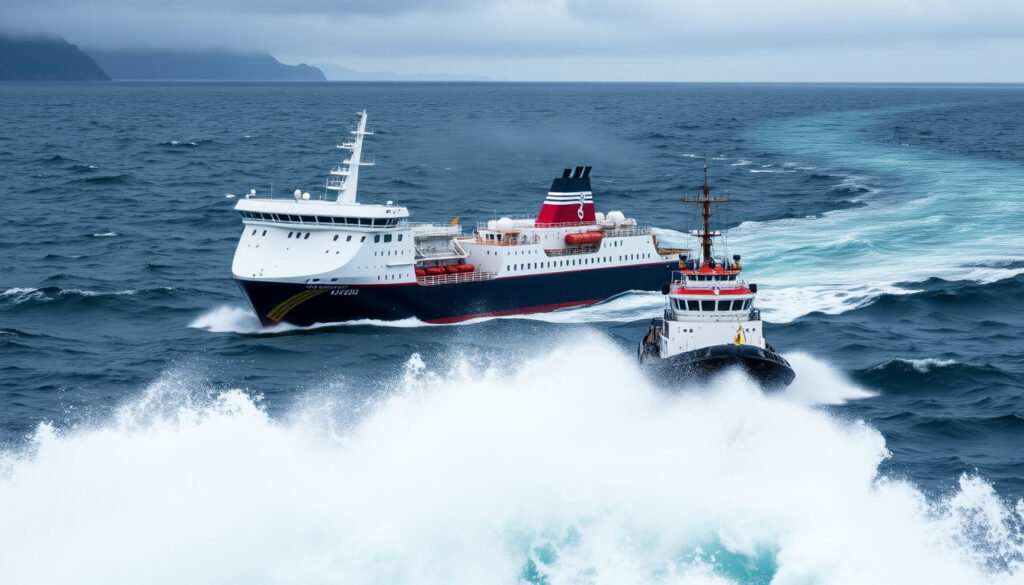
Emergency Towing Cook Strait: Ferry Safety Explained
Anyone who has watched a Cook Strait ferry disappear into a squall knows the crossing can turn serious fast, but what most passengers do not know is that the ocean-going tug backing those sailings left the route this month after the Government ended its contract (RNZ (national broadcaster)). The public fight over that tug is easier to follow than a Cook Strait swell chart, so here is what is settled, what is still unresolved, and what it means for anyone with a booked sailing.
Budget 2024: $600,000 for emergency towing options ·
Interim tug: MMA Vision, off contract since ·
Maritime NZ assessment: published ·
Government position: costs outweigh benefits ·
Cook Strait ferry operators: 2
Quick snapshot
- Budget 2024 put $600,000 toward investigating emergency towing options (Beehive.govt.nz, 25 Nov 2025).
- MMA Vision was contracted as an interim ocean-going tug (Beehive.govt.nz (NZ Government)).
- In November 2025, the Government said a permanent Cook Strait tug’s costs outweigh its benefits (Beehive.govt.nz (NZ Government)).
- Whether a dedicated ocean-going tug will ever return to Cook Strait (RNZ (national broadcaster)).
- What exact wind speed cancels any given sailing — no universal threshold exists. (RNZ (national broadcaster))
- Whether weather-related cancellations mean compensation beyond a rebooking or refund (operator terms vary). (RNZ (national broadcaster))
- The MMA Vision contract ended on (Greater Wellington (regional council)).
- From July 2026, the closest large-vessel rescue ship would be 1,200 nautical miles away (Greater Wellington).
- Large-vessel rescue will rely on commercially available ships that may not be in New Zealand waters (Greater Wellington (regional council)).
- Regional leaders are pressing the Government to restore a dedicated rescue tug (RNZ, Feb 2026). (Greater Wellington (regional council))
The one-line version: the policy has cooled, the strait has not.
Key facts
Ten facts, one pattern: funding came, a tug was contracted, and the plan was cancelled before the gap was closed.
| Label | Value |
|---|---|
| Budget 2024 | $600,000 for emergency towing options |
| Interim tug | MMA Vision, contracted as a stop-gap while a long-term option was assessed |
| Contract end | |
| Maritime NZ report | Emergency Towing Capacity, |
| Government decision | Costs outweigh benefits of a permanent Cook Strait tug, November 2025 (Beehive.govt.nz (NZ Government)) |
| Saving | About NZ$9 million from ending the interim contract |
| Incidents reviewed | 23 in five years where emergency towage may have helped; all resolved with existing capabilities |
| Future gap | From July 2026, closest capable rescue ship about 1,200 nautical miles away (Greater Wellington (regional council)) |
| Ferry operators | Interislander and Bluebridge |
| Most common cancellation cause | Weather |
The pattern in the table: every number points the same direction — less capability, more risk.
What are the requirements for emergency towing arrangements on tankers?
Tankers that use Cook Strait already carry a safety feature most passengers never see: emergency towing arrangements. The idea is built into international maritime safety rules under SOLAS, so that a rescue tug can connect to a ship quickly after a loss of power or steering.
Where do tanker emergency towing requirements come from?
- SOLAS — the International Convention for the Safety of Life at Sea — sets the baseline for emergency towing arrangements on tankers.
- The operational goal is simple: a towline that can be passed and secured even when the ship’s main power is gone.
- Maritime NZ’s Emergency Towing Capacity assessment applied the same safety thinking to Cook Strait’s conditions, feeding the Government’s November 2025 conclusion (Beehive.govt.nz (NZ Government)).
For a ferry passenger, the distinction matters less than the outcome. A ship without power in Cook Strait drifts with wind and tide; the tug that reaches it first decides how long that drift lasts.
What equipment is usually involved?
SOLAS equipment rules apply to tankers; the most exposed commercial traffic in Cook Strait is passenger and freight ferries. The rules guarantee a ship can be towed — they do not guarantee that a tug will be nearby.
- Emergency towing arrangements are designed so a line can be secured if the ship loses power.
- What matters on a ferry crossing is the response around the ship, not the hardware on it.
How do these requirements connect to Cook Strait emergency towage?
- In April 2025, the Government outlined a user-pays long-term model: a locally based first-strike tug in Cook Strait and a regional second-strike capability around Port Taranaki (Beehive.govt.nz (NZ Government)).
- A Ministry of Transport paper later directed Maritime NZ to cancel the interim contract, with the earliest termination point in February 2026 (Ministry of Transport (NZ Government)).
- Regional councils argue that leaves the strait without a dedicated ocean rescue tug (Greater Wellington, Feb 2026).
The implication: international rules can dictate what a ship carries, but they cannot dictate what floats nearby when something goes wrong.
Why would a ferry be cancelled?
Weather is the most common reason a Cook Strait ferry does not sail, but it is not the only one. Mechanical issues, crew availability, and port conditions all cause cancellations, and every call is about protecting passengers, crew, and the vessel.
What does DFDS stand for?
“DFDS ferry cancelled” looks like Cook Strait news, but DFDS is a separate European ferry operator. Its cancellations are not Cook Strait sailings.
In New Zealand search results, the acronym mostly stands for confusion: wind-related DFDS headlines surface alongside local ferry updates even though the operator does not run the strait. Before you panic about a sailing, check which operator actually runs it.
Which DFDS sailings were cancelled due to strong winds?
- None on Cook Strait — DFDS does not operate the route.
- Any DFDS wind-cancellation headlines concern its European network.
- For Wellington–Picton, the operators to watch are Interislander and Bluebridge.
What are the usual non-weather cancellation reasons?
- Mechanical issues with the vessel.
- Crew availability and rest requirements.
- Port conditions, including berth congestion or terminal delays.
- The operator’s duty of care: sail only when it is safe for everyone aboard.
The catch: a cancelled ferry is rarely a single-factor decision — wind, tide, machines, and people all interact, and the master’s call is the one that has to hold up in the moment.
How high do winds have to be to cancel ferries?
There is no universal wind-speed number that cancels every sailing. The decision depends on the vessel, the route, the tide, and the local sea state — which is why a gust that is routine for one ship can stop another.
Is there a universal wind-speed cutoff?
- No universal threshold exists; each operator and master works to the vessel’s limits and the day’s conditions.
- Sustained gale-force conditions or strong wind warnings often lead to cancellations.
- Cook Strait’s exposed stretch between Wellington and Picton can build steep, wind-driven seas quickly.
When a strong wind warning is issued, treat disruption as possible rather than certain. Operators watch the same forecast you do — then add tide, swell, and their own vessel’s limits before calling it.
How do ferry operators decide to cancel?
- Operators monitor wind, swell, and tide continuously for the specific route and vessel.
- The call is operational, not formulaic: the master and the operator’s marine team make it.
- Advance forecasts matter, but live conditions override them.
How does Cook Strait weather affect the decision?
- Cook Strait is known for rough water from strong winds, tidal flows, and the meeting of the Tasman Sea and Pacific Ocean.
- Conditions can change quickly between Wellington and Picton.
- That is why operators watch the day in real time rather than trusting a morning forecast.
Why this matters: the threshold that counts is the one the skipper sees from the bridge — and no website can promise it in advance.
How rough is the Cook Strait today?
The honest answer: check the live service status, not a news page. Cook Strait has a deserved reputation for rough water, and conditions that look calm at the terminal can be rough mid-strait.
Are there any Interislander cancellations today?
- The only reliable answer is the operator’s live status — Interislander and Bluebridge both publish official updates when sailings are affected.
- Live service status beats any forecast made in advance.
- At the terminal, the operator’s own announcement is the only version that counts.
How can travellers check current conditions?
- Start with the operator’s official status page and social channels.
- Compare that with the latest marine weather forecast for the strait.
- If your sailing is close and the weather is closing in, call the operator before driving to the port.
If you are already planning a Picton stop, the Picton Yacht Club Hotel Guide sorts the practical options near the terminal.
Why is Cook Strait often rough?
- Strong winds, tidal flows, and the meeting of the Tasman Sea and Pacific Ocean combine in the narrow gap between the North and South islands.
- The result is steep, confused seas that can develop quickly.
- Those same conditions are why emergency towing capacity is a live political issue, not a hypothetical one.
Wellington’s harbour — Te Whanganui-a-Tara — has always been defined by the same wind and tide.
The trade-off: the same weather that makes Cook Strait dramatic is exactly what has regional leaders demanding a rescue tug the Government says it will not fund.
What are my rights if my ferry is cancelled?
Rights start with the operator’s terms and conditions, your booking type, and the reason for the cancellation. When the operator cancels, rebooking or a refund is the general expectation; when the weather cancels the sailing, the fine print decides the rest.
Does travel insurance cover a cancelled ferry?
Travel insurance may cover a cancelled ferry if the policy includes trip cancellation or travel disruption cover — but weather cancellations are often treated differently from mechanical ones.
- Check whether your policy names “trip cancellation” or “travel disruption” explicitly.
- Keep the operator’s cancellation notice and any receipts for extra accommodation or travel.
- Refund or rebooking from the operator comes first; insurance covers the gap beyond it.
The difference matters: a refund gives you money back; compensation covers the costs the cancellation creates. Most ferry terms promise the first. Whether you get the second depends on the fare you bought and the policy you hold.
What happens if the DFDS ferry is cancelled?
- DFDS’s terms apply to its own European routes, not to Cook Strait.
- For Wellington–Picton, the terms that matter are Interislander’s and Bluebridge’s.
- Treat a “DFDS ferry cancelled” snippet as a search trap and confirm which operator runs the sailing.
What should passengers do before travelling?
- Check the live service status on the morning of departure.
- Re-read the cancellation and rebooking terms tied to your fare type.
- If you have travel insurance, confirm what it covers before you need it.
The trade-off: passengers carry the weather risk. Operators will rebook or refund, but compensation beyond that depends on terms most travellers never open.
Which ferry company is better for me, Interislander or Bluebridge?
Interislander and Bluebridge are the two main Cook Strait ferry services, and both run the core route between Wellington and Picton. The right choice depends on schedule, fare, vehicle requirements, and onboard amenities — and, in the strait’s wind season, on how each operator handles disruption.
Four comparisons, one pattern: the right operator is less about brand loyalty than about which schedule and cancellation terms fit your trip.
| What to compare | Interislander | Bluebridge |
|---|---|---|
| Route | Wellington–Picton | Wellington–Picton |
| What decides the choice | Schedule, fare, vehicle needs, onboard amenities | Schedule, fare, vehicle needs, onboard amenities |
| When weather hits | Official operator status updates | Official operator status updates |
| Cancellation handling | Rebooking or refund per the operator’s terms | Rebooking or refund per the operator’s terms |
How much does it cost to cross the Cook Strait on the ferry?
- Fares vary by sailing time, vehicle size, passenger numbers, and fare class.
- Prices change often; compare them on the operators’ official channels.
- Flexible fares cost more upfront and can be worth it when the wind turns.
What are the main differences between Interislander and Bluebridge?
- Schedules differ, and so do onboard facilities and vehicle-loading setups.
- Both operators publish official status updates when weather affects sailings.
- Neither can promise a wind-free crossing — the strait is the same for both.
Which factors should decide the choice?
- Schedule fit: which sailing gets you there when you need to be there.
- Total cost including vehicle, cabin, and meals.
- Cancellation flexibility, especially if your plans cannot absorb an overnight delay.
The pattern: in a wind-prone strait, flexibility is a feature, not a footnote. The operator that rebooks you onto the next sailing without drama is worth more than a slightly cheaper fare.
Emergency towing arrangements: what is in place and what changed
Ten specifications, one storyline: a funded interim plan was cancelled before its replacement existed.
| Item | Detail |
|---|---|
| Regulatory baseline | SOLAS emergency towing arrangements for tankers |
| Purpose | Allow a rescue tug to connect quickly if a ship loses power or steering |
| NZ assessment | Maritime NZ Emergency Towing Capacity, published |
| Interim capability | MMA Vision tug; April 2025 plan: user-pays, Cook Strait first strike plus regional second strike (Beehive.govt.nz (NZ Government)) |
| Contract end | (Greater Wellington (regional council)) |
| Saving | About NZ$9 million (Beehive.govt.nz (NZ Government)) |
| Incident record | 23 incidents in five years where emergency towage may have helped; all resolved without the dedicated tug (Beehive.govt.nz (NZ Government)) |
| Future gap | From July 2026, closest capable rescue ship about 1,200 nautical miles away (Greater Wellington) |
| Who directed the change | Ministry of Transport paper; Maritime NZ directed to cancel the interim contract (Ministry of Transport (NZ Government)) |
| Earliest cancellation point | February 2026, after a six-month minimum plus three-month notice (Ministry of Transport) |
The implication: the table shows a capability that was funded, then cut, with the gap beginning before a replacement model exists.
The case for and against a dedicated Cook Strait tug
The Government and the regions read the same incident list and reached opposite conclusions. Here is the trade in plain terms.
Upsides
- A dedicated tug gives immediate, guaranteed response when a large vessel loses power in Cook Strait.
- It closes the July 2026 gap, when the closest large-vessel rescue ship would be about 1,200 nautical miles away (Greater Wellington).
- It covers the same ferries that carry thousands of passengers between the North and South islands every day.
- It removes the gamble of relying on “vessels of opportunity” that may not be in New Zealand waters.
Downsides
- The Government says the costs of a permanent tug outweigh the benefits (Beehive.govt.nz (NZ Government)).
- Ending the interim contract saves about NZ$9 million.
- Over five years, 23 incidents were reviewed where emergency towage may have helped — and all were resolved without the dedicated tug.
- The funding model was still unresolved; the plan was user-pays, but no levy was settled (Beehive.govt.nz (NZ Government)).
The pattern: this is a cost-versus-certainty trade, and the two sides are pricing different things. The Government prices incidents; the regions price worst cases.
What to do if your Cook Strait ferry is cancelled
The steps are simple; most travellers just learn them after the wind has already ruined an itinerary.
- Check the live service status before leaving for the terminal. If the sailing is cancelled, do not drive to the port.
- Contact the operator directly — Interislander or Bluebridge — for a rebooking or refund.
- Screenshot the cancellation notice and keep any operator messages.
- Review your fare type and the booking terms for cancellation conditions.
- If you have travel insurance, read the trip cancellation and travel disruption wording before you claim.
- If you booked accommodation or onward travel, contact those providers the same day — weather delays cascade fast.
The reason the order matters: the operator is the first payer, insurance is the backstop, and documentation is what makes both move.
Cook Strait emergency towing timeline
Six dates, one direction: the capability was funded, extended, and then cut before it could be replaced.
| Date | Event | Source |
|---|---|---|
| Budget 2024 allocates $600,000 to investigate emergency towing options for Cook Strait. | Beehive.govt.nz (NZ Government) | |
| Government confirms MMA Vision as an interim tug through June 2026 and says the long-term model will be user-pays. | Beehive.govt.nz (NZ Government) | |
| Government decides costs outweigh benefits; the MMA Vision contract is set to end in February 2026. | Beehive.govt.nz (NZ Government) | |
| The MMA Vision contract ends. | Greater Wellington (regional council) | |
| Greater Wellington and Marlborough leaders warn Cook Strait rescue capability is compromised. | Greater Wellington (regional council) | |
| Without a replacement, the closest large-vessel rescue ship would be about 1,200 nautical miles away. | Greater Wellington (regional council) |
What this means: the gap is not theoretical — it starts now and widens in July.
What is confirmed, what is still unclear
After two years of announcements, the confirmed list is short and the open questions are wide.
Confirmed facts
- Budget 2024 allocated $600,000 to investigate emergency towing options (Beehive.govt.nz, 25 Nov 2025).
- MMA Vision was contracted as an interim tug; its contract ended on 4 February 2026.
- The Government concluded in November 2025 that a permanent Cook Strait tug is not justified on cost (Beehive.govt.nz (NZ Government)).
- Greater Wellington warns that from July 2026 the closest capable rescue ship would be about 1,200 nautical miles away (Greater Wellington (regional council)).
What’s unclear
- Whether a dedicated tug will ever return to Cook Strait; regional leaders were still campaigning in February 2026 (RNZ).
- What exact wind speed cancels a given sailing; no universal threshold is published.
- Whether weather-related cancellations mean compensation beyond a rebooking or refund (operator terms vary).
- Whether commercially available rescue vessels will be in New Zealand waters when needed.
- Who would pay for any future capability; a user-pays levy was never finalised (Beehive.govt.nz (NZ Government)).
The balance is the story: hard facts about the past, open questions about the future.
What officials are saying
Four voices frame the argument — a Government, a regulator, a regional council, and the public broadcaster’s reporting.
“Costs outweigh benefits of Cook Strait tug.”
— Release title, Beehive.govt.nz (NZ Government), 25 November 2025
“Cook Strait rescue capability compromised.”
— Greater Wellington (regional council), February 2026
“Effective emergency towage would bolster response capability.”
— Maritime NZ (NZ maritime safety regulator), Emergency Towing Capacity assessment, 21 May 2025
“Cook Strait had been left without a tug capable of ocean rescue for more than a week.”
— RNZ (national broadcaster), February 2026
The official positions frame the debate: the Government says costs outweigh benefits, regional councils say the rescue capability is compromised.
What this means for your crossing
The fight over emergency towing is not a distant Wellington argument. It is the difference between a fast rescue and a long wait for whichever ship is next in trouble. For Cook Strait ferry passengers, the choice is clear: book flexible, check the live status before driving to the port, and treat every sailing as weather-dependent — because the tug that used to stand behind the crossing is gone, and the wind has not changed its habits.
gw.govt.nz, taic.org.nz, rnz.co.nz, scoop.co.nz, thedcn.com.au, gw.govt.nz, taic.org.nz
Frequently asked questions
What is emergency towing?
Emergency towing is the ability to connect a towline to a ship that has lost power or steering, so a tug can move it out of danger. For tankers, emergency towing arrangements are part of international maritime safety rules under the SOLAS convention.
Why does Cook Strait need emergency towing capacity?
Cook Strait is exposed to strong winds, tidal flows, and the meeting of the Tasman Sea and Pacific Ocean, which is why it is often rough. If a large ferry or tanker lost propulsion there, a nearby ocean-going tug would be the difference between a fast rescue and a long drift.
Has the Government approved an emergency towing vessel for Cook Strait?
No. In November 2025, the Government decided the costs of a permanent Cook Strait tug outweigh the benefits (Beehive.govt.nz (NZ Government)). The interim tug MMA Vision ended its contract on 4 February 2026 (Greater Wellington (regional council)).
Who is responsible for emergency towing response in New Zealand waters?
Maritime NZ is the agency that prepared the emergency towing capacity assessment and managed the interim tug contract. Policy direction runs through the Ministry of Transport, whose paper directed Maritime NZ to cancel the contract (Ministry of Transport (NZ Government)).
How does emergency towing differ from standard harbour towage?
Harbour tugs work inside ports and help with berthing in sheltered water. Emergency ocean towage needs a sea-going tug that can operate in open, rough water for extended periods — the difference between a berthing push and an open-water rescue.
What does emergency towing mean for ferry passengers?
It is the safety net behind the sailing. When a ferry loses power in Cook Strait, response time depends on whether a capable tug is near the strait — and from July 2026, the closest large-vessel rescue ship would be about 1,200 nautical miles away (Greater Wellington).
More related posts
 Plane Crash Lake Hawea: Ivan Van de Water Killed, 1 Injured
 House for Sale Rolleston: Complete Listings & Market Guide
 Small Things Like These: Plot, Cast, and True Story Explained
 Is the Desert Road Open? Real-Time NZTA Status & Alerts
 Wicked: For Good Runtime – How Part 2 Compares to Part 1
 Mission Impossible The Final Reckoning: Release, Cast, Stunts
 Woman of the Dead: Is It Worth Watching? Season 2 Guide
 NZD to PHP Forecast 2026: Will the New Zealand Dollar Rise?