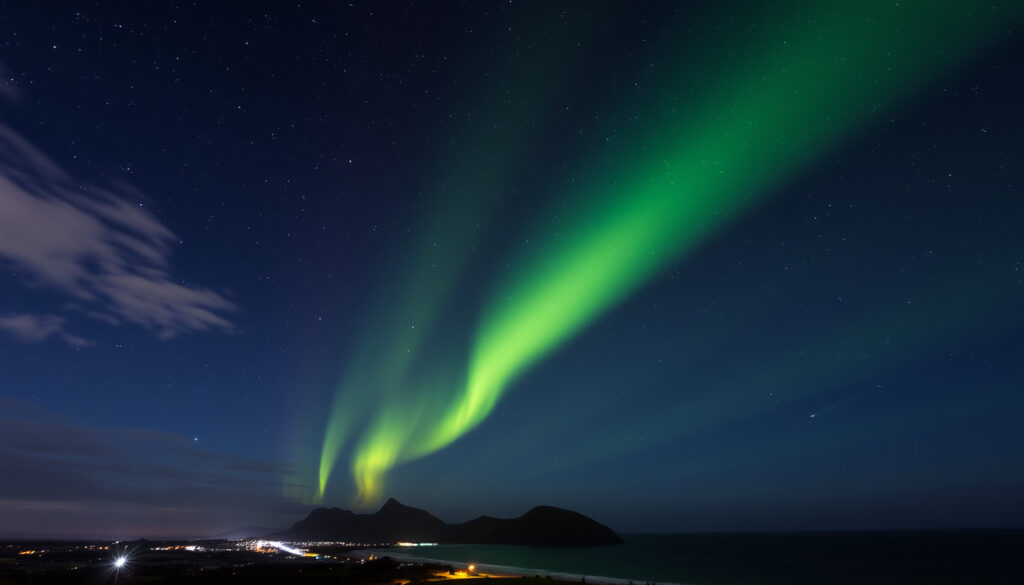
Ōpōtiki Night Sky Fireball: Green Meteor Lights Up NZ
There’s a reason so many of us now point cameras at the night sky: you never know when a rock from space will put on a show. Just before 11pm on March 12, 2025, that’s what happened in rural Ōpōtiki, where a security camera recorded a fireball bright enough to dominate the Bay of Plenty sky. The footage, captured by Tauranga Astronomical Society president David Greig and carried by New Zealand’s national broadcaster 1News, raised one obvious question: how rare is that, really?
Date of Ōpōtiki fireball: March 12, 2025 (before 11pm) ·
Color observed: Bright green ·
Direction: West to East over upper North Island ·
Reported by: Security camera footage in rural Ōpōtiki ·
Frequency of fireball events worldwide: Several per month, most over oceans
Quick snapshot
- Whether any meteorites reached the ground
- The exact composition of the object
- The size of the object
- Observed around 22:49 local time on March 12, 2025 (The Watchers).
- Footage published by news outlets on March 13–14, 2025 (The Watchers). (The Watchers)
- A similar bright fireball was reported over the upper North Island on August 30 of the previous year. (The Watchers)
- Fireballs Aotearoa’s 154-camera network could help track the object’s orbit (NZ Herald).
- Any meteorite from the event has not been confirmed or recovered.
- Sightings should be reported to Fireballs Aotearoa.
Six details separate this event from an ordinary shooting star, and together they explain why the footage ended up in national news.
| Fact | Detail |
|---|---|
| Event | Green fireball over Ōpōtiki |
| Date and time | March 12, 2025, before 11pm local time |
| Reported by | Security cameras in rural Ōpōtiki |
| Direction | West to east across the upper North Island |
| Camera model | Tapo C325WB (NZ Herald) |
| Visibility | Reported from Auckland, Bay of Plenty, Hawke’s Bay, Taranaki, Waikato, and Wellington (The Watchers) |
| Observed colors | Light blue, green, orange, yellow, and white (The Watchers) |
| Associated report | Some observers reported a sonic boom (The Watchers) |
| Expert network | Fireballs Aotearoa runs 154 tracking cameras (NZ Herald) |
The pattern in those rows: a small, fast object created a remarkably wide footprint of sightings across the North Island.
Was there a fireball meteor last night?
Yes — and the event is now documented from two independent angles: security-camera footage and a regional network of eyewitness reports.
Security footage captures the Ōpōtiki fireball
- The fireball was filmed by Tauranga Astronomical Society president David Greig on security cameras (1News).
- Major New Zealand publication NZ Herald reported that the event was captured on a Tapo C325WB security camera in rural Ōpōtiki.
- Fireballs Aotearoa said the object was a fireball crossing the Bay of Plenty (NZ Herald).
The camera model matters more than it sounds. A Tapo C325WB is an ordinary consumer security camera, not a scientific instrument — yet it caught an event bright enough to make national news. David Greig, who set up the camera, is no casual observer: he is the president of the Tauranga Astronomical Society, which is how home security footage ended up in a national news report.
What makes the footage valuable is its timestamp. The event was recorded shortly before 11pm local time (1News), a detail that lets meteor groups match the clip against other observations from the same night.
Timing and location of the sighting
- Local time: about 22:49 NZDT on Wednesday, March 12, 2025 (The Watchers).
- UTC time: 09:48 UTC the same day (The Watchers).
- Visible across the North Island, with reports from Auckland, the Bay of Plenty, Hawke’s Bay, Taranaki, Waikato, and Wellington (The Watchers).
The 22:49 local time matches the “before 11pm” record from the Ōpōtiki security camera. The sighting locations form a broad line across the North Island, which is consistent with an object moving west to east at high altitude rather than a close, slow-moving fireball.
The pattern: one object, one consumer camera, and a timestamp that ties a small farming town to reports from six regions.
For Fireballs Aotearoa, footage like this is the missing link between a blur on a screen and a recoverable meteorite. Its 154-camera network (NZ Herald) is built to catch the same event from multiple angles; a well-placed home camera shows what an ordinary resident can add to that picture.
Is it rare to see a fireball meteor?
Rare enough to make headlines, common enough that researchers detect them every day.
What defines a fireball meteor
- A fireball is an unusually bright meteor — not a different kind of object, just one that stands out.
- The green color often associated with fireballs is commonly linked to magnesium and nickel in the object.
- If part of the object survives the atmosphere, the remaining rock is called a meteorite.
Fireballs constantly enter Earth’s atmosphere. What makes the Ōpōtiki event stand out is brightness and visibility, not rarity of cause. According to meteor and space-weather reporting site The Watchers, observers reported colors including light blue, green, orange, yellow, and white, and a sonic boom was also reported (The Watchers).
Meteors are common — 10,785 were detected in February alone.
— David Greig, president of the Tauranga Astronomical Society, as reported by NZ Herald
Sonic booms happen when a meteor moves fast enough to outpace sound in the lower atmosphere, so the reports are a useful clue about how deep the object traveled before fading out.
How often do fireballs occur over populated areas
- Fireballs Aotearoa’s network detected 10,785 meteors in February alone (NZ Herald).
- The network runs 154 cameras across New Zealand to track meteor frequency and recover meteorites (NZ Herald).
- Most of those detections are small streaks; fireballs over populated areas are a small fraction of the total.
Greig’s point, reported by NZ Herald, is that meteors are common — the February count of 10,785 proves it. But most of that activity never gets a second look from the public. A fireball bright enough to light the sky over the Bay of Plenty and draw reports from six regions is a different tier of event, especially when a camera catches it.
Has a meteorite ever hit New Zealand?
Yes — several confirmed meteorite falls have been recorded in New Zealand. They are rare enough that each new find matters, which is why Fireballs Aotearoa runs a 154-camera network to track meteors and support recoveries (NZ Herald). Whether the Ōpōtiki event added to that record is unconfirmed.
New Zealand’s meteorite record is small but real: several confirmed falls have been recorded over the years. Whether the Ōpōtiki event added to that record is unconfirmed.
How to tell if a rock is a meteorite at home?
You can narrow it down, but the only reliable confirmation comes from someone who studies rocks for a living.
Simple tests to check a rock
- Fusion crust — a dark, thin, smooth coating left by intense heating during atmospheric entry is one of the strongest visual clues.
- Density — meteorites are dense and feel noticeably heavier than an ordinary rock of the same size.
- Shape — many meteorites have rounded, sculpted forms with shallow depressions, rather than sharp, jagged edges.
Start with the tests that don’t damage anything. Look at the surface for a fusion crust. Weigh the rock in your hand. Study its outline. If the rock checks all three boxes, the next step is not a DIY experiment — it’s a message to Fireballs Aotearoa with a photo and the location.
Why you should not use magnets or vinegar
- Meteorites are often magnetic, but exposing them to a magnet can damage the scientific value of the sample.
- Vinegar and other acids can react with meteorite minerals and alter them.
- Oils and moisture from bare skin can degrade minerals and remove the fusion crust.
The DIY tests that spread online are attractive because they are cheap — and they are destructive. A magnet can disturb the fine magnetic structures that researchers use to reconstruct an object’s history. Vinegar can chemically change minerals. Even a brief touch can transfer oils that degrade a sample over time. In New Zealand, a suspected meteorite may also be considered taonga, which can carry legal protections.
Why shouldn’t you touch a meteorite?
Oils and moisture from bare skin can degrade meteorite minerals and remove the delicate fusion crust — the dark outer layer formed during atmospheric entry. In New Zealand, a suspected meteorite may also be considered taonga, carrying legal protections. The practical read: the right response to a possible meteorite is to protect it from yourself. Photograph it, note the location, and let specialists take the next step.
Most magnetic rocks are not meteorites — basalt and industrial slag are everywhere. The cheap tests don’t just risk damaging a sample; they also produce false positives that slow down real identifications.
Timeline of the Ōpōtiki fireball
- March 12, 2025, ~22:49 NZDT: Fireball crosses the upper North Island; a security camera in rural Ōpōtiki records it (The Watchers, 1News).
- March 13, 2025: The Watchers publishes its report, noting North Island-wide visibility and a reported sonic boom (The Watchers).
- March 14, 2025: 1News and NZ Herald publish the footage and Fireballs Aotearoa’s identification (1News, NZ Herald).
- August 30 (previous year): Fireballs Aotearoa reported an earlier bright green fireball over the upper North Island.
The two-day gap between the sighting and the news coverage is a normal pipeline: eyewitness reports first, then camera data, then public confirmation from media and meteor groups.
A lucky security camera provides one angle. Fireballs Aotearoa’s 154-camera network (NZ Herald) is designed to provide dozens — but it only works when people report what they saw. The Ōpōtiki clip already sharpened the record; more public reports would have sharpened it further.
The implication: even one additional camera angle could have pinned down the fireball’s trajectory with enough precision to target a ground search.
What’s confirmed and what’s still unclear
Confirmed
- A very bright fireball was recorded on security footage near Ōpōtiki on March 12, 2025 (1News).
- The event happened shortly before 11pm local time (1News).
- The object moved west to east over the upper North Island (NZ Herald).
- The fireball drew reports from at least six North Island regions (The Watchers).
Still unclear
- Whether any meteorites reached the ground.
- The exact composition and size of the object.
- Whether the reported sonic boom can be independently confirmed.
- Some witness reports suggested the object broke into pieces; no footage shows this.
- Whether pink tones some observers reported were real or an optical effect (The Watchers).
That gap between the first four facts and the last five unknowns is normal for a fireball investigation in its early days. Cameras confirm the event; the aftermath is a waiting game for ground searches and lab analysis.
What experts and observers said
Fireballs Aotearoa identified the object as a fireball crossing the Bay of Plenty.
— Fireballs Aotearoa (New Zealand meteor-tracking network), as reported by NZ Herald
Meteors are common — 10,785 were detected in February alone.
— David Greig, president of the Tauranga Astronomical Society, as reported by NZ Herald
The fireball was visible across the North Island, with observers reporting a sonic boom and a mix of colors from light blue and green to orange, yellow, and white.
— The Watchers (meteor and space-weather reporting site)
One thread runs through all three accounts: each describes a fireball — an unusually bright meteor — not a close encounter or an impact event. That word matters because it tells anyone searching for debris exactly what kind of object to look for: a dense, dark rock, not ice or human-made wreckage.
The takeaway
The Ōpōtiki fireball is what happens when a routine cosmic event meets modern surveillance: a few seconds of light, caught by a consumer camera, turned into scientific context. Fireballs Aotearoa’s 154-camera network (NZ Herald) exists to turn moments like this into trajectories, and its biggest prize is not footage — it’s a recovered meteorite. For anyone walking a Bay of Plenty paddock, the decision is clear: photograph every suspicious rock, leave it exactly where it landed, and contact Fireballs Aotearoa before touching it — because the first hand that grabs it could destroy the evidence researchers have been waiting for.
nzherald.co.nz, nzherald.co.nz, rnz.co.nz, rnz.co.nz, theguardian.com, rnz.co.nz, cneos.jpl.nasa.gov, rosario3.com, worldjournal.com
Frequently asked questions
Is the Ōpōtiki fireball dangerous?
No ground impact has been confirmed, and the reports describe a fireball — a meteor burning brightly in the atmosphere — not a collision event. Observers reported a sonic boom (The Watchers), but no injuries or damage were reported in any of the accounts.
Can I find a meteorite from this fireball?
Potentially. Fireballs can drop meteorites when part of the object survives, but none have been confirmed from this event so far. Fireballs Aotearoa built its camera network partly to help recover meteorites, so a confirmed find would be a meaningful scientific outcome (NZ Herald).
What should I do if I think I found a meteorite in New Zealand?
Photograph it where it lies, note the location, and contact Fireballs Aotearoa before touching it. Avoid magnets, vinegar, and bare skin contact — those tests and oils can degrade the sample. In New Zealand, a suspected meteorite may also be considered taonga and carry legal protections.
Are green fireballs more common than other colors?
Green is a common meteor color, often linked to magnesium and nickel, but fireballs can show several colors. This one reportedly displayed light blue, green, orange, yellow, and white, with some observers also noting pink tones (The Watchers).
How fast do fireballs travel?
Fireballs typically enter the atmosphere at speeds between 11 and 72 kilometres per second. The exact velocity of the Ōpōtiki fireball has not been calculated, but the wide spread of sightings — from Auckland to Wellington — suggests it was travelling fast and high.
More related posts
 How to Clean Cast Iron with Salt: A Step-by-Step Guide
 New World Mt Roskill: Hours, Phone, Online Shopping & More
 Movie Theater Showtimes in Wellington for Today and Tomorrow
 Disney Plus Cost NZ 2025: Plans, Prices & Comparisons
 Fried Zucchini Flowers Near Me – Top Restaurants and Seasonal Tips
 West Indies vs New Zealand – 13-Run Victory Secures Super 8s
 How to Choose a Paint Color: Step-by-Step Guide for 2025-2026
 How to Remove Oil Stains from Clothes – Fix Set-In Stains