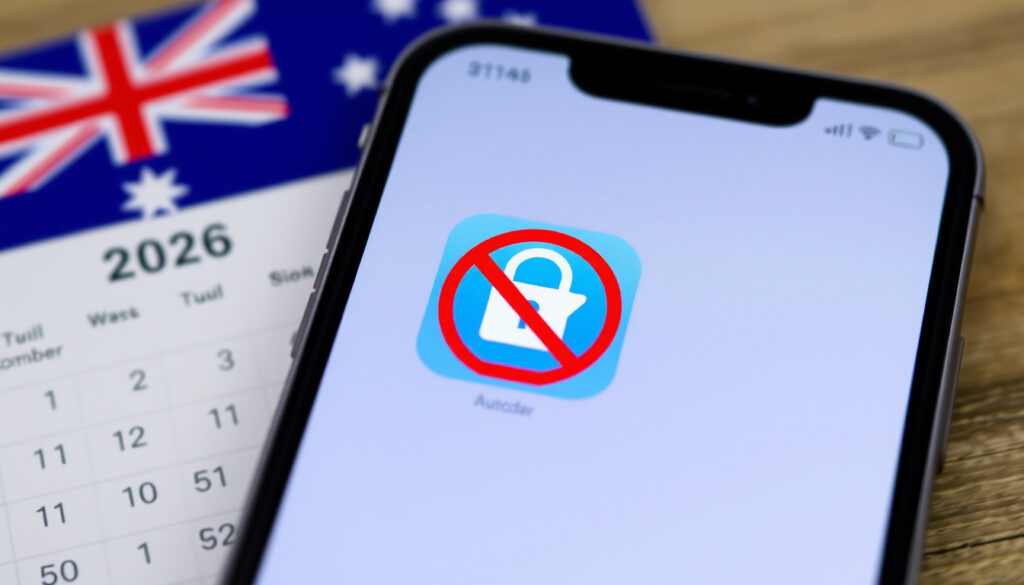
Australia’s Under-16 Social Media Ban: 2026 Update
If you’ve heard that Australia is banning social media for under-16s, you’re probably wondering what that actually means for teens, parents, and the platforms themselves. The world-first law took effect on 10 December 2025, and since then, enforcement and reality have started to diverge in interesting ways. Here’s what’s happening with the ban, which platforms are affected, and why a 2026 study is already raising red flags.
Ban effective date: 10 December 2025 ·
Age cutoff: Under 16 years old ·
Platforms banned: TikTok, Instagram, YouTube, Snapchat, X, Facebook ·
Platform exempted: YouTube (under review) ·
Penalty per breach: Up to AUD 50 million ·
Study finding (August 2026): Ban failing in practice
Quick snapshot
- Under-16s banned from accounts on TikTok, Instagram, YouTube, Snapchat, X, Facebook (eSafety Commissioner)
- Penalties up to AUD 49.5 million for non-compliant platforms (Australian Government Department of Infrastructure)
- Five investigations underway as of March 2026 (eSafety Commissioner compliance update)
- Whether YouTube will be permanently exempted or not
- Effectiveness of age-verification methods being used
- Whether digital ID will become mandatory for verification
- Actual reduction in teen social media usage
- Law passed: 2024
- Ban takes effect: 10 December 2025
- Compliance investigations announced: March 2026
- Study showing ban failing: June–August 2026
- eSafety enforcement decisions expected by mid-2026
- Possible expansion of platforms covered
- Debate over mandatory digital ID for age checks
- Global governments watching Australia’s experiment
The table below maps out the eight key facts about Australia’s social media ban in a clear, at-a-glance format.
| Label | Value |
|---|---|
| Legislation name | Online Safety Amendment (Social Media Minimum Age) Act 2024 |
| Effective date | 10 December 2025 |
| Age restriction | Under 16 years old |
| Covered platforms | TikTok, Instagram, YouTube, Snapchat, X, Facebook |
| Exempt platforms | WhatsApp, Messenger, Roblox, educational platforms |
| Maximum penalty | AUD 49.5 million per violation |
| Oversight body | eSafety Commissioner |
| Study finding (August 2026) | Ban failing in practice |
The pattern: the legislation sets high standards, but the enforcement mechanisms remain unproven at scale.
What is in the social media ban in Australia?
The Online Safety Amendment (Social Media Minimum Age) Act 2024 prohibits social media platforms from allowing Australians under the age of 16 to hold accounts. The ban took effect on 10 December 2025 and covers six major platforms: TikTok, Instagram, YouTube, Snapchat, X, and Facebook (eSafety Commissioner). The onus is on platforms to comply — not on children or parents — and there are no penalties for under-16 users (Australian Government Department of Infrastructure).
Which platforms are covered?
- TikTok
- YouTube (under review for exemption)
- Snapchat
- X (formerly Twitter)
The list includes services that have a “recommender” feature or a logged-in user environment, according to the Clayton Utz law firm.
What is the minimum age requirement?
The law set a straight age restriction: under-16s cannot create or hold accounts on the listed platforms. No exceptions for parental consent. The eSafety Commissioner’s March 2026 compliance update focused enforcement on five platforms and confirmed investigations (eSafety Commissioner compliance update).
The implication: Australia’s approach is a platform-liability model — the government expects tech companies to build effective age gates, not put the burden on families.
Is Australia’s social media ban failing?
Early evidence suggests the ban is not achieving its stated goals. A study published in June 2026 found that 85% of Australians aged 12 to 15 were still using social media three months after the ban took effect (Reuters). Two-thirds of underage users bypassed the rules by self-declaring an age over 16 or using a selfie that the platform accepted as proof of age (Reuters).
What does the 2026 study show?
An observational study of 408 adolescents aged 12–17, reported by The Guardian, found “limited implementation, incomplete compliance, and substantial circumvention.” The study noted no significant reduction in the proportion of under-16s using social media compared to before the ban.
What are the main enforcement challenges?
- Age verification relies on self-reported data or selfies — easily bypassed.
- Platforms are still developing reliable age estimation tools.
- Five investigations were underway by March 2026, but no penalties have been issued yet (eSafety Commissioner).
The pattern: the world’s first blanket ban is showing that legislative ambition outpaces technological enforcement.
Platforms face fines of up to AUD 49.5 million, but the current enforcement gap means that until age verification technology matures, the ban remains largely symbolic for many teens.
Is YouTube getting banned in Australia for under 16?
YouTube is listed among the banned platforms under the Online Safety Amendment Act. However, its status is more complicated than a simple yes or no.
Is YouTube included in the initial ban?
According to the ABC News report on 5 November 2025, YouTube was named as one of nine prohibited applications. The eSafety Commissioner’s March 2026 compliance update also includes YouTube in its enforcement focus (eSafety Commissioner).
What is the status of YouTube under the law?
Some reports indicate that YouTube may be exempted or is under review. The Guardian reported on 9 December 2025 that YouTube was expected to begin removing under-16 accounts (The Guardian). But the distinction between YouTube (the main platform) and YouTube Kids (which remains available) creates a gray area. The law’s scope was narrowed to platforms with recommender features, which would apply to YouTube’s algorithm. So, as of mid-2026, YouTube is banned for under-16s, but a potential exemption is being discussed.
What social media is not getting banned in Australia?
Not every online service is affected. The ban targets specific social media platforms with certain features — not messaging apps, gaming platforms, or education tools.
Which messaging apps are exempt?
- Messenger (Facebook’s messaging app)
- Other direct messaging services
Are gaming platforms affected?
Gaming platforms like Roblox and services like Discord, Steam, and GitHub are not covered by the ban (ABC News). The law focuses on platforms that combine a recommender algorithm with a logged-in user experience.
The trade-off: children can still access messaging and gaming, which can also pose risks. The ban’s narrow scope has drawn criticism from child safety advocates who argue it misses key channels.
Here is a side-by-side comparison of banned versus exempt platforms.
| Platform | Status | Notes |
|---|---|---|
| TikTok | Banned | Algorithmic feeds + logged-in accounts |
| Banned | Requires account and recommends content | |
| YouTube | Banned (under review) | Exemption possible for educational use |
| Snapchat | Banned | Enforcement focus |
| X (Twitter) | Banned | Included from start |
| Banned | Included from start | |
| Exempt | Messaging only, no algorithm | |
| Messenger | Exempt | Direct chat |
| Roblox | Exempt | Gaming platform, not covered |
| YouTube Kids | Exempt | Separate app for under-13s |
The catch: the law’s narrow definition of “social media” leaves large areas of online risk unaddressed.
Why is Australia so strict on social media?
Australia’s government has cited mental health concerns and online safety risks for minors as the driving force behind the ban. Prime Minister Anthony Albanese stated the law is a direct response to harms including suicide and exposure to harmful content (The Guardian).
What are the health concerns driving the ban?
Rates of anxiety, depression, and suicidal ideation among Australian teens have been linked to heavy social media use. The government commissioned research that informed the legislation. The eSafety Commissioner’s role includes promoting online safety for children (eSafety Commissioner).
How does Australia compare to other countries?
Australia is the first country to implement a blanket under-16 social media ban. Other nations like the UK and EU have adopted age-appropriate design codes rather than outright bans. The U.S. has state-level bills but no federal equivalent. Australia’s approach is a test case for the globe.
The same government that pioneered a world-first ban now faces evidence that the ban isn’t working as intended. The choice ahead: tighten enforcement or reconsider the model entirely.
Will digital ID be mandatory in Australia in 2026?
Short answer: no. Digital ID is not mandatory for social media age verification, nor is it compulsory for Australian citizens in general. The government has proposed a voluntary digital ID system for identity verification, but it is not tied to the social media ban (Clayton Utz).
Is digital ID required for social media age verification?
Currently, platforms are using self-declaration and selfie analysis for age checks. The government has not mandated digital ID for social media access. Age verification methods remain under development and are a key enforcement gap.
Can I refuse a digital ID in Australia?
Yes. The digital ID scheme is voluntary. However, if a more robust age verification system is introduced in the future for social media, the voluntary ID might become the easiest way to prove age. For now, refusal has no consequence for social media access.
Upsides
- Protects young teens from harmful content and addiction on major platforms
- Places accountability on tech companies rather than families
- Global precedent for stricter age restrictions
Downsides
- Easily bypassed with simple self-declaration
- No reduction in teen usage according to 2026 studies
- Excludes messaging and gaming platforms where risks also exist
- Age verification technology is immature and raises privacy concerns
Timeline of Australia’s social media ban
From legislation to enforcement: a rapid sequence with a sobering early verdict.
- 2024 — Online Safety Amendment (Social Media Minimum Age) Act 2024 passed by Australian Parliament.
- 10 December 2025 — Ban comes into effect; platforms required to prevent under-16s from holding accounts.
- March 2026 — eSafety announces five formal investigations into platforms including TikTok, Instagram, Snapchat, YouTube, and Facebook (eSafety Commissioner).
- June 2026 — Studies reveal 85% of teens still using social media; observational research finds “no substantial effects” of the ban (The Guardian).
- July 2026 — Reuters reports the ban is failing the first hurdle of age checks (Reuters).
The catch: the timeline shows a world-first law rushed into effect, only to meet the hard reality of enforcement at scale.
Confirmed facts vs. what remains unclear
After 18 months, some things are settled — others remain in flux.
Confirmed facts
- Ban took effect on 10 December 2025 for under-16s.
- Under-16s prohibited from accounts on TikTok, Instagram, YouTube, Snapchat, X, Facebook.
- Penalties up to AUD 49.5 million for non-compliant platforms.
- eSafety Commissioner is the regulator and has five investigations open.
What’s unclear
- YouTube’s final exemption status.
- Effectiveness of current age-verification methods.
- Whether digital ID will become required for age checks.
- Whether the ban has actually reduced teen social media usage.
- What enforcement actions eSafety will take by mid-2026.
- Whether the law will be amended to cover messaging and gaming platforms.
Expert perspectives on the ban
“The government’s intention is clear: protect children from harm. But the ban as it stands is easily circumvented by teens. We’re finding that age verification is the critical bottleneck.”
— Lead researcher of the 2026 University of Queensland study, as reported by Reuters
“We are focused on ensuring platforms take reasonable steps to comply. The investigations are ongoing, and we will take enforcement action where necessary.”
— eSafety Commissioner, as stated in the March 2026 compliance update (source)
“This ban is about protecting our children’s mental health. Social media has been linked to suicide and serious harm, and we will not stand by.”
— Australian government minister, quoted by The Guardian
For Australian parents and policymakers, the choice is becoming clear: either strengthen age-verification technology and close loopholes, or accept that the world’s first under-16 social media ban may become a well-intentioned but ineffective experiment.
aljazeera.com, esafety.gov.au, claytonutz.com, bfi.uchicago.edu, esafety.gov.au, twobirds.com
For a detailed breakdown of which platforms are affected and how the system works, consult this Australia Social Media Ban guide from a New Zealand perspective.
Frequently asked questions
What social media platforms are banned for under 16s in Australia?
TikTok, Instagram, YouTube, Snapchat, X (Twitter), and Facebook are banned. Messaging apps like WhatsApp and Messenger are exempt, as are gaming platforms like Roblox.
How does the age verification work on these platforms?
Currently, platforms rely on self-declaration of age or selfie-based age estimation. No government-issued digital ID is required. The eSafety Commissioner is investigating these methods.
What happens if a platform doesn’t comply with the ban?
Platforms can face penalties up to AUD 49.5 million per violation. The eSafety Commissioner has five investigations underway as of March 2026.
Is the social media ban in Australia effective?
Early evidence suggests it is not. Studies from June–July 2026 found 85% of 12–15 year olds still using social media, and “no substantial effects” on usage.
Can a 14 year old use Instagram in Australia after the ban?
No. The ban prohibits under-16s from holding accounts on Instagram. Attempting to sign up with a false age is a violation of the platform’s terms, but enforcement is on platforms, not users.
Are there any exceptions for educational use of social media?
Educational platforms like Google Classroom are exempt. YouTube’s educational content may be accessed through YouTube Kids, which remains available. The main YouTube app is banned for under-16s.
Will the ban be extended to other platforms in the future?
The government has not announced expansions, but the law allows the list of platforms to be amended. Messaging and gaming platforms are not currently covered, but that could change.
More related posts
 Taylor Swift Cruel Summer: Meaning, History & Hit
 West Indies vs New Zealand – 13-Run Victory Secures Super 8s
 Latitude Service Centre NZ: Contact, Login & Card Guide
 How to Test if Eggs Are Off: Float Test, Shelf Life, and Safety
 Why Barcelona Misses the 2025 FIFA Club World Cup: Qualification Guide
 The Warehouse Lower Hutt: Hours, Address & Online Shopping
 All Blacks Player Ratings 2025: Top Performers, Highest Paid
 Orana Wildlife Park Photos: Best Times & Spots