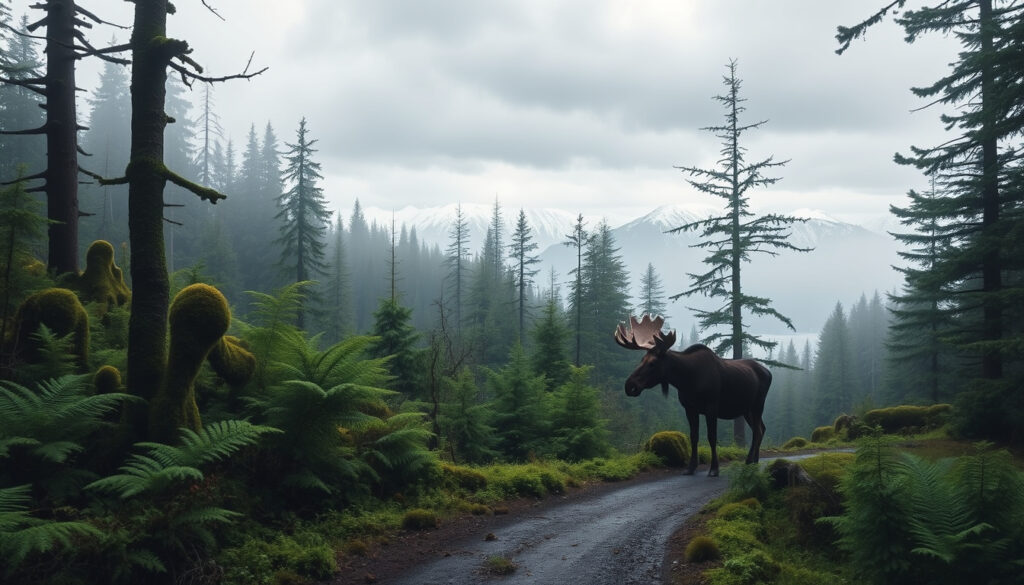
Moose Sighting on Kepler Track: 2025 Fiordland Report
Three Canadian hikers on a late-summer tramp along the Kepler Track saw something they never expected to meet in New Zealand’s Fiordland: a large, moose-like animal. Their report, filed in April 2025, has revived one of the country’s most persistent wildlife mysteries.
Last confirmed moose sighting in NZ: 1952 (photograph) · Recent unverified sighting: April 2025 (Kepler Track) · Reported by: Canadian hikers · Location: Fiordland National Park, Kepler Track · Current status: Unverified; no confirmed population
Quick snapshot
- Moose were introduced to Fiordland in 1910 (Otago Daily Times (South Island newspaper))
- Last widely accepted evidence: 1952 photograph (RNZ (New Zealand public broadcaster))
- No breeding population has ever been confirmed since (Otago Daily Times)
- Whether any moose survive in Fiordland (RNZ)
- Validity of the April 2025 sighting (RNZ)
- Existence of conclusive DNA evidence (DOC (NZ Department of Conservation))
- 1910: Ten moose released in Fiordland (Otago Daily Times)
- 1952: Photograph proves moose still present (RNZ)
- 2003–2004: Unverified claims resurface (RNZ)
- April 2025: Canadian hikers report moose-like animal (Otago Daily Times)
- No official investigation launched by DOC (Otago Daily Times)
- Hikers encouraged to report sightings to DOC (DOC)
- Public fascination likely to persist until physical evidence appears (NZGeo (NZ Geographic))
These facts set the stage for a mystery that refuses to die.
| Moose introduced to Fiordland | 1910 (10 animals from Canada) |
| Last confirmed sighting | 1952 (photograph) |
| Recent unverified sighting | April 2025 (Kepler Track) |
| Conservation status | Data deficient; possibly extinct in New Zealand |
Did New Zealand ever have moose?
Yes — and the evidence is solid. Moose (Alces alces) were deliberately brought to Fiordland from Canada in 1910 as a game animal. Ten animals were released near Dusky Sound with the intention of establishing a herd for hunting, according to the Otago Daily Times (South Island newspaper).
When were moose introduced to New Zealand?
- 1910: Ten moose (four bulls, six cows) arrived from Canada and were released in Fiordland National Park (Te Ara – the Encyclopedia of New Zealand).
- The location was chosen for its remote wilderness and similarity to moose habitat in North America.
The 1952 photograph
For decades after their introduction, moose were occasionally reported but never reliably documented. Then, in 1952, a photograph captured what is widely accepted as the last confirmed moose in New Zealand. The image, taken by a government surveyor, shows a bull moose standing in Fiordland vegetation. It remains the cornerstone of the moose-in-NZ evidence base. RNZ (New Zealand public broadcaster) notes that this is still the last proven sighting.
Why did moose disappear from Fiordland?
The moose population never thrived. Several factors likely contributed to their decline:
- Hunting pressure: The animals were deliberately hunted soon after release (Otago Daily Times).
- Habitat limitations: Fiordland’s dense rainforest, while remote, may not have provided the open browse that moose prefer.
- No natural predators, but also no management: Unlike in North America, moose in New Zealand faced no wolves or bears, but they also had no conservation program.
The implication: the 1910 introduction was a failed biological experiment. No breeding population ever established itself in a self-sustaining way.
When was the last moose sighting in New Zealand?
That depends on how you define “sighting.” If you require physical evidence, the answer is 1952. If you include unverified reports, the answer keeps shifting — most recently to April 2025.
The 2025 Kepler Track sighting
On 29 March 2025, three Canadian hikers — Annie-Pier Bourgeois, Antoine Beauchamp, and Chanel Sabourin-Dubois — were walking the Kepler Track between Iris Burn Campsite and Rocky Point Shelter. They spotted a large animal they immediately identified as a moose. “Oh my God, that’s a moose,” one of them said, according to the Otago Daily Times. The hikers, who had seen moose in Canada before, said the animal vanished into dense forest before they could take a photo or video.
Other recent unverified reports
The 2025 sighting was the second unverified claim that month. Earlier in March 2025, American hikers Norbert Nigon and Virginia Schuning reported a similar encounter elsewhere in Fiordland. Otago Daily Times notes that these two reports have generated renewed public interest, but no physical evidence has been produced.
How do experts verify sightings?
Wildlife authorities like the Department of Conservation rely on hard evidence: photographs (with location metadata), DNA from hair or scat, tracks cast in plaster, or carcasses. Without these, a sighting remains anecdotal. The RNZ reported that DOC considers moose most likely extinct in Fiordland.
The pattern: each fresh report raises hopes, but the evidentiary bar has not been cleared since 1952.
What month is the best time to see moose?
If you’re hoping to spot a moose in Fiordland, there is no established “best time” because the population, if it exists at all, is vanishingly small. But for moose in their native North American range, seasonal patterns are clear. Adirondack tourism sources note that moose are most active at dawn and dusk, particularly during spring and early summer when they feed on new growth. The 2025 Kepler Track sighting occurred in autumn (April), which is consistent with some moose activity patterns in temperate regions.
When did previous sightings occur?
- 1952 photograph: taken in summer (February).
- 2003–2004 reports: spring and autumn, according to RNZ.
- March 2025 (American hikers): early autumn.
- April 2025 (Canadian hikers): mid-autumn.
Tips for hiking the Kepler Track
The Kepler Track is a 60-kilometre loop in Fiordland National Park, one of New Zealand’s Great Walks. If you want to maximise your chances of seeing any large mammal — whether moose, deer, or birdlife — consider these tips from DOC (NZ Department of Conservation):
- Walk during early morning or late evening when animals are most active.
- Stay quiet and pause frequently to scan the edges of clearings and river flats.
- Carry binoculars and a camera with a telephoto lens.
- Report any unusual animal sightings to DOC with precise location details.
The catch: even if you follow every tip, the odds of encountering a moose in Fiordland are statistically negligible — but that hasn’t stopped people from looking.
What to do if a moose stares at you?
Moose are large, unpredictable animals. In North America, where moose encounters are relatively common, wildlife agencies have clear guidance. The Alaska Department of Fish and Game advises: if a moose stares at you, it is assessing you as a potential threat. Your response should be calm and deliberate.
Understanding moose behavior
- A staring moose is usually trying to determine if you are a predator.
- Ears laid back and raised hackles are signs of agitation.
- Moose may bluff charge before actually attacking.
Safe distance and response
- Do not run; moose can sprint at 35 mph (56 km/h).
- Back away slowly, maintaining a line of sight but without direct eye contact.
- If a moose charges, seek cover behind a large tree or object.
- If you are knocked down, curl into a ball and protect your head.
What not to do
- Do not turn your back and run.
- Do not make sudden movements or loud noises.
- Do not approach a moose, especially a cow with calves.
These guidelines are from Alaska Department of Fish and Game (state wildlife management agency). While the likelihood of a moose encounter on the Kepler Track is extremely low, the same rules apply anywhere.
What is a moose’s worst enemy?
In North America, moose face several natural predators, but their worst enemy is arguably the wolf. National Park Service (U.S. federal agency) research shows that wolves are the primary predator of adult moose in many ecosystems. Bears, especially grizzlies, also take calves and occasionally adults. In New Zealand, moose had no natural predators — which initially seemed like an advantage, but may have contributed to their failure to thrive.
Natural predators of moose
- Gray wolves (Canis lupus) are the most significant predator in North America (NPS).
- Brown bears and black bears prey on calves (Alaska Department of Fish and Game).
- Human hunters are a major source of mortality in managed populations.
Human impact on moose populations
In New Zealand, the main threats to moose were human hunting and habitat change. Without wolf or bear predation, the herd might have grown — but unregulated hunting in the early 1900s likely wiped out the small founder population. As Otago Daily Times reports, the moose were deliberately introduced for hunting, and they were hunted soon after.
Moose in New Zealand: lack of predators
The absence of predators might seem beneficial, but it also meant no natural population control that could have helped the moose adapt to local conditions. In Fiordland, moose faced competition from red deer (also introduced) and had to navigate unfamiliar terrain. Without a predator-prey dynamic that drives adaptation, the moose failed to establish a self-sustaining population.
Confirmed facts
- Moose were introduced to Fiordland in 1910 (Otago Daily Times)
- A photograph from 1952 is the last widely accepted evidence (RNZ)
- No confirmed breeding population exists today (DOC)
What remains unclear
- Whether any moose survive in Fiordland
- Validity of the April 2025 sighting
- Existence of conclusive DNA evidence
What next for the Fiordland moose mystery?
The Kepler Track sighting has reignited public curiosity, but without physical proof, it remains just another anecdote. The New Zealand Department of Conservation has not launched an investigation, and Otago Daily Times quotes DOC as stating that moose are most likely extinct in Fiordland. For the hikers who reported the animal, the lack of evidence is frustrating — but for the public, the allure of a hidden moose population is exactly what keeps the story alive. The next step is simple: anyone who visits Fiordland and sees something unusual should document it thoroughly. Until then, the moose of Fiordland remain a ghost — seen by many, proven by none.
Frequently asked questions
Are moose in New Zealand considered dangerous?
Moose can be dangerous if threatened, but since no moose are confirmed to exist in New Zealand, the practical risk is near zero. If you encounter any large animal on a trail, keep your distance.
What is the Kepler Track?
The Kepler Track is a 60-kilometre Great Walk in Fiordland National Park, known for its alpine views and diverse terrain. It is managed by the Department of Conservation.
Has any DNA evidence been found of moose in Fiordland?
No. Despite occasional unverified sightings, no DNA from scat, hair, or other sources has been confirmed as belonging to moose in Fiordland since the 1950s.
How did moose get to New Zealand?
Moose were introduced from Canada in 1910 as a game animal. Ten moose were released in Fiordland, but the population never thrived.
What should I do if I see a moose on the Kepler Track?
Stay calm, do not approach, and back away slowly. Do not run. Report the sighting to DOC with time, location, and any photos or tracks.
Why are moose thought to be extinct in New Zealand?
The last confirmed evidence of a moose in Fiordland is a 1952 photograph. Decades of searches and incidental observations have failed to produce any physical evidence of a surviving population.
What other animals are commonly mistaken for moose in Fiordland?
Red deer and wapiti (elk) are often misidentified as moose, especially at a distance or in poor light. Both species are larger than typical deer and can appear moose-like to inexperienced eyes.
How can I report a possible moose sighting?
Contact the Department of Conservation’s Fiordland office with date, exact location, description of the animal, and any photos or video. DOC may follow up if the report is credible.
More related posts
 When Is the Next Admin Abuse in Steal a Brainrot? Event Times
 Land for Sale Waikato: Prices, Foreign Rules & Build vs Buy Guide
 Taupo DeBretts Hot Springs Tickets: Prices, Hours & Booking Guide
 Wie Putzt Man Das Haus Schnell – 1-Hour Cleaning Guide
 Lightning Strike Auckland to Queenstown Flight: Safety & Delays
 Westpac Warns Subscription Trap – Spot and Avoid Pitfalls
 How to Change Apple Watch Band: Step-by-Step Guide from Apple